

Businesses today are under increasing pressure to reduce operational costs, improve efficiency, and scale faster, without expanding head count. As a result, automation has become a board-level priority. Yet many decision-makers still struggle with one fundamental question: AI automation vs RPA, which approach is right for the business? While both aim to streamline processes, they differ significantly in capability, scalability, and long-term strategic value.
Choosing the wrong automation strategy can lead to wasted investment, fragile workflows, and limited ROI. This article breaks down the key differences between AI automation and RPA from a business perspective, helping executives, tech leaders, and transformation teams determine where each solution fits, and how to make a smarter investment decision
What is RPA (Robotic Process Automation)?
RPA Definition
Robotic Process Automation (RPA) refers to rule-based software bots designed to automate repetitive, structured, and predictable business tasks. These bots follow predefined logic and workflows to execute processes exactly as programmed, without deviation or learning capability.
RPA mimics human actions within digital systems, such as clicking buttons, copying and pasting data, logging into applications, extracting information, or generating reports. It operates at the user interface (UI) level, interacting with software the same way a human employee would. Because it relies on structured data and clear rules, RPA is particularly effective for stable, high-volume processes where decision-making complexity is minimal.
⭐️ Learn more about Manufacturing process automation
Core Characteristics
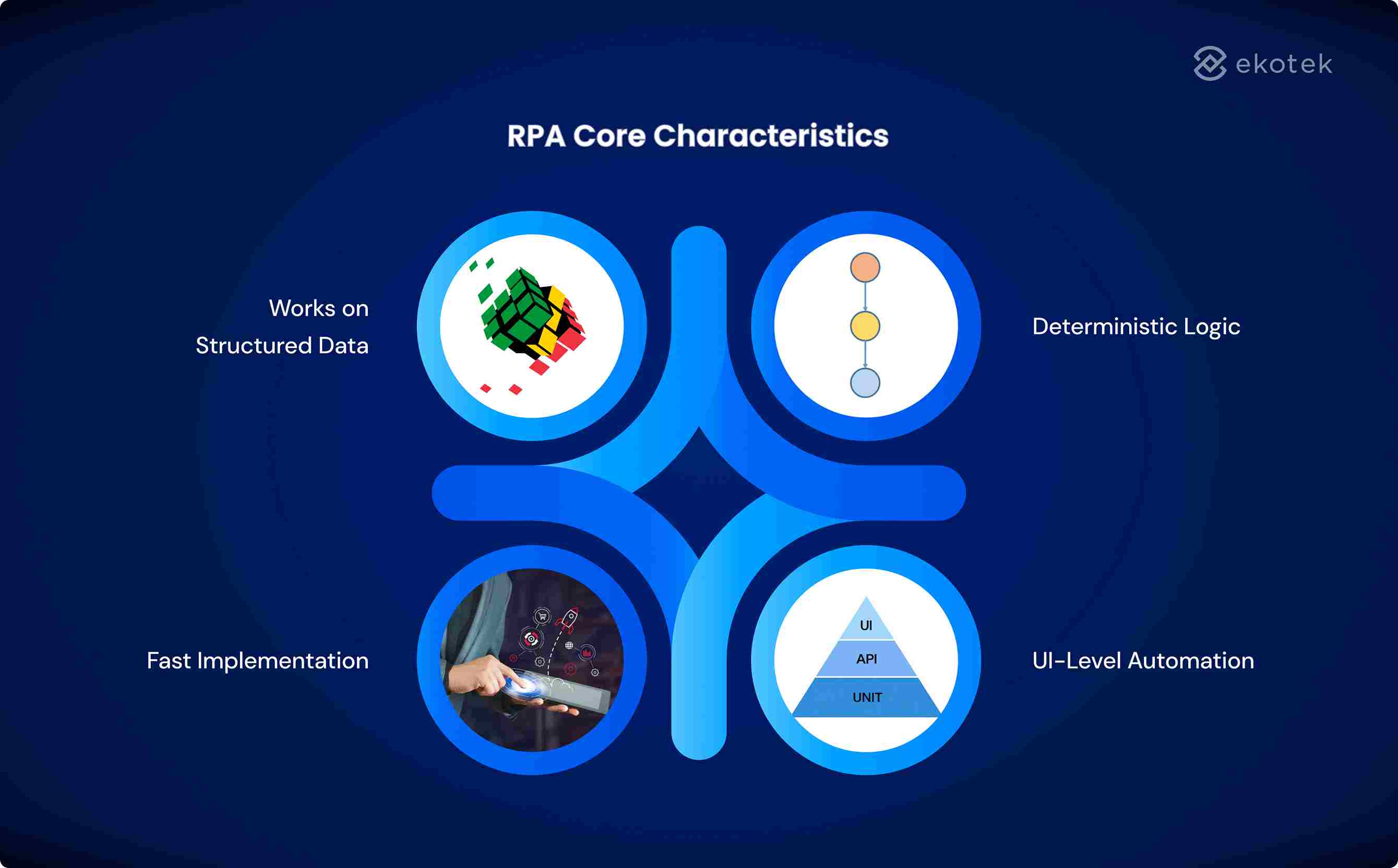
- Works on Structured Data: RPA performs best in environments where data is structured and standardized, such as spreadsheets, databases, ERP systems, or formatted forms. Because the inputs follow consistent rules, bots can process information reliably without interpretation or contextual understanding.
- Deterministic Logic: RPA operates on predefined, rule-based logic. Every action follows “if-then” instructions, meaning the outcome is predictable and consistent. There is no learning capability or adaptive behavior; the bot executes exactly what it has been programmed to do.
- UI-Level Automation: Unlike deep system integrations, RPA interacts with applications at the user interface level. It mimics human behavior, clicking buttons, navigating menus, entering data, and triggering workflows. This makes RPA particularly useful for automating legacy systems where API integration may be limited or unavailable.
- Fast Implementation: Compared to more advanced automation solutions, RPA can be deployed relatively quickly. Since it does not require model training, complex data pipelines, or significant system redesign, organizations often see rapid time-to-value, making it attractive for short-term efficiency gains and tactical process optimization.
RPA Typical Use Cases
- Invoice Processing: RPA is commonly used to extract invoice data from structured documents, validate it against predefined rules, and enter it into accounting or ERP systems. This reduces manual data entry errors and accelerates accounts payable cycles.
- Payroll Automation: For payroll operations, RPA bots can collect employee attendance data, calculate salaries based on fixed formulas, apply deductions, and update payroll systems. Because payroll processes typically follow strict rules and structured inputs, they are well-suited for rule-based automation.
- Data Migration: During system upgrades or digital transformation initiatives, RPA can automate the transfer of data between legacy systems and new platforms. Instead of manually re-entering information, bots replicate user actions to move data accurately and efficiently.
- Form Filling: Many organizations rely on repetitive form submissions across internal systems or third-party portals. RPA can automatically populate fields, upload documents, and submit forms, eliminating time-consuming administrative work.
- Report Generation: RPA can gather data from multiple systems, consolidate it into predefined templates, and generate standardized reports on a scheduled basis. This ensures consistency and frees teams from routine reporting tasks.
Business Advantages
- Quick ROI: RPA is often viewed as a low-risk entry point into automation because it delivers measurable results quickly. Since implementation typically does not require major system changes or complex data preparation, organizations can automate targeted processes and start realizing cost savings within months. This makes RPA particularly attractive for leaders seeking fast operational efficiency gains.
- Low Disruption: Because RPA works at the user interface level, it does not require deep system integration or large-scale infrastructure redesign. Existing workflows remain largely intact, with bots operating alongside human teams. This minimizes change management challenges and allows businesses to automate incrementally rather than through disruptive transformation programs.
- Suitable for Legacy Systems: Many enterprises still rely on legacy platforms that lack modern APIs or integration capabilities. RPA can interact with these systems just as a human user would, clicking, entering data, and extracting information, without requiring backend modifications. This makes it a practical solution for organizations that want to modernize operations without immediately replacing core systems.
⭐️ Dive deep into Application modernization
Limitations
- Breaks When UI Changes: Because RPA operates at the user interface level, it is highly sensitive to changes in screen layouts, button positions, field names, or application updates. Even minor UI modifications can disrupt automated workflows, requiring maintenance and reconfiguration. This can increase long-term support effort if systems change frequently.
- Cannot Handle Unstructured Data: RPA is designed to process structured, rule-based inputs. It struggles with unstructured data such as free-text emails, scanned documents, voice recordings, or images unless combined with additional technologies. Without intelligent data interpretation capabilities, its scope remains limited to predictable and standardized environments.
- No Decision-Making Intelligence: RPA follows predefined “if-then” rules and cannot learn, adapt, or make contextual judgments. It does not improve over time or analyze patterns to optimize outcomes. As a result, it is best suited for repetitive execution tasks rather than processes that require reasoning, prediction, or dynamic decision-making.
What is AI Automation?
Definition
AI automation refers to automation systems powered by artificial intelligence technologies such as machine learning (ML), natural language processing (NLP), computer vision, and large language models (LLMs). Unlike rule-based automation, AI-driven systems can analyze data, recognize patterns, interpret context, and make decisions based on probabilities rather than fixed instructions.
Instead of simply following predefined steps, AI automation enables systems to “understand” inputs, whether structured or unstructured, and adapt their responses accordingly. This allows organizations to automate more complex, judgment-based processes such as interpreting documents, responding to customer inquiries, detecting anomalies, or generating insights. In essence, AI automation extends beyond task execution and moves into intelligent decision-making and continuous optimization.
AI Automation Core Characteristics
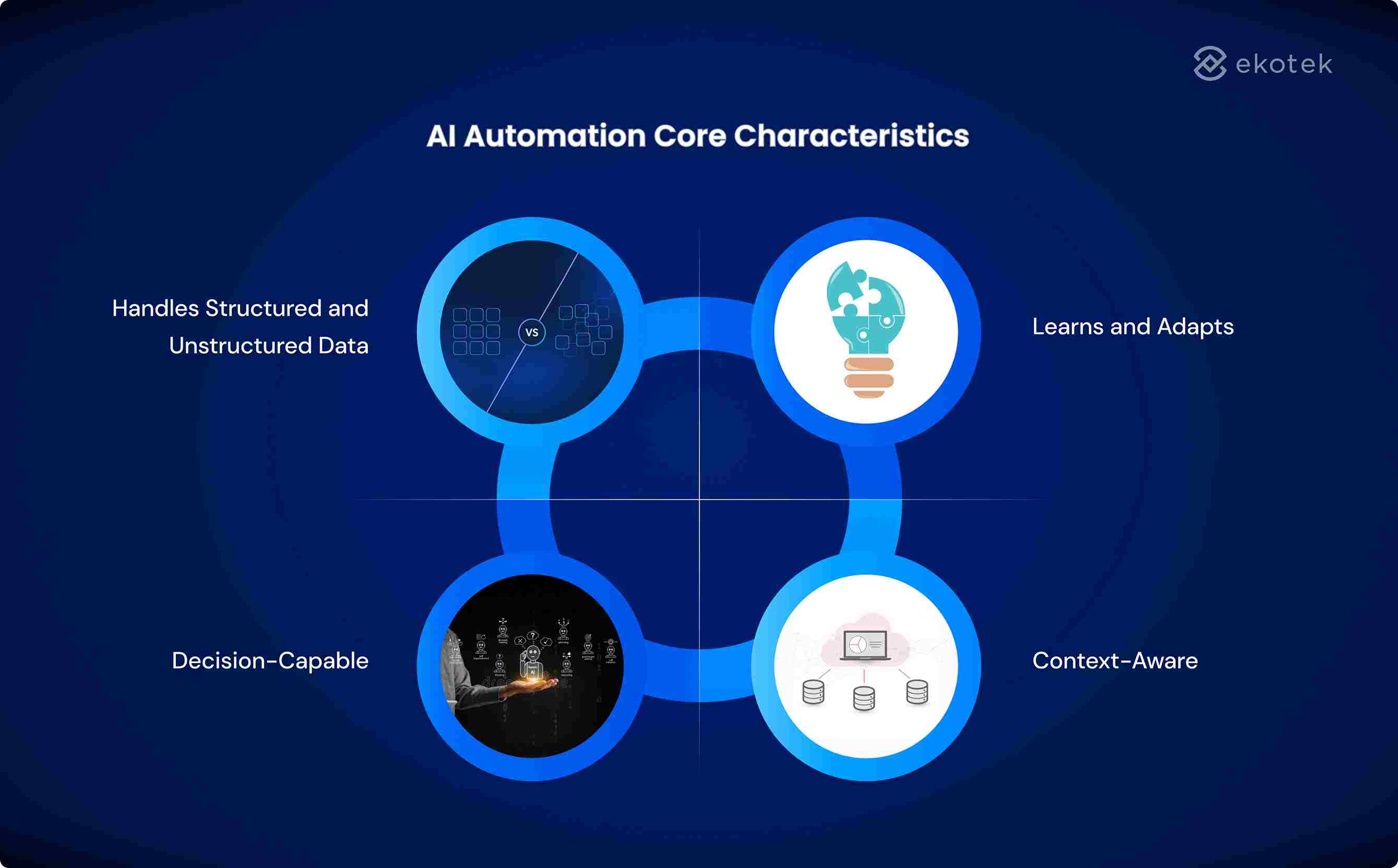
- Handles Structured and Unstructured Data: AI automation can process both structured data (databases, spreadsheets, ERP records) and unstructured data (emails, PDFs, images, voice, chat conversations). This expands automation beyond predictable workflows and enables organizations to digitize and optimize knowledge-heavy processes that were previously dependent on human interpretation.
- Learns and Adapts: Powered by machine learning models, AI systems improve over time as they are exposed to more data. Instead of relying solely on fixed rules, they identify patterns, refine predictions, and adapt to new scenarios. This makes AI automation more resilient in dynamic environments where inputs and conditions evolve.
- Context-Aware: AI automation can interpret meaning and context. For example, natural language processing allows systems to understand customer intent in emails or chat messages, while computer vision enables recognition of visual elements in scanned documents. This contextual understanding reduces errors and enables more sophisticated workflow orchestration.
- Decision-Capable: Unlike traditional rule-based automation, AI-driven systems can evaluate multiple variables and make probability-based decisions. Whether prioritizing support tickets, flagging potential fraud, or forecasting demand, AI automation supports judgment-driven processes. turning automation from simple execution into strategic intelligence.
Typical Use Cases
- Customer Support Automation (AI Chatbots): AI-powered chatbots and virtual assistants use natural language processing to understand customer intent, provide contextual responses, and resolve common inquiries without human intervention. Beyond scripted replies, advanced systems can analyze sentiment, personalize interactions, and escalate complex cases intelligently, improving both efficiency and customer experience.
- Fraud Detection: AI models can analyze transaction patterns, behavioral data, and historical records to identify anomalies in real time. Unlike rule-based systems that rely on predefined thresholds, AI-driven fraud detection continuously learns from new data, improving accuracy and reducing false positives over time.
- Intelligent Document Processing: AI automation can extract, classify, and interpret information from unstructured documents such as contracts, invoices, medical records, or compliance reports. Using machine learning and computer vision, systems can recognize patterns and contextual meaning, enabling faster and more accurate data processing across industries.
- Predictive Analytics: AI enables organizations to forecast trends, risks, and opportunities by analyzing large datasets. From predicting customer churn to identifying maintenance needs, predictive analytics supports proactive decision-making rather than reactive operations.
- Demand Forecasting: By analyzing historical sales data, market signals, and external variables, AI models can generate more accurate demand forecasts. This helps businesses optimize inventory, reduce waste, and improve supply chain planning, directly impacting revenue and operational efficiency.
⭐️ Explore Top 20 AI Agent Use Cases
Business Advantages
- Scalable Intelligence: AI automation allows organizations to scale not just tasks, but decision-making capability. Instead of hiring more employees to handle growing volumes of data or customer interactions, AI systems can process increasing complexity at scale, from thousands to millions of transactions, without proportional increases in cost.
- Improves Over Time: Unlike rule-based systems, AI models learn from new data and feedback. As more inputs are processed, the system refines its predictions, reduces errors, and enhances performance. This continuous improvement cycle means the automation becomes more accurate and valuable the longer it operates.
- Enables End-to-End Automation: AI automation can manage entire workflows that involve interpretation, decision-making, and execution. For example, it can analyze incoming documents, determine the appropriate action, trigger downstream processes, and monitor outcomes, reducing the need for human intervention across multiple stages. This shifts automation from isolated task efficiency to full process transformation.
Challenges
- Higher Initial Investment: AI automation typically requires greater upfront investment compared to rule-based solutions. Costs may include data infrastructure, model development or customization, system integration, and skilled talent. While the long-term ROI can be significant, leaders should plan for a phased investment approach rather than expecting immediate short-term returns.
- Requires a Clear Data Strategy: AI systems depend heavily on data quality, availability, and governance. Without clean, well-structured, and accessible datasets, model performance will suffer. Organizations must assess their data maturity, establish pipelines, and define ownership before scaling AI initiatives. In many cases, the biggest bottleneck is not the technology itself, but data readiness.
- Governance and Compliance Considerations: AI-driven decision-making introduces new risks related to transparency, bias, privacy, and regulatory compliance. Businesses must implement governance frameworks to monitor model behavior, ensure explainability where required, and comply with industry regulations. This is particularly critical in sectors such as finance, healthcare, and insurance.
AI Automation vs RPA – Side-by-Side Comparison
| Criteria | RPA | AI Automation |
|---|---|---|
| Logic | Rule-based | Data-driven learning |
| Data Type | Structured | Structured + Unstructured |
| Decision-Making | No | Yes |
| Implementation Speed | Fast | Medium |
| Cost | Lower upfront | Higher upfront |
| Scalability | Limited | High |
| Maintenance | UI-sensitive | Model tuning & monitoring |
From an executive perspective, the comparison is less about technology features and more about strategic impact.
RPA is primarily designed for short-term efficiency gains. It delivers quick wins by automating repetitive, stable processes with minimal disruption. For organizations looking to reduce operational costs quickly or stabilize legacy workflows, RPA provides tactical value.
AI automation, on the other hand, supports long-term transformation. It enables intelligent decision-making, handles complexity, and scales with business growth. While it requires greater investment and planning, it positions the organization for sustained competitive advantage.
In simple terms:
-
RPA = Tactical automation for operational efficiency
-
AI automation = Strategic automation for intelligent transformation
When Should Your Business Choose RPA?
RPA is most effective when the goal is operational efficiency rather than strategic transformation. It works best in controlled, predictable environments where speed and cost reduction are top priorities.
- You Need Quick Cost Reduction: If your organization is under pressure to reduce operational expenses in the short term, RPA can deliver rapid ROI. Automating high-volume, repetitive tasks reduces manual effort and error rates without requiring large infrastructure changes.
- Processes Are Repetitive and Stable: RPA performs well when workflows are standardized and unlikely to change frequently. Processes with clearly defined rules, minimal exceptions, and consistent inputs are ideal candidates.
- Data Is Structured: If your systems primarily handle structured data, such as spreadsheets, databases, or ERP records, RPA can automate tasks reliably without the need for complex interpretation or model training.
- You Have Legacy Systems: Organizations operating legacy platforms without modern APIs often struggle with integration. RPA can interact with these systems at the user interface level, making it a practical solution when backend modernization is not immediately feasible.
- Budget Constraints: When investment capacity is limited, RPA offers a lower upfront cost compared to AI-driven automation. It allows businesses to start small, automate targeted workflows, and gradually expand their automation footprint.
When Should You Choose AI Automation?
AI automation becomes the right choice when your organization moves beyond repetitive task execution and into complexity, intelligence, and scale. It is particularly suited for businesses seeking long-term strategic impact rather than short-term operational fixes.
- You Handle Unstructured Data (Emails, Documents, Voice): If a significant portion of your workflows involves interpreting emails, contracts, customer messages, scanned documents, or voice data, rule-based automation will fall short. AI automation can analyze, classify, and extract meaning from unstructured inputs, unlocking automation opportunities that traditional RPA cannot address.
- You Need Decision-Making Capability: When processes require evaluating multiple variables, assessing risk, prioritizing cases, or making probability-based judgments, AI becomes essential. Whether in fraud detection, credit scoring, ticket routing, or quality control, AI enables automation that supports intelligent decision-making rather than simple task execution.
- You Want Predictive Insights: If your goal is to move from reactive operations to proactive strategy, AI-powered predictive analytics can help forecast demand, detect anomalies, anticipate customer behavior, or optimize resource allocation. This shifts automation from cost-saving to value creation.
- You Aim for Digital Transformation: Organizations pursuing broader digital transformation initiatives often need automation that integrates data, intelligence, and workflow orchestration across departments. AI automation supports end-to-end process redesign, not just isolated task optimization.
- You Want Scalable Competitive Advantage: AI systems can continuously learn, improve, and scale with business growth. For companies looking to build sustainable differentiation, through smarter operations, better customer experience, or data-driven strategy, AI automation provides a foundation for long-term competitive advantage.
The Hybrid Approach: AI + RPA (Intelligent Automation)
For many enterprises, the real debate is not AI automation vs RPA, but how to combine both effectively. This integrated model, often referred to as intelligent automation, leverages the strengths of each technology to create a more resilient and scalable automation framework.
AI for the Decision Layer
AI handles interpretation, classification, prediction, and judgment-based tasks. It analyzes structured and unstructured inputs, determines intent or risk, and decides what action should be taken.
RPA for the Execution Layer
Once a decision is made, RPA executes the predefined steps across systems. It clicks, inputs data, triggers workflows, and updates records with speed and accuracy.
Example Workflow: AI reads and interprets an incoming invoice (extracts vendor details, validates amounts, flags anomalies) → RPA automatically enters the verified data into the ERP system, triggers approval workflows, and updates accounting records.
In this setup, AI provides intelligence, while RPA ensures reliable execution.
Enterprise-Grade Automation Stack
By combining AI and RPA, organizations build a layered automation architecture:
-
AI for cognitive tasks and decision-making
-
RPA for structured system interaction
-
Workflow orchestration for end-to-end process management
This approach reduces the limitations of standalone RPA while avoiding unnecessary complexity in AI-only deployments.
Why Many Companies Combine Both
Most real-world business processes involve both interpretation and execution. RPA alone cannot handle ambiguity, and AI alone may not efficiently interact with legacy systems at scale. Together, they create a balanced solution, enabling organizations to automate complex workflows while maintaining operational stability.
Cost & ROI Considerations for Decision Makers
When evaluating AI automation vs RPA, cost should not be viewed only through the lens of initial investment. Leaders must assess both short-term financial impact and long-term strategic returns.
Upfront Cost
- RPA: Lower: RPA typically requires a smaller initial investment. Implementation focuses on configuring bots to follow predefined rules, often without major infrastructure changes. This makes it attractive for organizations seeking fast deployment and measurable cost reduction with limited capital allocation.
- AI Automation: Higher (Data + Training): AI automation involves additional costs such as data preparation, model development or customization, integration, testing, and governance frameworks. Depending on complexity, organizations may also need specialized talent or external expertise. While the upfront investment is higher, it enables broader and more transformative use cases.
Long-Term ROI
- RPA: Efficiency Gains: RPA primarily drives ROI through operational cost savings, reducing manual labor, minimizing errors, and accelerating process cycles. The financial impact is often tied to headcount optimization and productivity improvements.
- AI Automation: Revenue Growth + Optimization: AI delivers ROI not only through efficiency but also through value creation. Predictive analytics, personalization, fraud reduction, demand forecasting, and smarter decision-making can directly influence revenue growth, margin improvement, and competitive differentiation. The return extends beyond cost reduction into strategic performance enhancement.
Hidden Costs to Consider
Regardless of approach, leaders should evaluate ongoing operational expenses:
-
Maintenance: RPA bots may require frequent updates when systems change; AI models require monitoring and retraining.
-
Scaling: Expanding automation across departments may increase licensing, infrastructure, and management costs.
-
Integration: Connecting automation tools with existing systems can introduce complexity.
-
Governance: Compliance, auditability, data security, and model oversight frameworks must be established, particularly for AI.
⭐️ You may be interested in AI automation cost
How to Build the Right Automation Strategy
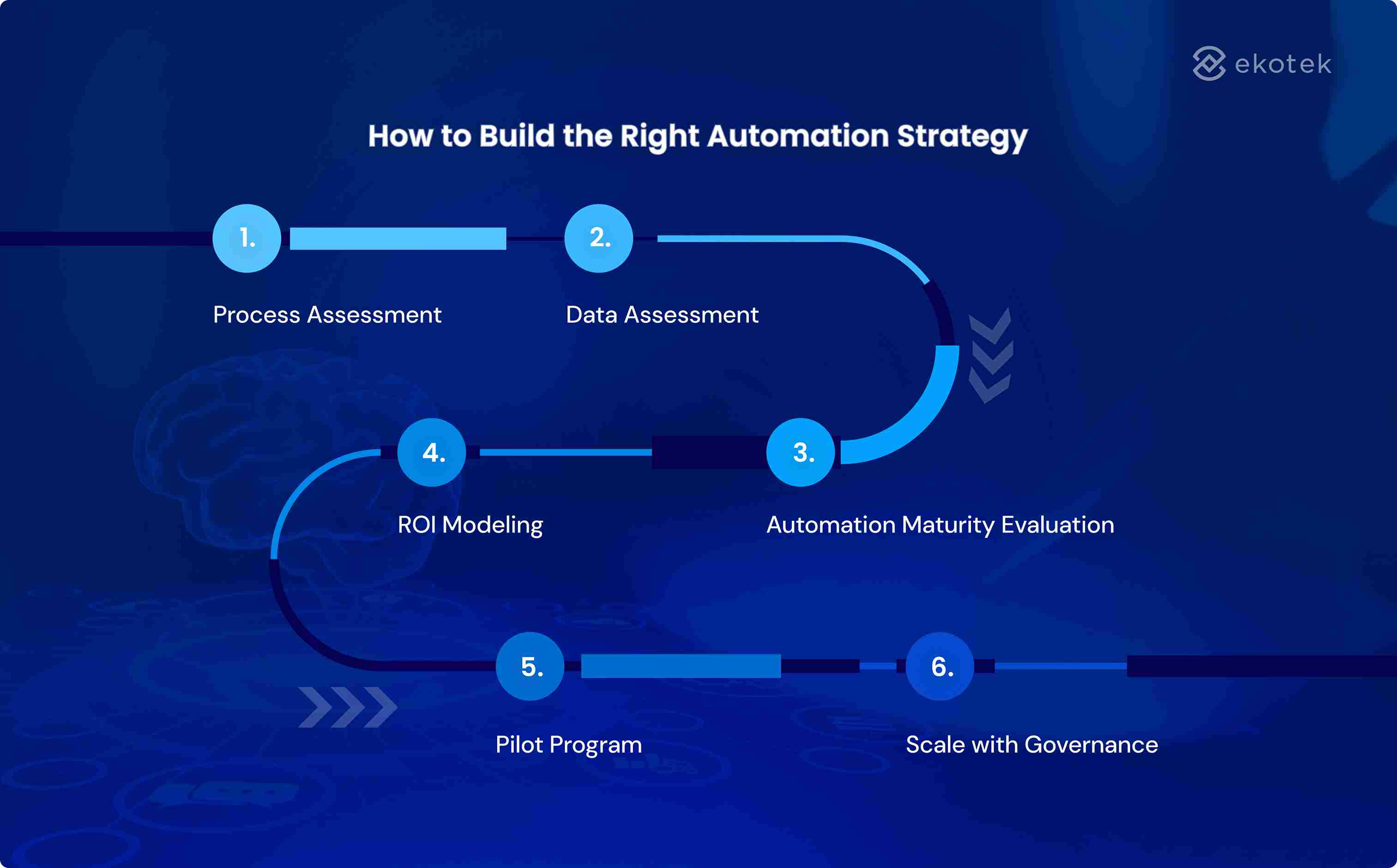
Choosing between AI automation and RPA should not start with technology selection, it should start with strategy. A structured approach ensures automation investments align with business objectives and deliver sustainable value.
Process Assessment
Begin by identifying and prioritizing processes based on volume, complexity, stability, and business impact. Determine which workflows are repetitive and rule-based (ideal for RPA) and which require interpretation or decision-making (better suited for AI). Map dependencies and exception rates to understand automation feasibility.
Data Assessment
Evaluate data availability, quality, and accessibility. AI automation depends heavily on reliable datasets, while RPA requires structured and standardized inputs. Assess whether data is centralized, clean, and governed, or if foundational data work is needed before automation can scale.
Automation Maturity Evaluation
Understand your organization’s current automation capabilities. Are you at a task-level automation stage, or ready for cross-functional orchestration? Evaluate infrastructure readiness, internal expertise, change management capacity, and executive alignment.
ROI Modeling
Quantify both cost savings and strategic value. For RPA, calculate efficiency gains and labor optimization. For AI, include revenue uplift, risk reduction, and long-term performance improvements. Build scenario-based projections to compare short-term and long-term returns.
Pilot Program
Start with a focused pilot in a high-impact but controlled environment. Validate technical feasibility, measure performance metrics, and gather stakeholder feedback. A successful pilot reduces risk and builds organizational confidence before scaling.
Scale with Governance
Once validated, expand automation through a structured rollout plan supported by governance frameworks. Define ownership, monitoring standards, compliance controls, and continuous improvement processes. For AI initiatives especially, establish model oversight and performance tracking mechanisms.
Conclusion: AI Automation vs RPA – Choosing the Right Path Forward
In summary, RPA is best suited for automating repetitive, rule-based processes to achieve quick efficiency gains, while AI automation enables intelligent decision-making, predictive insights, and scalable transformation. The right choice depends on your business objectives, whether you are optimizing operations in the short term or building long-term strategic advantage. For many enterprises, combining both technologies creates the strongest foundation for sustainable automation.
Turning automation potential into measurable business outcomes requires more than technology alone, it requires the right partner.
Ekotek is a trusted software development company specializing in AI, blockchain, and digital transformation. With deep expertise across generative AI, agentic AI, predictive analytics, AI chatbots, computer vision, and AI integration, Ekotek delivers end-to-end solutions, from strategy and data preparation to deployment and long-term optimization. Serving global clients across finance, manufacturing, retail, logistics, and education, Ekotek helps enterprises automate operations, enhance decision-making, and unlock new growth opportunities.
Ready to build your intelligent automation strategy? Talk to Ekotek and accelerate your digital transformation journey.