
What is AI Automation?
Why Traditional Automation is Not Enough
Take the example of Noventiq: by elevating from rule-based scripting to an AI-enhanced model using Microsoft 365 Copilot, Noventiq saved 989 hours in just four weeks, delivering roughly $12,000 in direct ROI plus intangible benefits like faster customer response and better employee engagement.
AI automation addresses these pain points by introducing context-aware, model-driven workflows that continuously learn and improve, offering executives and tech teams a pathway to sustained operational excellence.
⭐️ Learn more about Agentic AI vs Traditional AI
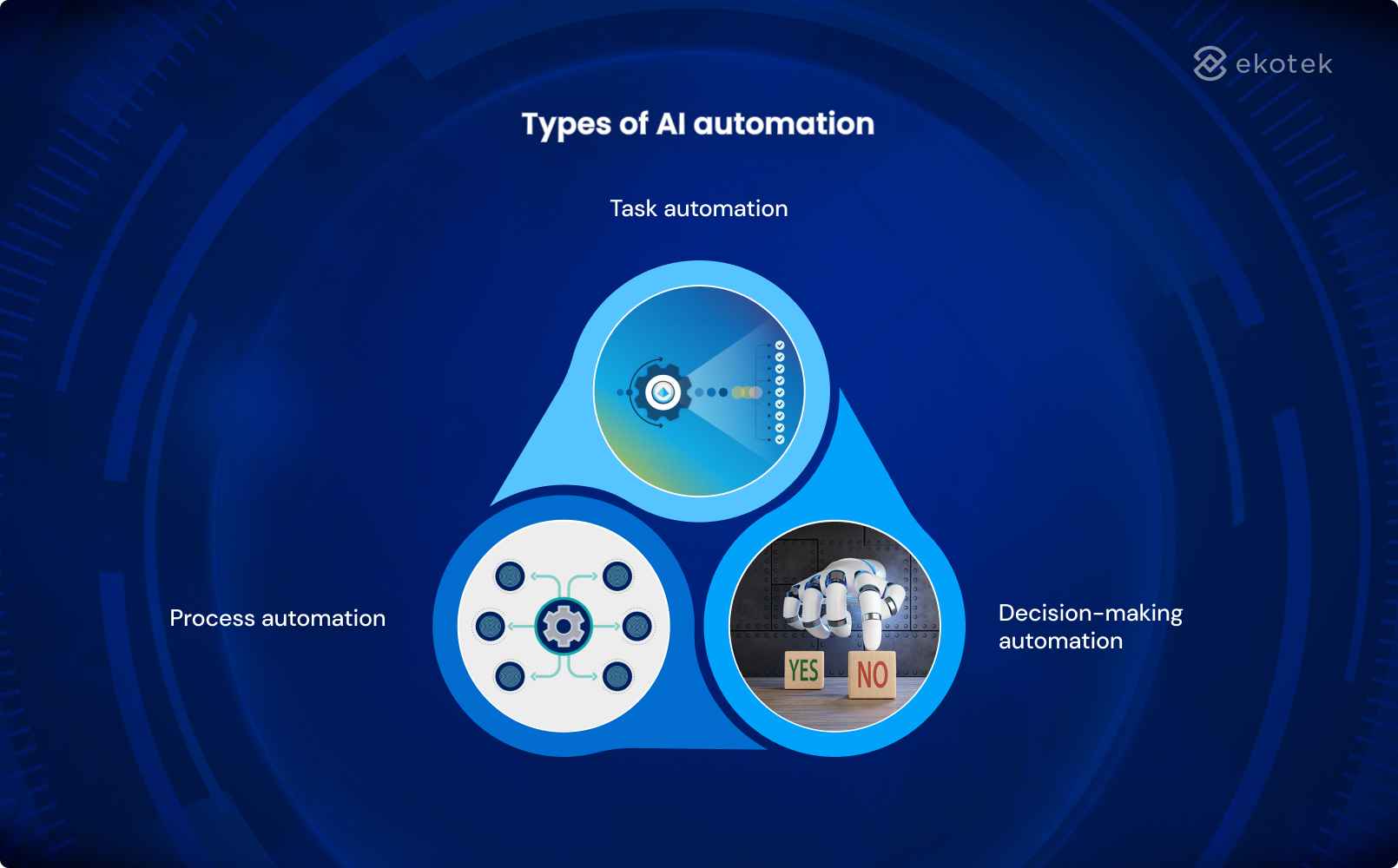
Types of AI Automation
Amid growing business complexity, understanding the right type of AI automation to deploy is critical for maximizing results. AI solutions span from granular task automation to end-to-end workflow orchestration and intelligent decision-making.
| Type | Business Problem Solved | Optimal Use Case Example |
|---|---|---|
| Process Automation | Siloed, slow cross-functional ops | HR onboarding, invoice-to-pay |
| Task Automation | Time-draining, repetitive tasks | Invoice data classification |
| Decision-Making Automation | Complex approvals, recommendations | AI chatbots, predictive analytics |
Process Automation
Process automation targets entire business workflows, integrating multiple steps and departments for seamless outcomes. For instance, automating procurement-to-payment not only speeds up invoice handling but also strengthens audit trails and compliance readiness. Typical areas: HR onboarding, order fulfillment, policy renewals. The 2025 enterprise sees process automation as foundational for digital transformation and data-driven management.
Task Automation
Task automation handles the granular, high-frequency work that drains resources. Automating tasks like invoice classification, data normalization, or internal status reporting lets teams focus on higher-value strategy. In high-volume environments, automating even a single repetitive task produces measurable savings across the business.
Decision-Making Automation
The advanced frontier of AI automation: empowering systems to recommend or approve actions, interpret data, or interact directly with customers. NTT DATA achieved up to 100% workflow automation in certain domains and delivered solutions to market up to 50% faster by embedding conversational AI and predictive analytics in customer service, claim processing, and operational oversight.
Selecting the right form of AI automation depends on problem type, existing tech stack, and strategic objectives. For management and tech leads, mapping automation style to business need is crucial for delivering rapid, scalable results.
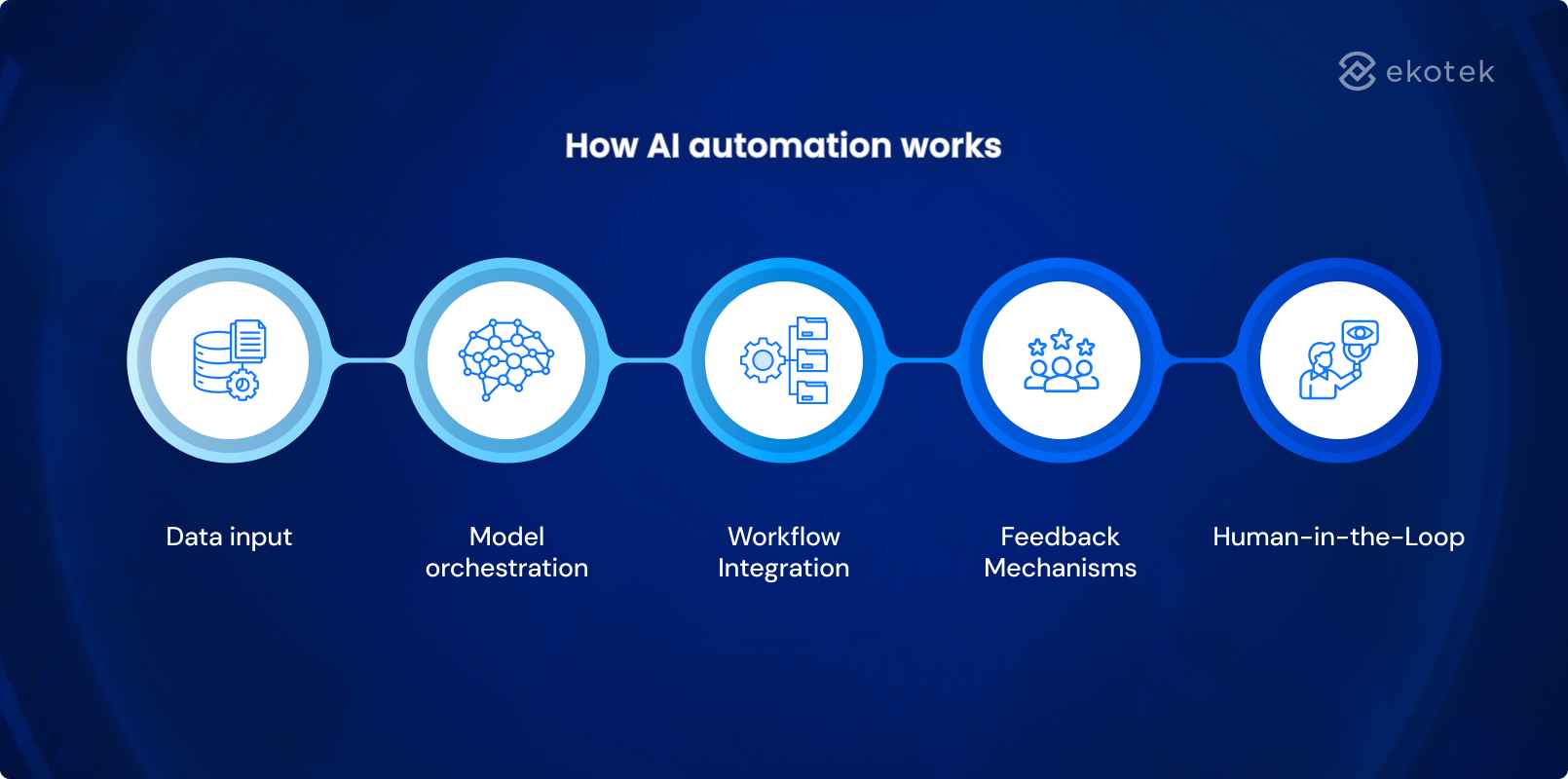
How AI Automation Works
- Data Input: Ingest structured and unstructured data from cloud and on-premise systems.
- Model Orchestration: AI models analyze, classify, and predict based on incoming data.
- Workflow Integration: Rules engines and APIs coordinate system actions, e.g., approvals, status updates.
- Feedback Mechanisms: Model performance monitored, errors flagged; continuous re-training possible.
- Human-in-the-Loop: Key escalations and validations routed to subject matter experts for oversight.
For example, NTT DATA uses advanced API orchestration and “Fabric” data agents to create a feedback-rich ecosystem, delivering not only up to 100% automation in critical workflows but also continuous, real-time improvement as user and market conditions shift.
- Data connectors (enterprise resource planning, CRM, documentation)
- Machine learning platform (internal or cloud-based)
- Workflow engine (API gateway, rules management)
- Monitoring dashboard (errors, exceptions, KPIs)
- Escalation routes for human review
Deploying this stack enables organizations to pilot AI workflow integration, delivering rapid proof-of-value and laying the groundwork for scale.
⭐️ Dive into this guide How To Create An AI Agent
What Tasks Can AI Automate?
AI automation extends far beyond repetitive back-office tasks. It can handle both structured processes and complex, data-driven activities that traditionally required human judgment. For business leaders, the opportunity lies in identifying high-impact areas where speed, accuracy, and scalability directly influence performance.
Operations and Supply Chain
AI can forecast demand, optimize inventory levels, detect bottlenecks, and automate procurement workflows. By analyzing historical and real-time data, it enables faster adjustments and reduces operational risk.
Customer Service and Experience
Intelligent chatbots and virtual assistants can manage inquiries, route tickets, personalize responses, and analyze customer sentiment. AI automation reduces response times while maintaining service quality at scale.
Finance and Risk Management
From invoice processing and expense validation to fraud detection and credit scoring, AI can process large datasets, flag anomalies, and support faster financial decision-making with greater accuracy.
Human Resources
AI automates resume screening, interview scheduling, employee onboarding workflows, and workforce analytics, freeing HR teams to focus on talent strategy and engagement.
Engineering and IT
AI-powered monitoring tools can detect system anomalies, automate incident response, generate code suggestions, and support testing processes, increasing development speed and reliability.
Ultimately, AI automation is most effective when applied to tasks that are high-volume, data-intensive, time-sensitive, or prone to human error. By automating these areas strategically, organizations can improve efficiency while redirecting human expertise toward innovation and growth.
⭐️ You may be interested in Top 20 AI Agent Use Cases
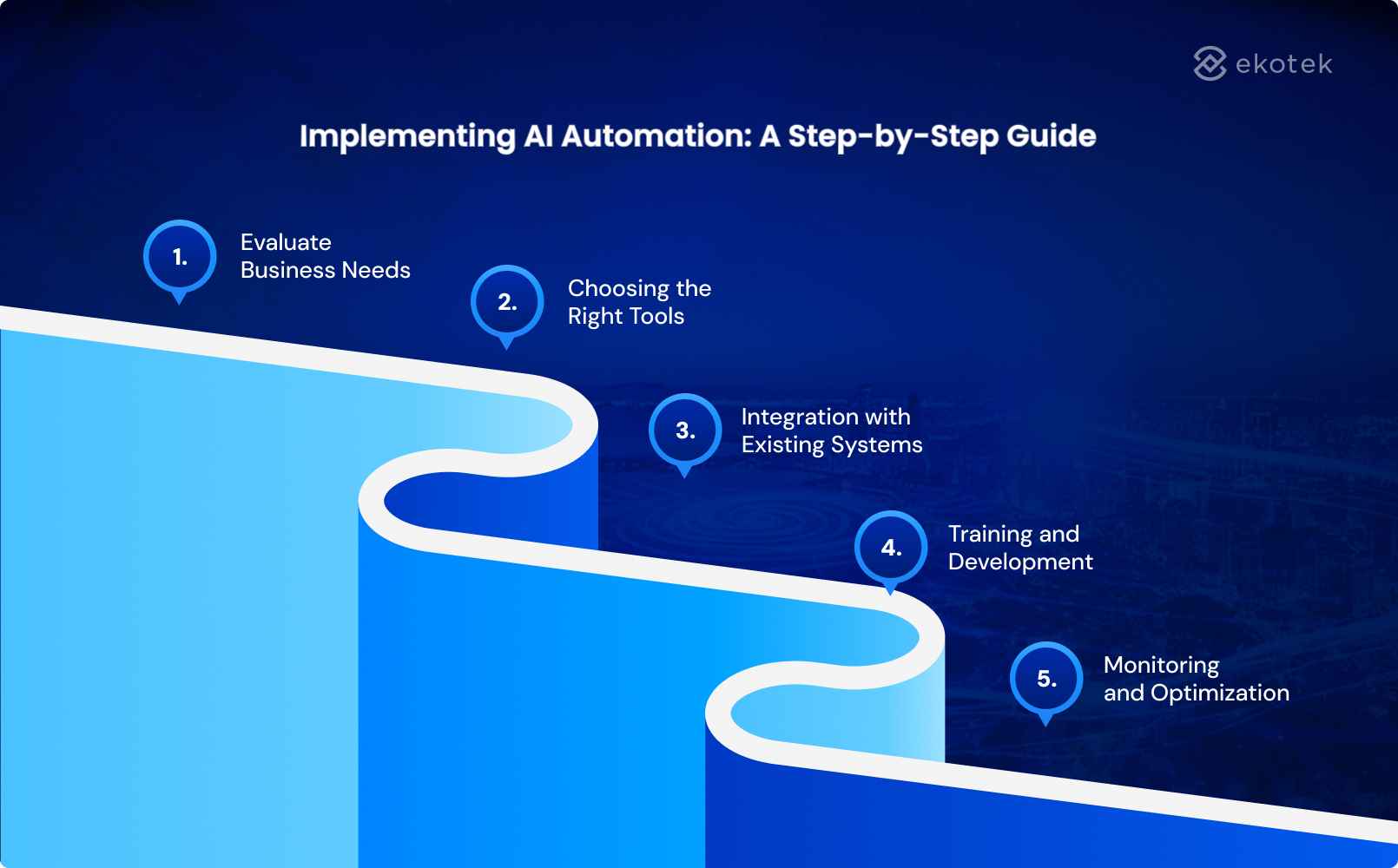
Implementing AI Automation: A Step-by-Step Guide
Building successful AI automation initiatives requires a pragmatic, de-risked approach, integrating business, technology, and change management for sustained results.
Evaluate Business Needs
- Stakeholder interviews to understand pain points and strategic goals.
- Process audits to map value leaks and automation readiness.
- Establish business KPIs (e.g., time/cost savings, compliance adherence).
Choosing the Right Tools
- Feature grid: Compare leading solutions like Microsoft 365 Copilot and Azure AI for integration depth, scalability, and security (ISO 27001/9001).
- Align with existing cloud and data infrastructure.
- Consider vendor track record and success stories.
Integration with Existing Systems
- Plan for data mapping, secure API integration, and process re-engineering as necessary.
- Leverage low-code or hybrid models for quick wins and cross-system compatibility.
Training and Development
- Upskill teams for new AI-powered workflows, custom workshops, vendor/offered certification.
- Foster a culture of innovation and experimentation, empowering process owners to identify automation candidates.
Monitoring and Optimization
- Establish clear governance, KPI dashboards, error monitoring, escalation policies.
- Integrate feedback loops for model retraining and rule adjustments.
- Benchmark progress with industry best-practice playbooks (e.g., Fabric agent methodology).
⭐️ Learn more about how AI Outsourcing can help you scale faster and access specialized AI expertise
Future of AI Automation
The future of AI automation is moving beyond isolated efficiency gains toward fully intelligent, adaptive enterprises. As AI models become more advanced and accessible, automation will no longer focus solely on task execution. it will increasingly support real-time decision-making, predictive insights, and autonomous workflows across entire business functions.
AI agents and autonomous systems
These systems can manage multi-step processes, interact with different software platforms, and adjust actions based on changing data without constant human input. Instead of automating a single task, organizations will automate outcomes, such as resolving customer issues end-to-end or dynamically optimizing supply chains.
Hyperautomation
Another key trend is hyperautomation, where AI integrates with existing enterprise systems, ERP, CRM, data platforms, to create connected, self-improving workflows. Continuous learning loops will allow systems to refine performance over time, improving accuracy, reducing exceptions, and identifying new optimization opportunities.
For business leaders, the strategic implication is clear: AI automation will become a core operating capability, not a supporting tool. Companies that invest early in scalable infrastructure, governance, and AI-ready talent will be positioned to build more resilient, data-driven organizations. In the coming years, competitive advantage will increasingly belong to enterprises that can automate intelligently, not just efficiently.
Conclusion
AI automation is no longer a future trend, it is a strategic necessity. As discussed, traditional automation alone cannot meet the demands of modern enterprises. AI-powered systems enable organizations to move beyond rule-based workflows, automate complex tasks, enhance decision-making, and build adaptive operations that continuously improve. From operations and finance to customer service and engineering, AI automation unlocks efficiency, scalability, and competitive advantage when implemented strategically.
Ekotek is a leading firm in software development in Vietnam, specializing in AI, blockchain, and digital transformation. Our team brings deep expertise across Gen AI, AI agents, AI automation, AI chatbots, AI integration, computer vision, and more. We have successfully delivered AI solutions across manufacturing, healthcare, banking and finance, education, logistics, and other industries, helping enterprises turn AI strategy into measurable business outcomes.
In addition to custom development, Ekotek offers ready-made AI solutions designed to accelerate time to market while remaining flexible enough to adapt to specific business requirements. Whether you are exploring AI automation for the first time or scaling enterprise-wide adoption, we provide the technical depth and strategic guidance to ensure long-term impact.
If you’re looking to build intelligent, future-ready operations, connect with Ekotek today and explore how AI automation can transform your business.