

For modern businesses, deploying artificial intelligence (AI) is no longer an abstract goal, it’s a competitive imperative. But as organizations consider integrating advanced technology, the question of AI automation cost comes sharply into focus. Understanding what goes into these costs, how to gauge return on investment, and how to control spending is crucial for effective, sustainable digital transformation. This guide is designed for executives and decision-makers, offering a clear look at the real cost factors of AI automation, what influences those numbers, and actionable strategies for maximizing value.
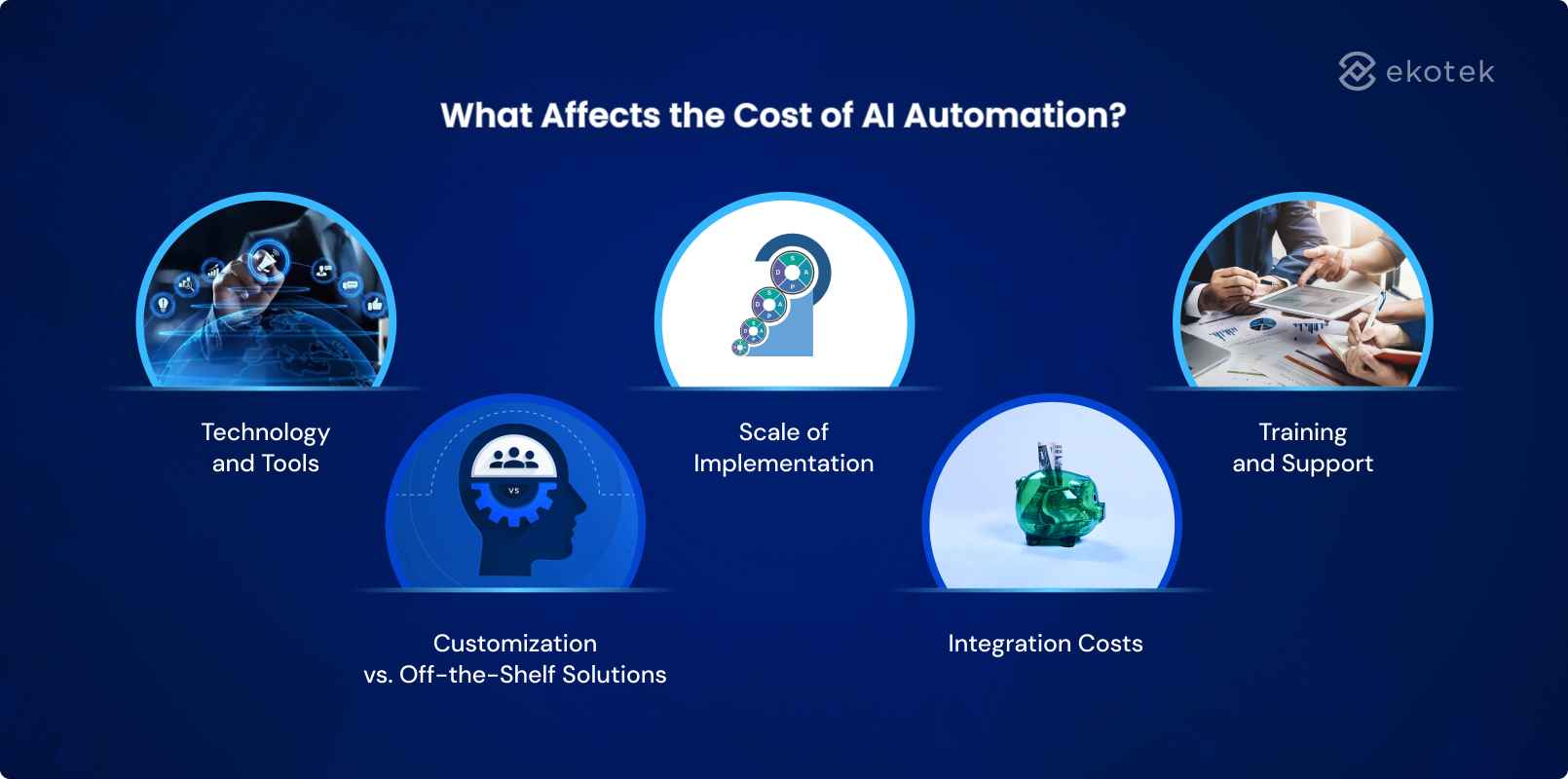
What Affects the Cost of AI Automation?
When business leaders ask about AI automation cost, the most accurate answer is: it depends on strategic choices. The total investment varies significantly based on technology decisions, implementation scope, and organizational readiness.
Below are the key factors that directly influence how much AI automation will cost your organization.
Technology and Tools
The foundation of your AI automation initiative plays a major role in determining cost.
Different technologies come with different pricing models:
-
Robotic Process Automation (RPA) tools typically charge per bot or per user license.
-
Machine learning and predictive analytics platforms may require cloud infrastructure and data engineering support.
-
Generative AI and large language models (LLMs) often operate on API-based, usage-driven pricing.
-
Enterprise AI platforms may bundle orchestration, monitoring, and governance features at premium rates.
Choosing between:
-
Open-source frameworks (lower licensing costs but higher engineering effort), and
-
Enterprise SaaS platforms (higher subscription fees but faster deployment)
…can significantly shift your overall AI automation cost structure.
Additionally, infrastructure decisions cloud vs. on-premise affect long-term operational expenses, scalability, and maintenance requirements.
Customization vs. Off-the-Shelf Solutions
One of the biggest cost drivers is the level of customization required.
Off-the-shelf AI automation solutions
-
Faster deployment
-
Predictable subscription pricing
-
Limited customization
-
Best for standardized workflows
Custom-built AI solutions
-
Higher upfront development costs
-
Greater flexibility
-
Better alignment with unique processes
-
Stronger competitive differentiation
For companies with complex operations, legacy systems, or industry-specific requirements, customization often increases initial AI automation cost but can deliver greater long-term ROI.
📌 Explore How Much Does AI Cost
Scale of Implementation
Scope determines spend.
Implementing AI automation in a single department is fundamentally different from rolling it out enterprise-wide.
Key scaling considerations include:
-
Number of users
-
Volume of transactions processed
-
Geographic deployment
-
Compliance requirements
-
Infrastructure expansion
A pilot project may cost a fraction of a full-scale transformation. However, enterprise-wide automation often benefits from economies of scale, reducing per-user cost over time.
Integration Costs
AI automation rarely operates in isolation.
Most organizations need to integrate automation tools with:
-
ERP systems
-
CRM platforms
-
HR and finance systems
-
Data warehouses
-
Legacy infrastructure
Integration complexity can significantly increase AI automation cost due to:
-
API development
-
Data transformation
-
Security architecture updates
-
Compliance validation
-
System testing and validation
In many cases, integration, not the AI tool itself, represents the largest portion of implementation expense.
The more fragmented your existing tech stack, the higher the integration effort.
📌 Learn more about AI integration
Training and Support
Technology adoption is not purely technical, it is organizational.
AI automation cost must account for:
-
Employee training programs
-
Change management initiatives
-
Process redesign
-
Internal support teams
-
Ongoing maintenance and monitoring
Without proper enablement, even well-built AI systems fail to deliver expected ROI.
Additionally, organizations may need:
-
AI governance frameworks
-
Risk management oversight
-
Continuous model optimization
These recurring support and optimization efforts contribute to long-term operational costs.
📌 Explore how Digital Workplace Transformation can streamline operations, enhance collaboration
Types of AI Automation Costs
Understanding AI automation cost requires breaking it down into clear financial categories. For executives and technology leaders, visibility into cost structure is critical for budgeting, forecasting, and ROI evaluation.
Below are the primary cost components organizations should anticipate.
Upfront Costs
Upfront costs represent the initial investment required to design and deploy AI automation.
These typically include:
-
System setup and configuration
-
Infrastructure provisioning (cloud or on-premise)
-
Data preparation and cleansing
-
Workflow redesign
-
Security and compliance setup
-
Initial testing and validation
For custom AI automation initiatives, upfront costs also include architecture design and model development.
The scale of this initial investment varies widely:
-
A small departmental pilot may require a modest budget.
-
A company-wide transformation may demand significant capital allocation.
While upfront costs can appear substantial, they often represent a one-time investment that enables long-term operational efficiency.
Subscription Fees
Many AI automation platforms operate under subscription or usage-based pricing models.
Common pricing structures include:
-
Per-user licenses
-
Per-bot or per-workflow charges
-
API usage fees (especially for generative AI systems)
-
Tiered SaaS subscriptions
-
Enterprise licensing agreements
These recurring costs must be forecasted carefully, especially for organizations expecting rapid growth in usage.
Subscription-based AI automation costs offer predictability but can scale quickly depending on transaction volume and user expansion.
Executives should evaluate:
-
Cost per automation task
-
Cost per user
-
Projected usage growth over 12–36 months
This ensures scalability does not lead to unexpected budget escalation.
Operational Costs
Operational costs refer to the ongoing expenses required to maintain and optimize AI automation systems.
These may include:
-
Cloud infrastructure usage
-
Data storage
-
Monitoring and logging tools
-
Security updates
-
Model retraining
-
Performance optimization
Unlike subscription fees, operational costs fluctuate based on system load, transaction volume, and computational requirements.
Organizations deploying advanced machine learning models or high-volume generative AI systems may experience significant operational expenses if usage is not monitored and optimized.
This is why continuous performance tracking is essential to control long-term AI automation cost.
Consulting and Development Fees
Many companies engage external partners for AI strategy, implementation, or system integration.
Consulting and development fees may cover:
-
Feasibility studies
-
AI readiness assessments
-
Solution architecture design
-
Custom development
-
System integration
-
Change management support
These fees vary depending on project complexity and vendor expertise.
Hidden Costs
Hidden costs are often underestimated but can significantly impact total investment.
Common hidden AI automation costs include:
-
Data quality remediation
-
Compliance adjustments (GDPR, industry regulations)
-
Internal process restructuring
-
Employee resistance and productivity dips during transition
-
Vendor lock-in risks
-
Downtime during integration
-
Cybersecurity upgrades
In many digital transformation initiatives, hidden costs emerge not from technology itself, but from organizational friction and legacy system constraints.
Typical AI Automation Project Cost Ranges
AI automation cost varies depending on scope, complexity, and business requirements. Here’s a practical breakdown of typical budgeting scenarios:
| Project Size | Deliverables | Estimated Cost Range | Main Cost Drivers | Example Use Case |
|---|---|---|---|---|
| Small | MVP, chatbot, simple workflow | $25,000 – $80,000 | Data prep, vendor fees, integration | Customer support bot for SMB |
| Medium | Custom ML model, automation suite | $80,000 – $250,000 | Custom dev, compliance, ongoing maintenance | Document processing for insurance firm |
| Large | Enterprise-scale AI, multi-module | $250,000 – $1M+ | Data engineering, orchestration, support teams | Predictive analytics for global logistics company |
Factors pushing costs up include high data complexity, need for custom integration, and regulatory compliance. Initiatives with reusable platforms, clear datasets, and defined ROI tend to reduce per-project costs. As reference, many organizations share that initial pilot projects are more cost-effective, with scaling incurring incremental costs as complexity and data volumes rise.
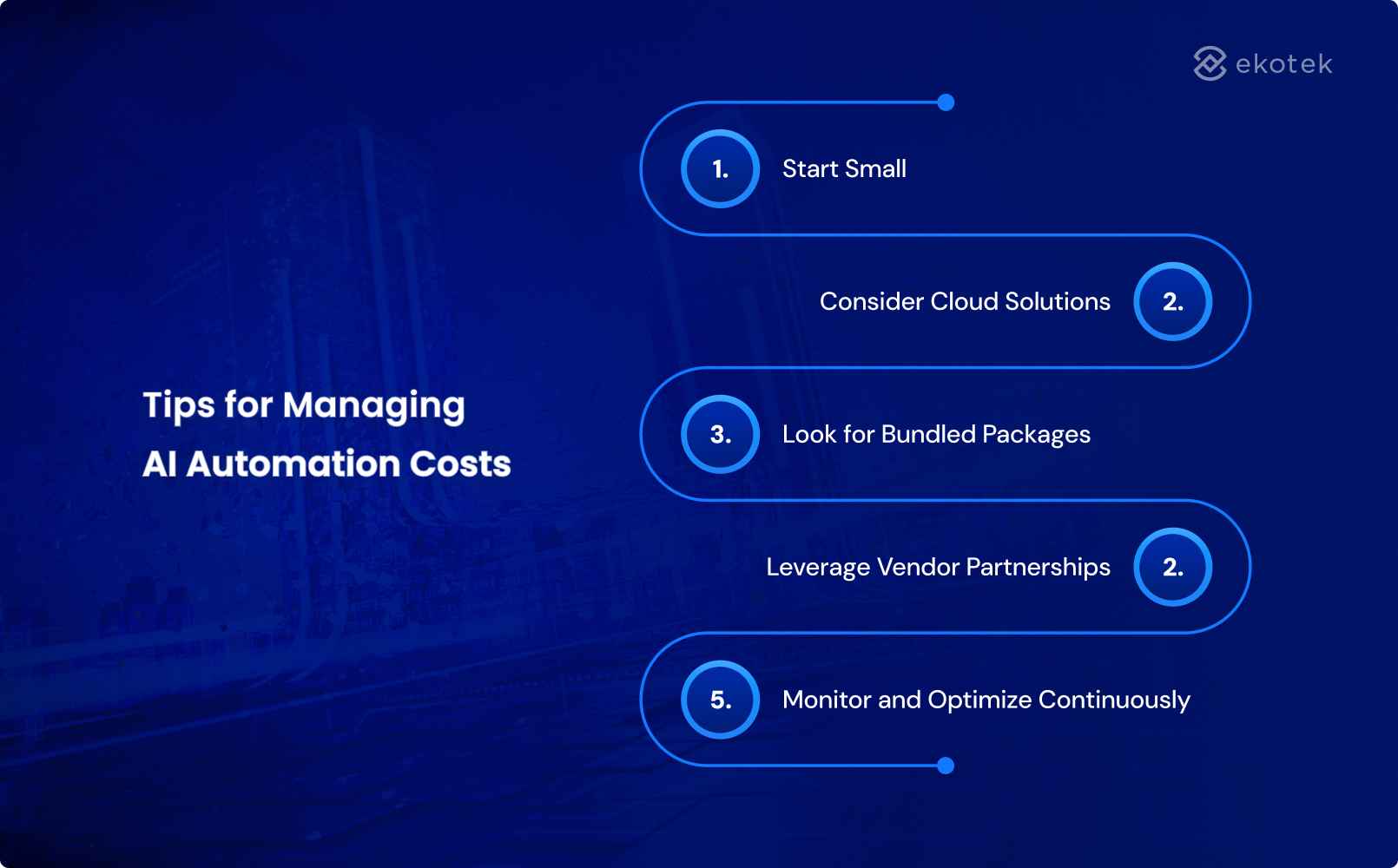
Tips for Managing AI Automation Costs
For many executives, the question isn’t just “What is the AI automation cost?”, it’s “How do we control it while maximizing ROI?”
The good news: AI automation costs are highly manageable when approached strategically. Below are practical, executive-level strategies to ensure your investment remains aligned with business outcomes.
Start Small
One of the most effective ways to manage AI automation cost is to begin with a focused pilot.
Instead of launching a company-wide initiative immediately, identify:
-
A high-impact but contained workflow
-
A process with measurable inefficiencies
-
A department open to experimentation
-
A use case with clear ROI metrics
This approach allows leadership to:
-
Validate technical feasibility
-
Measure productivity gains
-
Identify hidden implementation challenges
-
Refine governance models
Starting small reduces upfront risk and prevents overinvestment before proof of value is established. Once measurable results are achieved, scaling becomes a data-backed decision rather than a speculative one.
Consider Cloud Solutions
Cloud-based AI platforms offer flexibility and cost control advantages over heavy on-premise investments.
Benefits of cloud deployment include:
-
Lower upfront capital expenditure
-
Pay-as-you-go pricing models
-
Elastic scalability
-
Faster deployment cycles
-
Reduced internal infrastructure management
For many organizations, cloud solutions transform AI automation cost from a fixed capital expense into a more predictable operational expense.
Look for Bundled Packages
Many AI vendors offer bundled pricing that combines:
-
Automation tools
-
Analytics dashboards
-
Integration support
-
Training resources
-
Security features
Bundled packages often provide:
-
Better per-feature pricing
-
Simplified vendor management
-
Integrated compatibility
-
Reduced implementation friction
Rather than purchasing multiple disconnected tools, executives should evaluate whether bundled enterprise offerings provide better total value and lower long-term AI automation cost.
Leverage Vendor Partnerships
Strategic vendor relationships can significantly reduce cost and risk.
Instead of treating AI vendors as transactional suppliers, organizations can:
-
Negotiate enterprise-level pricing
-
Secure long-term licensing agreements
-
Co-develop custom solutions
-
Access priority technical support
-
Benefit from innovation roadmaps
Strong partnerships often lead to:
-
Better pricing predictability
-
Reduced consulting overhead
-
Faster problem resolution
-
Shared risk in early-stage deployments
📌 Discover how AI Outsourcing can reduce development costs and accelerate deployment
Monitor and Optimize Continuously
AI automation is not a “set-and-forget” initiative.
Ongoing monitoring is essential to prevent cost creep and performance inefficiencies.
Key optimization practices include:
-
Tracking cost per transaction or process
-
Monitoring API usage and cloud consumption
-
Auditing unused licenses
-
Reviewing automation performance metrics
-
Retiring low-impact automations
-
Regularly retraining and fine-tuning models
Organizations that actively optimize their AI systems often reduce operational costs over time while improving output quality.
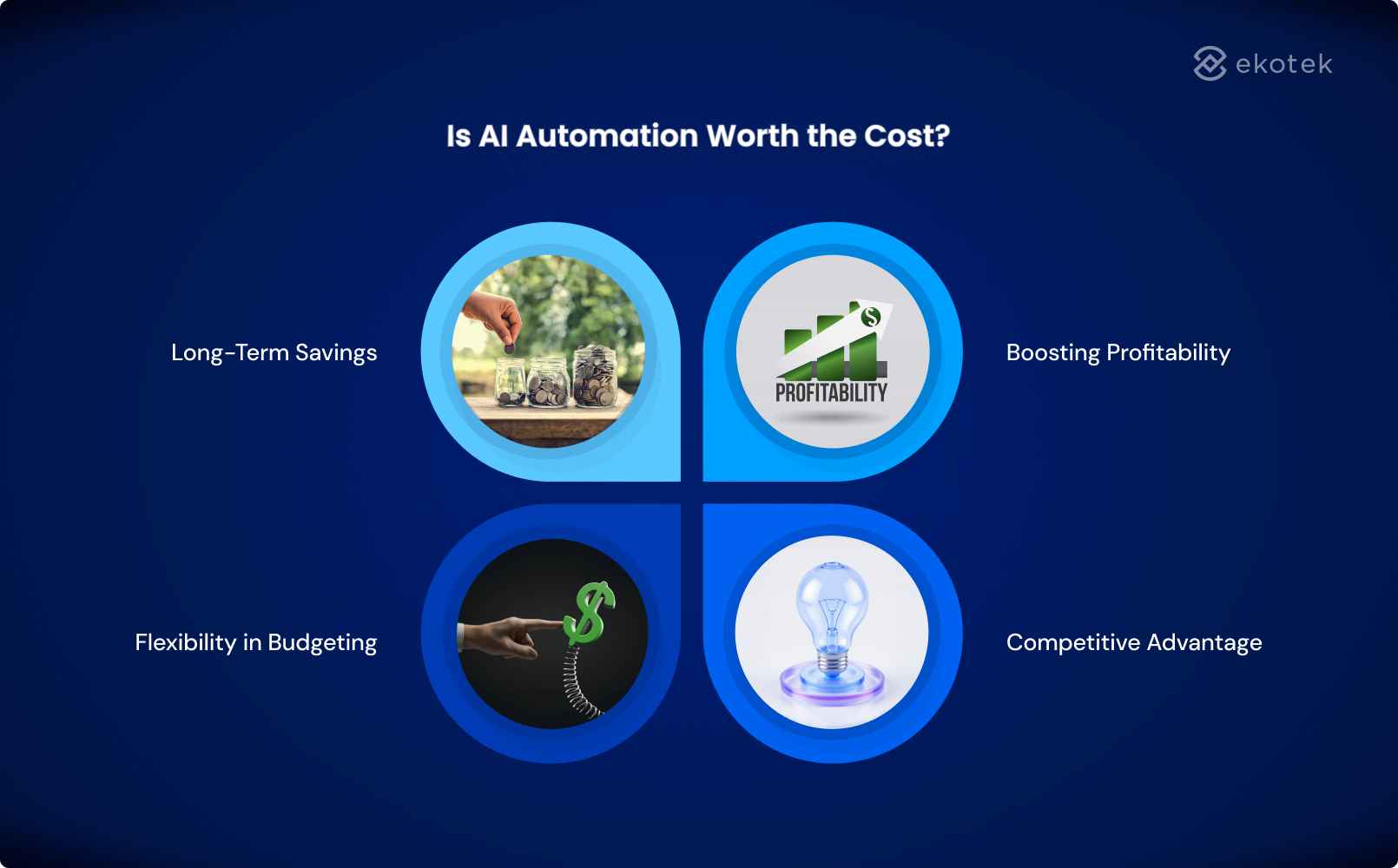
Is AI Automation Worth the Cost?
For business leaders, the real question is not simply about AI automation cost, it is about return on investment.
Is the financial commitment justified?
Will the impact outweigh the expense?
Does it create sustainable business value?
When evaluated strategically, AI automation is rarely just a cost line item. It is a long-term operational lever.
Below are the core dimensions executives should consider.
Long-Term Savings
While AI automation often requires meaningful upfront investment, its financial impact compounds over time.
Automation reduces:
-
Manual labor costs
-
Error-related losses
-
Process inefficiencies
-
Rework and correction cycles
-
Administrative overhead
In many organizations, repetitive workflows consume a disproportionate amount of skilled employee time. By automating routine tasks, companies can reallocate talent to higher-value strategic work.
Additionally, AI-driven predictive capabilities can:
-
Reduce downtime
-
Optimize supply chains
-
Improve demand forecasting
-
Minimize risk exposure
Over a multi-year horizon, these efficiencies frequently offset the initial AI automation cost and create measurable operational savings.
Boosting Profitability
Beyond cost reduction, AI automation can directly improve revenue performance.
AI systems enable:
-
Faster decision-making
-
Personalized customer engagement
-
Intelligent pricing optimization
-
Sales process automation
-
Data-driven cross-selling and upselling
By accelerating workflows and improving accuracy, companies shorten cycle times and increase throughput.
For example:
-
Faster lead qualification increases conversion rates.
-
Intelligent customer support automation improves retention.
-
Predictive analytics improves inventory management and reduces lost sales.
In this sense, AI automation becomes a profitability multiplier, not merely an efficiency tool.
Competitive Advantage
Markets are increasingly shaped by speed, data intelligence, and operational agility.
Organizations that successfully implement AI automation gain:
-
Faster response times
-
More accurate insights
-
Scalable operations
-
Reduced dependency on manual intervention
In competitive industries, the ability to process information and act in real time creates differentiation.
Moreover, automation improves resilience. Companies with intelligent workflows adapt more easily to:
-
Demand fluctuations
-
Workforce shortages
-
Economic uncertainty
-
Regulatory changes
Over time, this operational agility becomes a strategic advantage that competitors without automation struggle to match.
Flexibility in Budgeting
Modern AI solutions offer flexible financial models that reduce investment barriers.
Instead of large capital expenditures, organizations can choose:
-
Subscription-based pricing
-
Usage-based billing
-
Scalable cloud deployment
-
Phased implementation strategies
This flexibility allows leadership teams to align AI automation cost with cash flow planning and performance milestones.
Companies can:
-
Launch small pilots
-
Measure ROI
-
Expand incrementally
Such modular investment structures make AI automation more financially manageable and strategically adaptable.
Conclusion: Making AI Automation Work for Your Business
AI automation cost is shaped by multiple factors, from technology choices and customization levels to integration complexity, operational expenses, and long-term optimization. While the investment may include upfront, recurring, and hidden costs, organizations that approach AI strategically often realize sustained efficiency gains, improved profitability, and stronger competitive positioning. Ultimately, the true value of AI automation lies not in minimizing cost, but in aligning investment with measurable business outcomes.
Ekotek is a leading software development firm in Vietnam, specializing in AI, blockchain, and digital transformation. Our team brings deep expertise across generative AI, AI agents, AI automation, AI chatbots, AI integration, computer vision, and advanced analytics. We have successfully delivered AI solutions across industries such as manufacturing, healthcare, banking and finance, education, and logistics, helping organizations turn complex challenges into scalable, intelligent systems.
Beyond fully customized solutions, Ekotek also provides ready-made AI platforms that accelerate time to market while remaining flexible enough to adapt to specific business requirements. If you are evaluating AI automation and want a clear, ROI-driven roadmap, our team is ready to help you move from strategy to execution with confidence.