

Types of Healthcare Software
Healthcare software development encompasses a wide range of solutions designed to support clinical operations, patient care, and strategic decision-making. For enterprises and healthcare leaders, understanding the core types of healthcare software is essential to selecting the right investments and building scalable digital ecosystems.
Electronic Health Records (EHR/EMR)
Definition: EHR/EMR systems are digital platforms used to store, manage, and access patient medical records across healthcare facilities.
Typical scope
-
Patient demographics and medical history
-
Diagnoses, prescriptions, and lab results
-
Clinical documentation and reporting
These systems often serve as the core data layer within broader healthcare software ecosystems.
Telemedicine Platforms
Definition: Telemedicine software enables healthcare providers to deliver medical services remotely through digital communication channels.
Typical scope
-
Virtual consultations and follow-ups
-
Appointment scheduling and patient onboarding
-
Secure communication and data exchange
Telemedicine platforms are commonly integrated with EHR systems and patient-facing applications.
Hospital Information Systems (HIS)
Definition: Hospital Information Systems manage administrative, financial, and operational workflows within healthcare institutions.
Typical scope
-
Patient admissions and discharge management
-
Billing, insurance, and financial reporting
-
Resource and inventory management
HIS solutions act as centralized operational platforms that connect clinical and non-clinical departments.
Healthcare Mobile Apps
Definition: Healthcare mobile applications are digital tools designed for patient interaction, engagement, and self-service.
Typical scope
-
Appointment booking and notifications
-
Medication reminders and health tracking
-
Direct communication with healthcare providers
These apps often function as front-end interfaces connected to backend healthcare systems.
📌 Discover how Enterprise Mobile App Development helps enterprises improve efficiency and engage users
Medical Data Analytics & AI Solutions
Definition: Medical data analytics and AI solutions process large volumes of healthcare data to support insights and automation.
Typical scope
-
Clinical decision support and predictive analytics
-
Population health analysis
-
Operational and performance reporting
These solutions typically leverage data collected from EHRs, HIS, and digital health platforms.
 Key Business Benefits of Healthcare Software Development
For enterprises and healthcare leaders, healthcare software development is not merely an IT initiative, it is a strategic investment that directly impacts operational performance, risk management, and long-term competitiveness. When designed and implemented effectively, healthcare software delivers measurable business value across the organization.
Operational Efficiency and Process Automation
Custom healthcare software streamlines complex clinical and administrative workflows by automating manual processes and reducing system fragmentation. From patient intake to billing and reporting, automation minimizes redundancies and accelerates day-to-day operations.
For organizations operating at scale, improved efficiency translates into faster service delivery, optimized resource utilization, and reduced operational bottlenecks.
Cost Optimization and Better Resource Allocation
Healthcare software development enables organizations to gain greater visibility into costs, utilization rates, and operational performance. Digital systems help identify inefficiencies, reduce paperwork, and optimize staffing, inventory, and infrastructure usage.
Over time, this data-driven approach supports smarter budget planning and sustainable cost control without compromising quality of care.
Improved Patient Experience and Service Quality
Digital healthcare solutions enhance patient interactions across multiple touchpoints, including scheduling, communication, and follow-up care. Consistent, user-friendly digital experiences increase patient satisfaction and engagement.
For enterprises, improved patient experience strengthens brand trust, retention, and competitive positioning in an increasingly consumer-driven healthcare market.
Data-Driven Decision Making and Strategic Insights
Healthcare software consolidates data from clinical, operational, and financial systems into centralized platforms. Advanced reporting, analytics, and dashboards provide leadership teams with real-time insights into performance and outcomes.
These insights empower executives to make informed strategic decisions, respond quickly to market changes, and align technology investments with business goals.
Enhanced Data Security, Compliance, and Risk Management
Healthcare organizations operate in highly regulated environments where data protection and compliance are critical. Purpose-built healthcare software incorporates security-by-design principles, access controls, audit trails, and compliance frameworks.
By reducing data risks and ensuring regulatory alignment, healthcare software development protects organizational reputation and minimizes legal and financial exposure.
Scalability and Long-Term Digital Growth
Custom healthcare software is designed to evolve alongside organizational growth. Modular architectures and scalable infrastructures allow enterprises to expand services, integrate new technologies, and adapt to changing regulations or market demands.
This flexibility ensures that digital investments remain relevant and continue to deliver value over the long term.
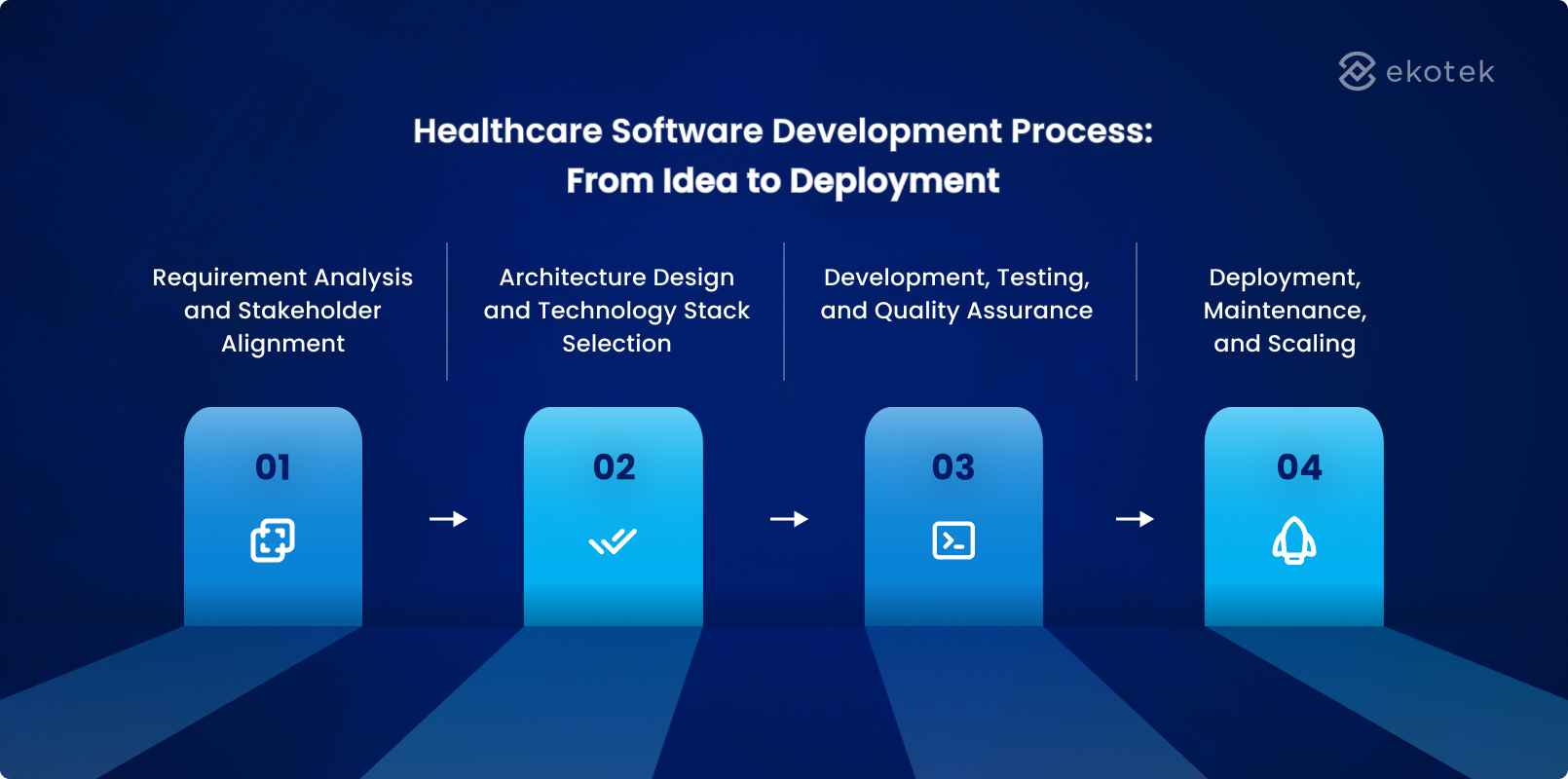
Healthcare Software Development Process: From Idea to Deployment
Successful healthcare software development requires a structured, compliant, and scalable approach. For enterprises, the development process must align business objectives, clinical needs, and regulatory requirements while minimizing risks and ensuring long-term value.
Requirement Analysis and Stakeholder Alignment
The foundation of effective healthcare software development lies in thorough requirement analysis and stakeholder alignment. This stage involves identifying business objectives, regulatory constraints, clinical workflows, and user expectations.
Key stakeholders, including executives, IT teams, clinicians, and compliance officers, must share a unified understanding of project scope and success criteria. Clear alignment at this stage reduces costly rework, mitigates risks, and ensures the software supports both operational and strategic goals.
Architecture Design and Technology Stack Selection
Once requirements are defined, the next step is designing a robust software architecture and selecting the appropriate technology stack. This phase determines how the system will scale, integrate, and remain secure over time.
For healthcare enterprises, architecture decisions must prioritize data security, interoperability, performance, and regulatory compliance. Strategic technology selection enables future integrations, supports system resilience, and protects long-term technology investments.
Development, Testing, and Quality Assurance
During the development phase, healthcare software is built through iterative cycles that emphasize quality, security, and compliance. Rigorous testing and quality assurance are essential to ensure system reliability and data integrity.
This stage typically includes functional testing, security testing, and performance validation. A disciplined development and QA approach minimizes operational disruptions and ensures the software meets healthcare industry standards before deployment.
Deployment, Maintenance, and Scaling
Deployment marks the transition from development to real-world operations. Healthcare software must be rolled out carefully to ensure system stability, data accuracy, and user adoption.
Post-deployment, ongoing maintenance and monitoring are critical to address performance issues, security updates, and regulatory changes. Scalable healthcare software development allows organizations to expand functionality, onboard new users, and adapt to evolving business needs without major system overhauls.
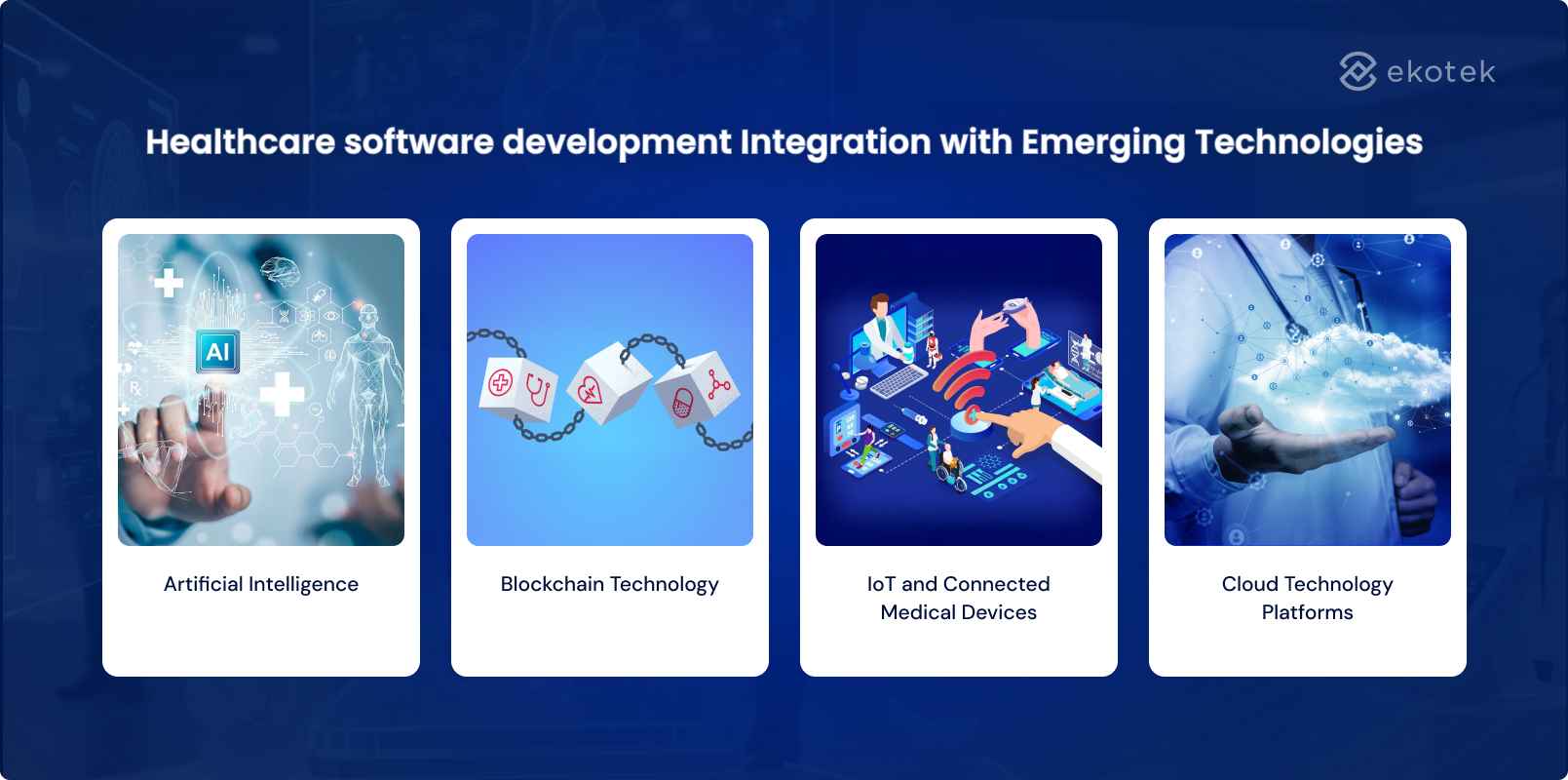
 Healthcare software development Integration with Emerging Technologies
As healthcare continues to evolve, healthcare software development is no longer limited to building standalone systems. Modern healthcare platforms must seamlessly integrate with emerging technologies to enhance intelligence, connectivity, security, and scalability across the entire ecosystem.
Artificial Intelligence (AI)
AI is transforming how healthcare organizations analyze data, support clinical decisions, and optimize operations. When integrated into healthcare software platforms, AI enables advanced capabilities such as predictive analytics, automation, and intelligent decision support.
From a business perspective, AI-powered healthcare software helps organizations:
-
Extract actionable insights from complex medical datasets
-
Improve accuracy and speed in clinical and operational processes
-
Support proactive and preventive care models
One example of how advanced software development delivers real business impact is a recent AI-powered mobile application developed by Ekotek. The solution leverages AI-driven image analysis to provide personalized insights and recommendations through a seamless mobile experience, achieving strong user adoption shortly after launch. This project highlights Ekotek’s expertise in combining AI, data processing, and scalable architecture to build intelligent digital platforms.
📌 Explore the full case study here
Blockchain Technology
Blockchain introduces a new level of transparency, security, and trust in healthcare data management. By integrating blockchain into healthcare software systems, organizations can strengthen data integrity and control access to sensitive information.
Key applications include:
-
Secure data sharing across stakeholders
-
Immutable audit trails for compliance and accountability
-
Enhanced patient data ownership and consent management
📌 Learn more about Blockchain for business
IoT and Connected Medical Devices
IoT and connected devices enable continuous data collection from medical equipment, wearables, and remote monitoring tools. When integrated into healthcare software platforms, these technologies provide real-time visibility into patient health and operational performance.
Strategic healthcare software development enables:
-
Seamless device integration and data synchronization
-
Real-time monitoring and alerts
-
Improved coordination between care providers and patients
Cloud Technology Platforms
Cloud technology serves as the backbone of modern healthcare software architectures. Cloud-based platforms provide the scalability, flexibility, and resilience required to support growing user bases and data volumes.
By leveraging cloud infrastructure, healthcare organizations can:
-
Scale systems efficiently without heavy upfront investment
-
Enable faster deployment and updates
-
Support secure data storage, disaster recovery, and system availability
 In-House vs Outsourced Healthcare Software Development
Choosing between in-house and outsourced healthcare software development is a strategic decision that impacts cost structure, speed to market, risk management, and long-term scalability. For healthcare enterprises, the right approach depends on internal capabilities, business priorities, and the complexity of digital initiatives.
In-House Healthcare Software Development
Building an internal development team provides organizations with direct control over resources, processes, and intellectual property. In-house teams may work well for companies with mature IT capabilities, stable requirements, and long-term product roadmaps.
However, healthcare enterprises often face challenges when developing software internally, including:
-
High recruitment and retention costs for specialized talent
-
Long onboarding and ramp-up timelines
-
Limited exposure to diverse healthcare technology use cases
-
Difficulty keeping pace with rapidly evolving technologies and regulations
For many organizations, these constraints can slow innovation and increase operational risk.
Outsourced Healthcare Software Development
Outsourcing healthcare software development allows enterprises to partner with specialized technology providers that bring proven expertise, scalable teams, and domain knowledge.
Key advantages of outsourcing include:
-
Access to experienced healthcare software engineers without long-term hiring commitments
-
Faster time to market through established development processes and reusable frameworks
-
Cost efficiency and predictable budgeting, especially for complex or large-scale systems
-
Built-in compliance and security expertise, reducing regulatory and operational risks
By leveraging external partners, healthcare leaders can focus internal resources on core business strategy and patient care while accelerating digital transformation initiatives.
Why Outsourcing Is a Strategic Advantage for Healthcare Enterprises
In today’s competitive and regulated healthcare environment, software development is no longer a one-time project but a continuous journey. Outsourcing provides the flexibility to scale development capacity up or down based on business needs, without the overhead of maintaining large in-house teams.
Moreover, experienced outsourcing partners bring cross-industry insights and best practices, helping healthcare organizations avoid common pitfalls and adopt modern architectures more efficiently.
Conclusion
Healthcare software development has become a strategic pillar for enterprises navigating digital transformation in an increasingly complex and regulated healthcare landscape. As explored throughout this blog, successful healthcare initiatives depend on selecting the right software types, realizing clear business benefits, following a structured development process, leveraging outsourcing strategically, and integrating emerging technologies such as AI, blockchain, IoT, and cloud platforms.
For healthcare leaders and enterprises, the challenge is no longer whether to invest in healthcare software but how to build secure, scalable, and future-ready solutions that deliver measurable business value while adapting to constant technological change.
This is where Ekotek comes in. Ekotek is a leading software development company specializing in digital transformation, AI, and blockchain development. With a team of 200+ experienced professionals and deep expertise in emerging technologies, Ekotek has successfully delivered over 450 projects for global clients across industries including healthcare, manufacturing, retail, banking, and finance.
Beyond custom development, Ekotek offers ready-made healthcare solutions that help enterprises significantly reduce time to market, while still allowing full customization to meet specific business and operational requirements. This balanced approach enables organizations to innovate faster without sacrificing flexibility, security, or scalability.
Ready to accelerate your healthcare digital transformation?
Explore how our healthcare software development expertise can help your organization build intelligent and scalable digital healthcare solutions