

FinTech app development is more than a technical initiative, it is a strategic investment that impacts security, compliance, scalability, and long-term business growth. One of the first questions decision-makers ask is: how much does it actually cost to build a fintech app? The answer varies widely depending on product type, feature complexity, regulatory requirements, and technology choices.
In this article, we break down the average fintech app development cost, explain the key factors that influence pricing, highlight hidden expenses, and share practical ways to optimize your budget without compromising quality or compliance. This guide is designed to help business leaders and tech decision-makers plan fintech development with clarity and confidence.
What Is the Average FinTech App Development Cost?
The cost of developing a FinTech application can vary significantly depending on scope, complexity, compliance requirements, and long-term scalability goals. For decision-makers, the key is not just knowing a number, but understanding what level of product that budget actually delivers.
Typical Cost Ranges for FinTech App Development
In most cases, FinTech products fall into two main stages: MVP (Minimum Viable Product) and full-scale production platforms.
-
FinTech MVP
-
Estimated cost: $30,000 – $80,000
-
Timeline: 3-5 months
-
Purpose: Validate business ideas, test core user flows, attract early users or investors
-
Scope: Core features only (basic onboarding, limited transactions, essential security)
-
An MVP focuses on speed and cost-efficiency while still meeting minimum security and compliance standards.
-
Full-scale FinTech product
-
Estimated cost: $120,000 – $300,000+
-
Timeline: 6-12+ months
-
Purpose: Market-ready, scalable, and compliant fintech solution
-
Scope: Advanced features, high availability, regulatory compliance, scalability, and enterprise-grade security
-
Full-scale products are designed for growth, larger user bases, and long-term operational stability.
Cost Comparison by App Complexity
Below is a high-level comparison to help you align budget expectations with product ambition:
| FinTech App Type | Typical Cost Range | Description |
|---|---|---|
| Simple FinTech App | $30,000 – $60,000 | Basic functionality such as user accounts, simple payments, and limited integrations. Often used for MVPs or niche use cases. |
| Mid-Level FinTech App | $60,000 – $120,000 | Includes advanced features like real-time transactions, third-party APIs, dashboards, and stronger security layers. Suitable for growing businesses. |
| Enterprise-Grade FinTech Platform | $150,000 – $300,000+ | Complex systems with high scalability, regulatory compliance, advanced security, analytics, and multi-region support for large user bases. |
It’s important to note that FinTech app development cost is not linear. Adding features such as real-time processing, compliance automation, or multi-currency support can significantly increase both development and long-term maintenance costs.
Understanding where your product fits within these ranges is the first step toward building a realistic budget and choosing the right development strategy.
Key Factors That Affect FinTech App Development Costs
There is no fixed price for building a fintech application because development costs are shaped by multiple strategic and technical decisions. From the type of fintech product and feature complexity to security requirements, technology choices, and team structure, each factor can significantly impact the final budget.
App Type and Business Model
The type of fintech application and its business model directly determine development cost, as each category requires different levels of functionality, security, compliance, and system integration. Choosing the right product scope early helps avoid unnecessary complexity and budget overruns.
-
Digital Wallets: Development costs depend on transaction volume handling, third-party payment integrations, and security layers. Basic wallets are suitable for MVPs, while features like multi-currency support and real-time settlements significantly increase cost.
-
Mobile Banking Apps: These are among the highest-cost fintech products due to complex backend systems, real-time data processing, strong authentication, and strict regulatory compliance. Integration with core banking systems is a major cost driver.
-
Payment & Money Transfer Apps: Cost is driven by scalability, transaction speed, fraud prevention, and cross-border payment capabilities. Supporting multiple payment gateways and currencies adds both development and operational expenses.
- Investment & Wealth Management Apps: These apps require real-time market data integration, high reliability, and advanced reporting dashboards. Accuracy, performance, and compliance standards push development costs higher than basic fintech solutions.
-
Blockchain & Crypto Apps: Blockchain-based products typically involve higher upfront costs due to smart contract development, security audits, and specialized expertise. Architecture complexity and regulatory uncertainty further impact budget planning.
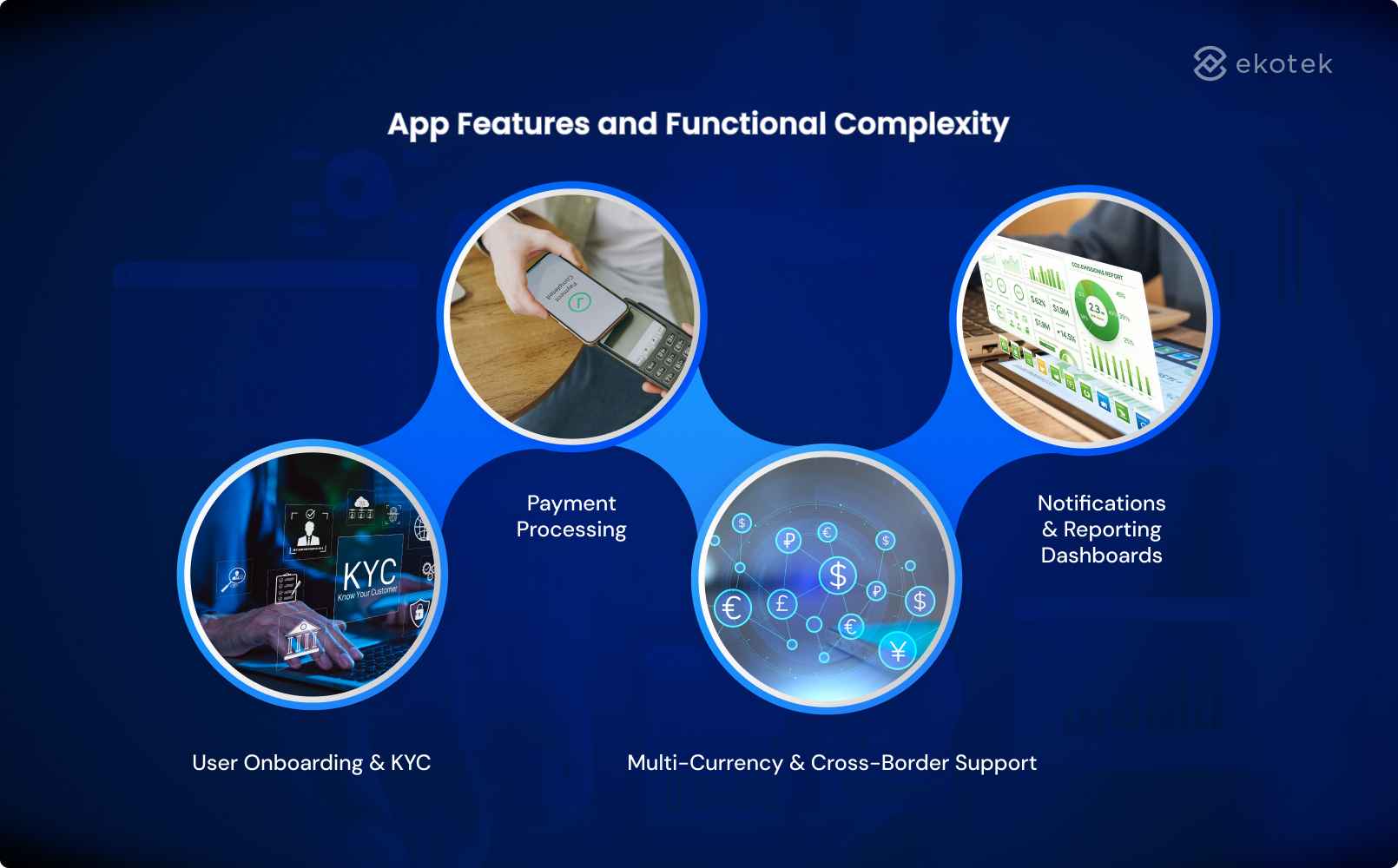
App Features and Functional Complexity
The number and complexity of features included in a fintech application have a direct and often exponential impact on development cost. Each additional function increases not only development effort, but also testing, security, compliance, and long-term maintenance requirements.
-
User Onboarding & KYC: Basic user registration is relatively simple, but compliant onboarding requires identity verification, document processing, and integration with third-party KYC providers. Automated KYC workflows, manual review tools, and compliance logging add substantial development and integration costs.
-
Payment Processing: Payment functionality involves more than transferring money. Secure transaction handling, payment gateway integrations, reconciliation logic, and error handling all contribute to higher development complexity. Supporting multiple payment methods further increases cost.
-
Multi-Currency & Cross-Border Support: Supporting multiple currencies introduces exchange rate handling, currency conversion logic, regional compliance requirements, and additional integrations. Cross-border transactions also require more complex settlement and reporting mechanisms.
-
Notifications & Reporting Dashboards: User notifications and administrative dashboards improve transparency and usability but add backend logic, data processing, and UI complexity. Real-time alerts, analytics, and customizable reports require additional development and testing effort.
Security, Compliance, and Regulations
Security and regulatory compliance are non-negotiable requirements in fintech and they are also among the largest cost drivers in fintech app development. Unlike other industries, fintech products must meet strict legal, technical, and operational standards from day one.
-
Regulatory Compliance (PCI DSS, GDPR, AML, KYC): Compliance with standards such as PCI DSS and GDPR, along with AML and KYC regulations, requires additional system design, documentation, audits, and testing. These requirements often influence architecture decisions and extend development timelines.
- Why Compliance Significantly Increases Development Cost: Compliance affects every stage of development, from system architecture and feature design to testing, deployment, and post-launch operations. Regular audits, penetration testing, security updates, and regulatory changes also create continuous costs beyond the initial build.
-
Data Encryption & Secure Authentication
Protecting sensitive financial and personal data involves encryption at rest and in transit, secure key management, and advanced authentication mechanisms such as multi-factor authentication or biometric verification. Implementing these security layers increases engineering effort and quality assurance costs. -
Fraud Detection Systems
Fraud prevention adds another layer of complexity. Rule-based engines, behavioral analysis, transaction monitoring, and alert systems require ongoing tuning, data processing, and performance optimization, all of which contribute to higher development and maintenance costs.
💡 Learn how AI Fraud Detection helps prevent fraud while reducing operational costs
Platform Selection
Platform choice has a direct impact on fintech app development cost, timeline, and long-term maintenance. Each platform comes with different technical requirements, development efforts, and user expectations, making platform strategy a key budgeting decision.
-
iOS App Development: iOS development often involves higher initial costs due to stricter security standards, design guidelines, and testing requirements. However, iOS apps typically offer more predictable device environments and faster OS adoption, which can reduce long-term maintenance effort.
-
Android App Development: Android apps require broader device compatibility and more extensive testing across different screen sizes and OS versions. While development costs can be comparable to iOS, fragmentation often increases testing and quality assurance effort.
-
Cross-Platform vs Native Development: Cross-platform development can reduce initial costs by sharing code across iOS and Android, making it attractive for MVPs and early-stage products. Native development, while more expensive, offers better performance, security control, and scalability, often preferred for complex or enterprise-grade fintech solutions.
-
Web-Based FinTech Platforms: Web platforms are commonly used for admin dashboards, internal tools, or customer-facing portals. They can lower entry costs and enable faster iteration but may require additional security hardening and optimization to meet fintech compliance and performance standards.
💡 Explore best practices for enterprise mobile app development
Technology Stack and Architecture
The technology stack and system architecture define how scalable, secure, and maintainable a fintech application will be, and they play a critical role in overall development cost. More advanced architectures enable long-term growth but require higher upfront investment.
-
Backend Infrastructure: Fintech backends must handle high transaction volumes, ensure data consistency, and maintain high availability. Designing robust architectures with proper monitoring, logging, and failover mechanisms increases development time and cost compared to basic backend setups.
-
Cloud Services & Scalability: Cloud-based infrastructure supports scalability and performance but introduces ongoing costs for compute resources, storage, and traffic. Building cloud-native systems with auto-scaling, redundancy, and disaster recovery requires additional engineering effort and careful cost planning.
-
API Integrations with Banks and Third-Party Providers: Integrating with banking systems, payment gateways, KYC providers, and financial data services adds significant complexity. Each API integration involves development, testing, error handling, and ongoing maintenance, all of which increase development and operational expenses.
-
Blockchain, AI, and Big Data Technologies: Advanced technologies such as blockchain, artificial intelligence, and big data analytics can unlock powerful capabilities but substantially increase cost. These solutions require specialized expertise, complex infrastructure, and additional security and performance testing.
💡 Read our breakdown of AI development costs
Development Team Location & Engagement Model
The structure, location, and engagement model of the development team have a major impact on fintech app development cost. Beyond hourly rates, these choices affect productivity, communication efficiency, and long-term flexibility.
-
In-House Team vs Outsourcing: Building an in-house team offers full control but comes with high costs related to hiring, salaries, infrastructure, and long-term retention. Outsourcing fintech development allows companies to access specialized expertise, reduce upfront investment, and scale teams more flexibly based on project needs.
-
Offshore, Nearshore, and Onshore Development Costs: Team location directly influences cost. Offshore development typically offers the lowest rates, nearshore provides a balance between cost and collaboration, and onshore teams deliver proximity and regulatory familiarity at a higher price. Choosing the right model depends on budget, complexity, and risk tolerance.
-
Fixed-Price vs Time-and-Material Models: Fixed-price contracts work best for well-defined scopes and limited flexibility. Time-and-material models are more suitable for fintech projects with evolving requirements, offering transparency and adaptability but requiring strong project governance.
Hidden Costs in FinTech App Development You Should Plan For
Many fintech projects exceed their initial budgets not because of poor development, but due to hidden costs that are often overlooked during early planning. Understanding these expenses upfront helps businesses build more accurate budgets and avoid unexpected financial pressure after launch.
-
Regulatory Audits & Certifications: Compliance does not end at development. Regulatory audits, security certifications, and periodic assessments require ongoing time and financial investment. These processes often involve external auditors and detailed documentation, adding recurring costs.
-
Third-Party Service Fees (APIs & Payment Gateways): Fintech apps rely heavily on third-party services such as payment gateways, banking APIs, KYC providers, and data services. While integration costs are part of development, usage-based fees and subscription charges can significantly increase operational expenses as user volume grows.
-
Cloud Infrastructure & Scaling Costs: Cloud services support performance and scalability but come with variable costs tied to traffic, data storage, and processing. As the user base expands, infrastructure expenses can rise quickly if not carefully monitored and optimized.
-
Security Upgrades & Penetration Testing: Security is an ongoing requirement. Regular updates, vulnerability assessments, and penetration testing are necessary to protect sensitive financial data and meet compliance standards, adding continuous post-launch costs.
-
Post-Launch Feature Enhancements: Market demands, regulatory changes, and user feedback often require new features or improvements after launch. Budgeting for continuous enhancement and maintenance is essential for long-term product success.
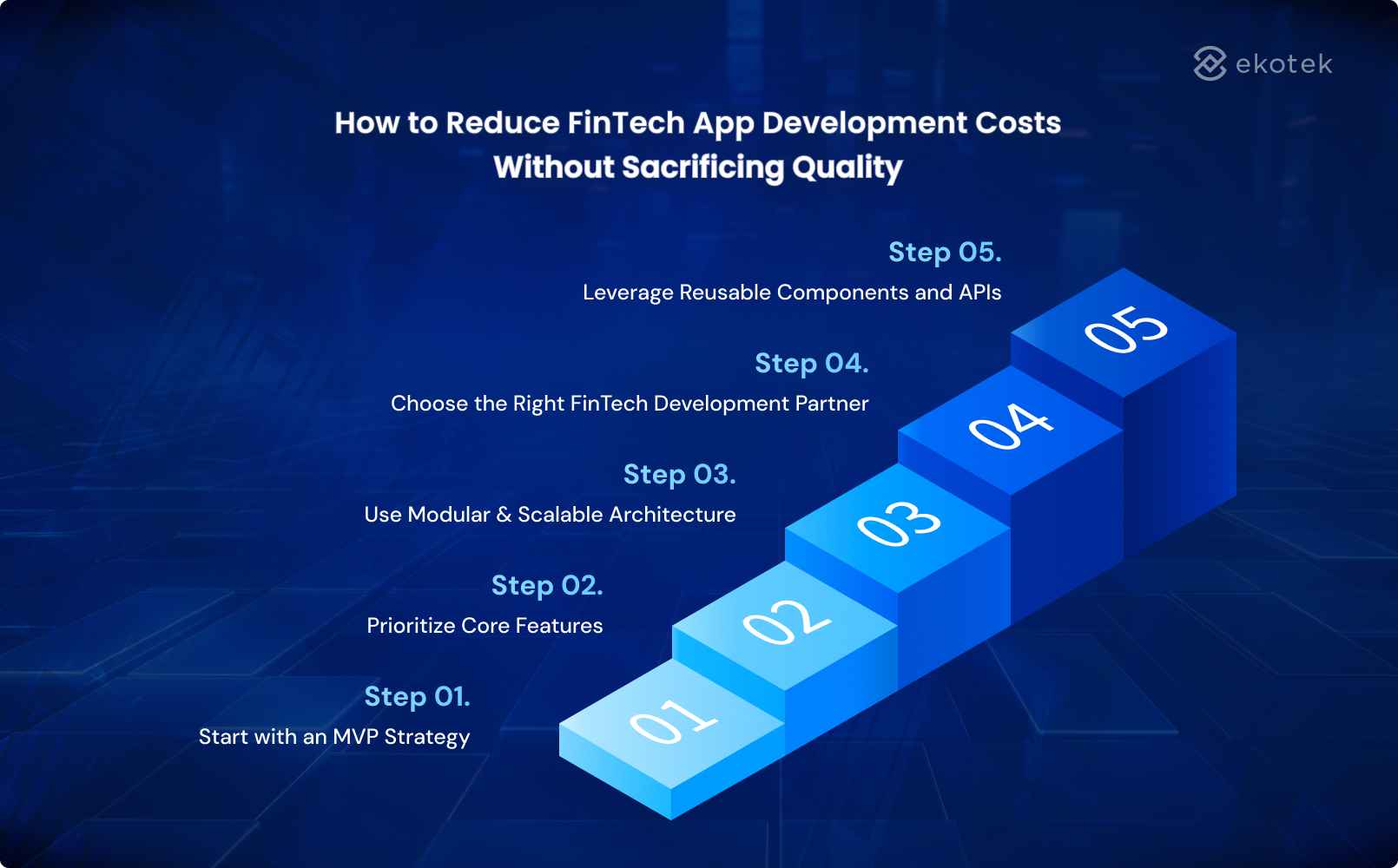
How to Reduce FinTech App Development Costs Without Sacrificing Quality
Reducing fintech app development cost does not mean cutting corners on security, compliance, or performance. The most effective cost optimization strategies focus on building smarter, not cheaper, while maintaining long-term product quality.
Start with an MVP Strategy
Launching with an MVP allows businesses to validate core assumptions, test market demand, and gather user feedback before committing to a full-scale investment. This approach minimizes upfront cost and reduces the risk of overbuilding.
Prioritize Core Features
Not all features deliver equal business value. Focusing on essential functionality first helps control scope, shorten development timelines, and allocate budget to the areas that matter most for early adoption and revenue.
Use Modular & Scalable Architecture
Modular system design enables teams to add or modify features without rebuilding the entire platform. While it may require more planning upfront, a scalable architecture reduces long-term development and maintenance costs.
Choose the Right FinTech Development Partner
An experienced fintech development partner brings domain knowledge, proven processes, and awareness of regulatory requirements. This reduces rework, speeds up development, and helps avoid costly compliance or security issues.
💡 Discover best practices for software outsourcing vendor selection
Leverage Reusable Components and APIs
Using pre-built components, SDKs, and trusted third-party APIs for payments, identity verification, and data services can significantly reduce development time and cost while maintaining reliability and compliance.
Conclusion: Planning Your FinTech App Development Budget Effectively
Planning a fintech app development budget requires more than estimating development hours. As outlined in this guide, fintech app development cost is shaped by multiple factors, from app type and feature complexity to security, compliance, technology stack, platform strategy, and team model. Companies that clearly define scope, prioritize core features, and account for hidden costs are far more likely to deliver secure, scalable fintech products on time and within budget.
Partnering with the right technology provider is a critical part of this process. Ekotek is a leading software development firm specializing in digital transformation, AI, and blockchain, with a team of 200+ experienced engineers and deep domain expertise in fintech. Ekotek has successfully delivered a wide range of fintech solutions, including payment gateways, core banking systems, embedded finance platforms, and more across multiple technology stacks.
In addition to custom development, Ekotek also offers ready-made fintech solutions that accelerate time-to-market while remaining flexible enough to be tailored to specific business needs. This approach helps organizations reduce development cost, minimize risk, and scale faster without compromising quality or compliance.
Ready to estimate your fintech app development cost with confidence?
👉 Talk to Ekotek’s fintech experts today to get a custom cost assessment and development roadmap tailored to your business goals