

Introduction
As Web3 adoption grows across industries, enterprises are increasingly challenged by the complexity of decentralized systems, particularly when it comes to automation, scalability, and real-time decision-making. While blockchain enables transparency and trust, it often lacks the intelligence required to manage risk, optimize operations, and adapt to dynamic market conditions. This is where AI in Web3 is emerging as a critical capability for organizations looking to move beyond experimental implementations.
This article will explore how AI and Web3 work together, the key business-driven use cases of AI in Web3, and the tangible benefits enterprises can achieve by integrating intelligence into decentralized architectures. It also outlines practical considerations for building AI-powered Web3 applications effectively, helping decision-makers assess whether this investment aligns with their technology strategy and long-term business goals.
Difference Between Traditional AI and Decentralized AI
The distinction between traditional (centralized) AI approaches and decentralized AI within the Web3 business strategy context is pivotal for forward-thinking organizations. Understanding this difference helps executives and managers make informed decisions about agility, security, and scalability.
Traditional AI
Traditional AI relies on centralization, companies collect and control large datasets, execute machine learning in cloud silos, and keep control within platform boundaries. This setup inherently creates data bottlenecks, exposes organizations to privacy risks, and restricts cross-industry innovation. Worse, proprietary AI models heighten risks around vendor lock-in and lack transparency, challenging compliance in an era of increasing regulation.
Decentralized AI
In contrast, decentralized AI (the model powering AI in Web3 solutions) transforms the landscape by empowering users and enterprises to own and manage their data. Data is distributed, often stored on blockchain or decentralized file systems. Decisions and computations can be made on-chain, supporting iron-clad transparency and verifiability. For organizations, this shift means improved security, trust among stakeholders, and the ability to scale AI-driven applications without ceding control to a third party.
2026’s business landscape is already being shaped by market drivers such as rising privacy expectations and the need for multi-stakeholder trust, making decentralization not just a technology choice, but a business imperative.
Key Comparison Table
| Aspect | Traditional (Centralized) AI | Decentralized AI (Web3) |
|---|---|---|
| Data Ownership | Centralized (provider-controlled) | Distributed (user/enterprise) |
| Transparency | Generally black-box | On-chain, auditable |
| Scalability | Vendor/platform-bound | Peer-driven, cross-ecosystem |
| Security | Perimeter-based, breach-prone | Built-in cryptographic security |
| Trust | Reliant on provider | Established via protocol |
| Compliance | Restrictive for privacy laws | Supports regulatory objectives |
👉 Explore how Blockchain for Business can drive real enterprise value
Architecture: How AI and Web3 Work Together
Successfully implementing AI in Web3 requires a carefully designed architecture that balances decentralization, performance, and security. Unlike traditional systems, Web3 environments impose constraints on computation, storage, and execution, making architectural decisions a critical factor in long-term scalability and cost efficiency.
On-Chain vs. Off-Chain AI Processing
Due to computational and cost limitations, AI model training and inference are typically performed off-chain, where scalability and performance can be optimized. The results of AI processing, such as predictions, risk scores, or decision signals are then verified and executed on-chain through smart contracts. This hybrid approach allows enterprises to leverage advanced AI capabilities while preserving the transparency, immutability, and trust guarantees of blockchain systems.
AI Models, Oracles, and Smart Contracts
AI models do not interact directly with blockchains. Oracles act as trusted communication layers that deliver AI-generated outputs to smart contracts in a verifiable manner. Smart contracts then enforce business logic automatically, ensuring that AI-driven decisions are executed consistently and without centralized control. This architecture is essential for use cases such as automated compliance checks, fraud detection, and intelligent financial protocols.
Data Pipelines and Decentralized Storage
High-quality data is the foundation of effective AI in Web3. Data pipelines must aggregate information from on-chain transactions, off-chain sources, and external systems, while maintaining data integrity and provenance. Decentralized storage solutions are commonly used to ensure availability, tamper resistance, and transparency, key requirements for enterprise-grade Web3 applications.
Infrastructure Overview: Blockchain and AI Stack
At an infrastructure level, AI-powered Web3 applications combine blockchain networks, smart contract platforms, decentralized storage, oracle services, and AI frameworks into a unified stack. Designing this architecture correctly is crucial to managing operational complexity, controlling costs, and ensuring that AI-driven Web3 solutions remain secure, scalable, and compliant as they grow.
👉 See how Crypto AI Agents can optimize decentralized operations
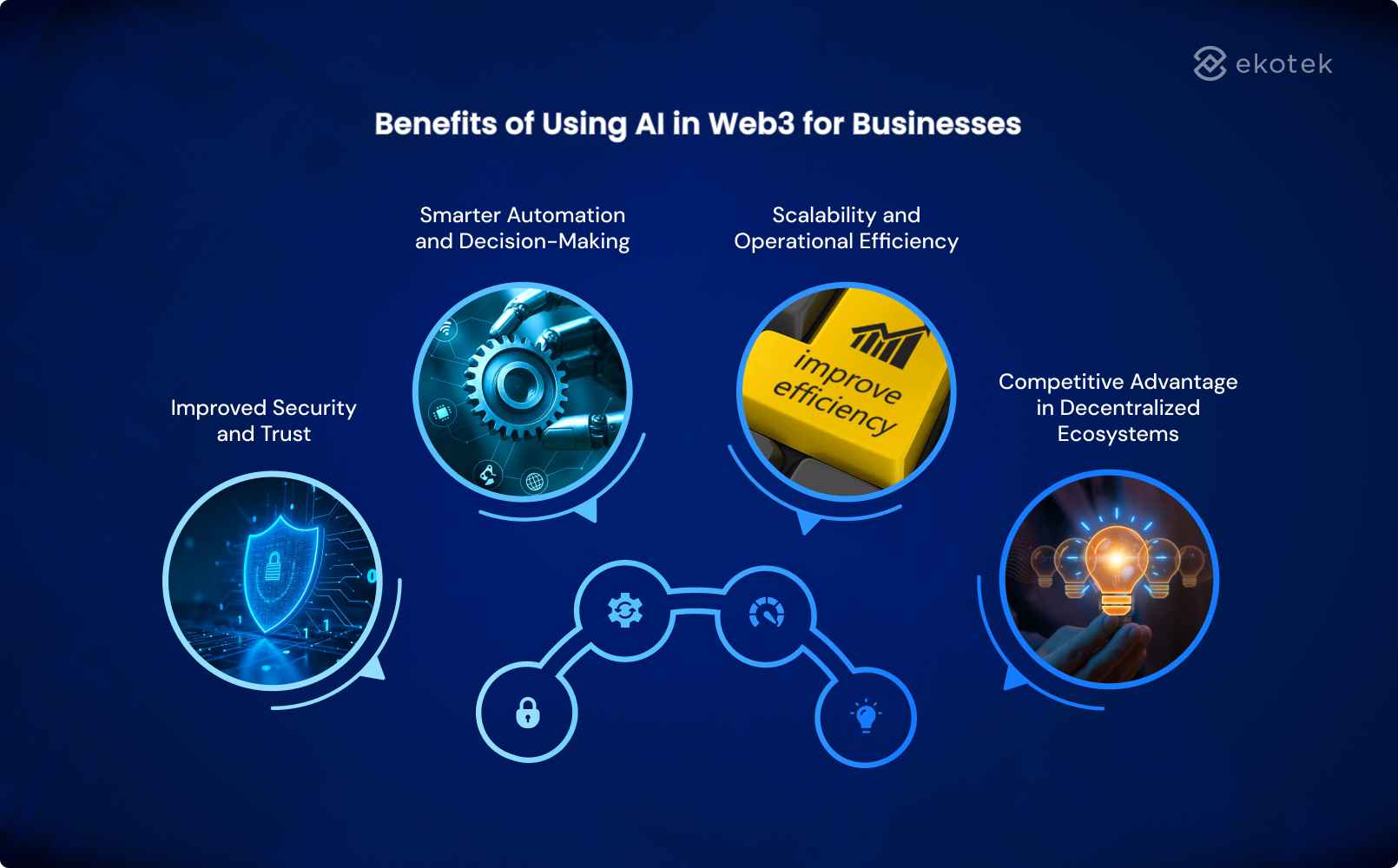
Benefits of Using AI in Web3 for Businesses
Enterprises investing in AI in Web3 are seeing a new spectrum of quantifiable benefits, many of which map directly to critical business KPIs like fraud reduction, automation speed, trust, and customer engagement.
Improved Security and Trust
Security remains one of the most critical concerns in Web3 ecosystems. AI enhances traditional blockchain security by enabling real-time anomaly detection, behavioral analysis, and predictive threat identification. By continuously monitoring on-chain and off-chain activities, AI-powered systems can identify fraudulent transactions, malicious actors, and protocol vulnerabilities before they escalate. This proactive approach strengthens trust among users, partners, and regulators, an essential factor for enterprise adoption.
Smarter Automation and Decision-Making
AI in Web3 enables intelligent automation that goes far beyond predefined rules. Smart contracts can incorporate AI-driven insights to adapt execution logic based on risk scores, market conditions, or user behavior. This allows businesses to automate complex decision-making processes while maintaining transparency and auditability, reducing manual intervention and minimizing human error.
👉 A closer look at Blockchain in Manufacturing for enterprises
Scalability and Operational Efficiency
As Web3 platforms scale, operational complexity and costs increase rapidly. AI helps enterprises optimize resource allocation, streamline workflows, and manage decentralized operations more efficiently. By automating monitoring, optimization, and exception handling, organizations can scale their Web3 applications without proportionally increasing operational overhead.
Competitive Advantage in Decentralized Ecosystems
Enterprises that successfully integrate AI into Web3 gain a clear competitive edge. AI-powered Web3 applications are more adaptive, resilient, and data-driven, enabling faster innovation and differentiated user experiences. In increasingly crowded decentralized markets, this intelligence layer can become a decisive factor in attracting users, capital, and strategic partnerships.
Key Use Cases of AI in Web3 (Business-Driven)
The adoption of AI in Web3 is being driven by concrete business applications rather than theoretical advantages. Enterprises are increasingly deploying AI to enhance how decentralized systems execute logic, manage risk, and generate actionable insights across Web3 platforms.
AI-Powered Smart Contracts
Traditional smart contracts execute predefined rules without context awareness. By integrating AI-driven inputs, smart contracts can become adaptive, adjusting execution based on risk assessments, user behavior, or external conditions. This enables use cases such as dynamic pricing, automated compliance enforcement, and context-aware transaction approval, particularly in complex enterprise workflows.
For example, Fetch.ai uses autonomous AI agents to execute on-chain actions dynamically, supporting use cases such as automated coordination and decentralized service optimization.
👉 Additional insights on enterprise AI integration
Fraud Detection and Security in Web3
AI plays a critical role in identifying suspicious activities across decentralized networks. By analyzing transaction patterns, wallet behavior, and protocol interactions, AI systems can detect fraud, exploits, and abnormal behavior in near real time. These insights can trigger automated responses via smart contracts or alert security teams before financial losses occur.
Forta applies machine learning to detect exploits and suspicious behavior, allowing Web3 platforms to respond before attacks cause significant losses.
Decentralized Data Analytics and Prediction
Web3 ecosystems generate large volumes of on-chain and off-chain data that are often underutilized. AI enables enterprises to extract predictive insights from decentralized data, such as user behavior trends, network performance forecasting, and market movement predictions. These analytics support better strategic planning and product optimization in decentralized environments.
The Graph provides structured blockchain data that enterprises can combine with AI models to generate insights for forecasting, analytics, and product optimization.
AI in DeFi Platforms
In decentralized finance, AI is increasingly used for risk scoring, liquidity optimization, and yield strategy management. AI models can evaluate market volatility, user risk profiles, and protocol health to support automated portfolio rebalancing, dynamic interest rates, and more resilient DeFi mechanisms, helping platforms manage risk while improving capital efficiency.
AI for DAOs and Governance
Decentralized Autonomous Organizations face challenges in decision-making at scale. AI supports DAOs by analyzing proposals, voting patterns, and historical outcomes to provide data-driven recommendations. This enables more informed governance, reduces decision fatigue, and improves the effectiveness of decentralized coordination without undermining transparency or autonomy.
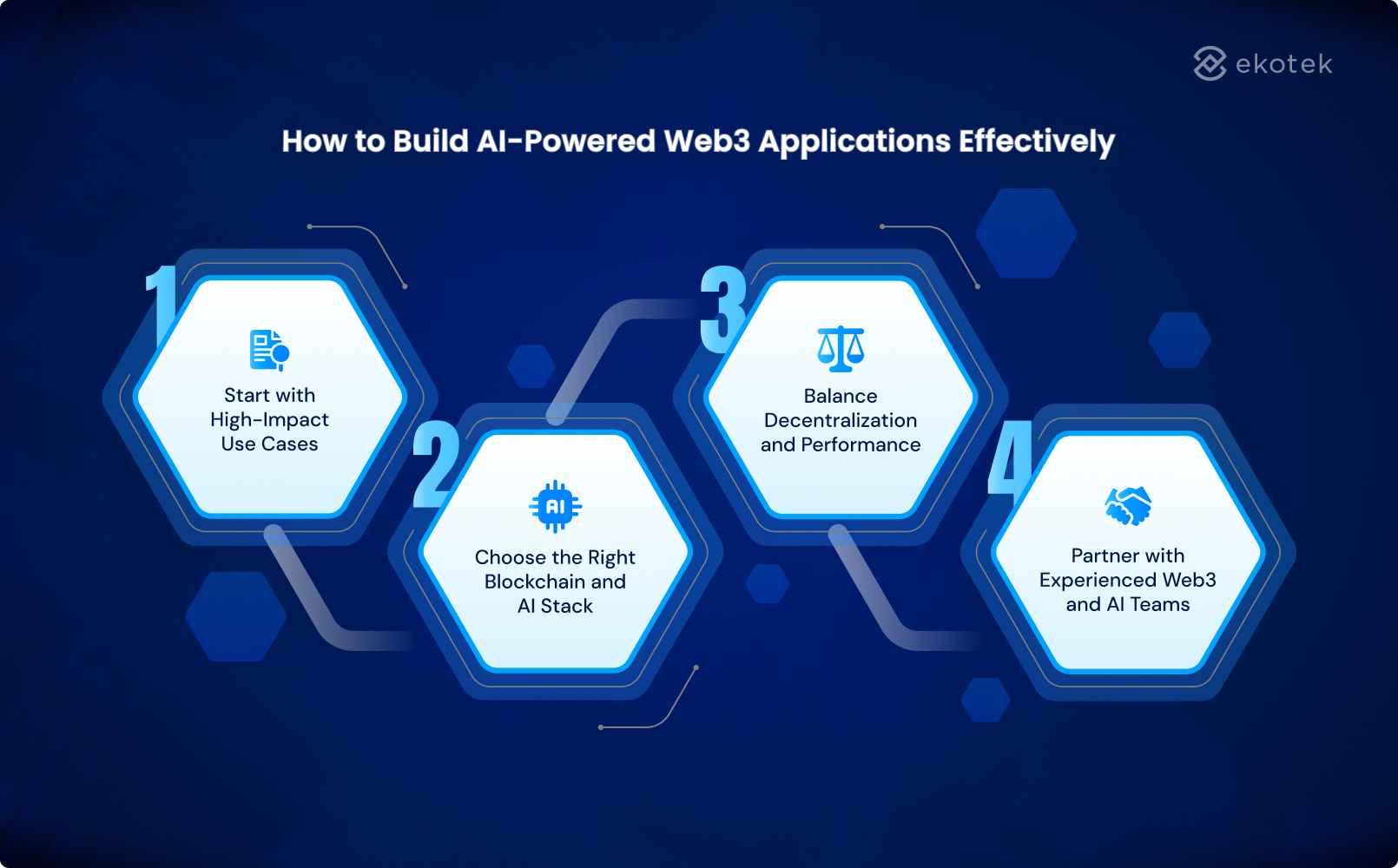
How to Build AI-Powered Web3 Applications Effectively
Start with High-Impact Use Cases
Rather than attempting to decentralize and automate everything at once, organizations should begin with use cases that deliver clear and measurable business impact. Common starting points include fraud detection, risk scoring, and intelligent automation in high-value workflows, where AI can demonstrate ROI early and justify further investment.
Choose the Right Blockchain and AI Stack
Not all blockchains and AI frameworks are suited for enterprise-grade applications. Key considerations include transaction throughput, cost, ecosystem maturity, and integration capabilities with AI infrastructure. Selecting the right combination of blockchain networks, AI models, data services, and oracle solutions is essential to avoid architectural bottlenecks and unnecessary technical debt.
Balance Decentralization and Performance
Full decentralization often comes with trade-offs in speed and cost. Effective AI-powered Web3 architectures adopt a hybrid approach, keeping compute-intensive AI processing off-chain while preserving on-chain transparency and trust. This balance enables enterprises to meet performance requirements without compromising the core principles of Web3.
Partner with Experienced Web3 and AI Teams
Given the complexity of combining AI and decentralized systems, execution risk is high without the right expertise. Partnering with teams that have hands-on experience in both Web3 and AI helps enterprises accelerate development, avoid costly design mistakes, and move from proof of concept to production-ready solutions with confidence.
Challenges and Risks of Implementing AI in Web3
While AI in Web3 offers significant potential, enterprises must be aware of the challenges and risks involved before moving into large-scale deployment. Understanding these risks early helps organizations make informed decisions and design more resilient systems.
Data Availability and Quality
AI models rely on high-quality data, yet Web3 data is often fragmented across on-chain transactions, off-chain systems, and decentralized storage. Inconsistent formats, limited historical data, and data integrity issues can reduce model accuracy and reliability if not addressed through robust data pipelines and validation mechanisms.
Model Transparency and Explainability
In decentralized environments, opaque “black-box” AI models can undermine trust and governance. Enterprises may struggle to justify or audit AI-driven decisions executed by smart contracts, especially in regulated contexts. Ensuring model explainability and traceability is critical for maintaining accountability and stakeholder confidence.
Security and Adversarial Attacks
AI systems in Web3 are exposed to unique attack vectors, including data poisoning, model manipulation, and oracle exploitation. Adversarial actors can attempt to influence AI outputs to trigger unintended on-chain actions, making security design and continuous monitoring essential components of any AI-powered Web3 architecture.
Regulatory and Compliance Concerns
The intersection of AI and Web3 raises complex regulatory questions around data usage, automated decision-making, and financial compliance. Enterprises must consider evolving regulations across jurisdictions and ensure that AI-driven Web3 solutions align with legal, ethical, and governance requirements to avoid long-term operational and reputational risks.
Conclusion: Is AI in Web3 Worth the Investment?
AI in Web3 is becoming a practical enabler for enterprises seeking smarter automation, stronger security, and scalable decision-making in decentralized environments. As discussed throughout this article, AI enhances Web3 architectures by improving how smart contracts execute, how risks are managed, and how data is transformed into actionable insights. However, realizing these benefits requires clear use cases, the right architecture, and a strong understanding of both AI and blockchain trade-offs.
Ekotek is a leading software development company in Vietnam, specializing in digital transformation, blockchain, and AI development. With a team of over 200 engineers and deep expertise across both blockchain and AI, Ekotek has successfully delivered solutions for industries such as manufacturing, banking and finance, healthcare, and logistics.
Ekotek provides a full range of services, from AI agents and generative AI to dApp development and blockchain-AI integration, along with ready-made solutions that accelerate time-to-market while remaining fully customizable to enterprise needs.
If you are exploring AI-powered Web3 solutions and want to move from strategy to execution with confidence, contact Ekotek to discuss how your organization can turn AI in Web3 into a real competitive advantage.