Predictive Analytics in Corporate Finance: What is it and How is it Used?

Picture of Ngoc Lam
저자
게시됨
8 mins read
Table of Contents

Introduction

In today’s volatile and data-intensive business environment, corporate finance teams face growing pressure to forecast accurately and respond quickly to change. Traditional planning models often rely on static assumptions and historical data, limiting their ability to support strategic decisions. Predictive Analytics in Corporate Finance enables enterprises to move beyond reactive reporting toward forward-looking, data-driven insights. By applying advanced analytics and machine learning to financial and operational data, organizations can anticipate risks, optimize capital allocation, and improve decision-making speed. This blog explores how Predictive Analytics in Corporate Finance works, its key business applications, and the strategic value it delivers for modern enterprises

The Limitations of Traditional Financial Forecasting

Despite being deeply embedded in corporate finance processes, traditional financial forecasting methods are increasingly unable to meet the demands of modern enterprises. Many organizations still rely on legacy tools and manual workflows that were not designed for today’s dynamic, data-rich environment.

Spreadsheet-driven planning issues remain one of the most common challenges. While spreadsheets offer flexibility, they are highly error-prone, difficult to scale, and hard to govern across large organizations. Version conflicts, manual data entry, and limited auditability often lead to inconsistent forecasts and reduced confidence in financial outputs.

Another critical limitation lies in static assumptions and human bias. Traditional forecasts are typically built on fixed assumptions that quickly become outdated as market conditions change. Human judgment, while valuable, can introduce cognitive bias, overconfidence, or conservative estimates that distort financial projections and weaken strategic decisions.

Traditional forecasting models also show a clear inability to process big data and real-time signals. They struggle to integrate large volumes of structured and unstructured data from ERP systems, CRM platforms, market feeds, and operational sources. As a result, finance teams miss early warning signals and emerging trends that could materially impact performance.

Finally, these approaches suffer from a slow response to market volatility. Updating forecasts often requires manual rework and lengthy approval cycles, preventing finance leaders from reacting quickly to economic shifts, demand fluctuations, or competitive pressure. In an environment where agility is critical, such delays can translate directly into financial risk and lost opportunities.

⭐️ Read more about Digital Transformation in Banking

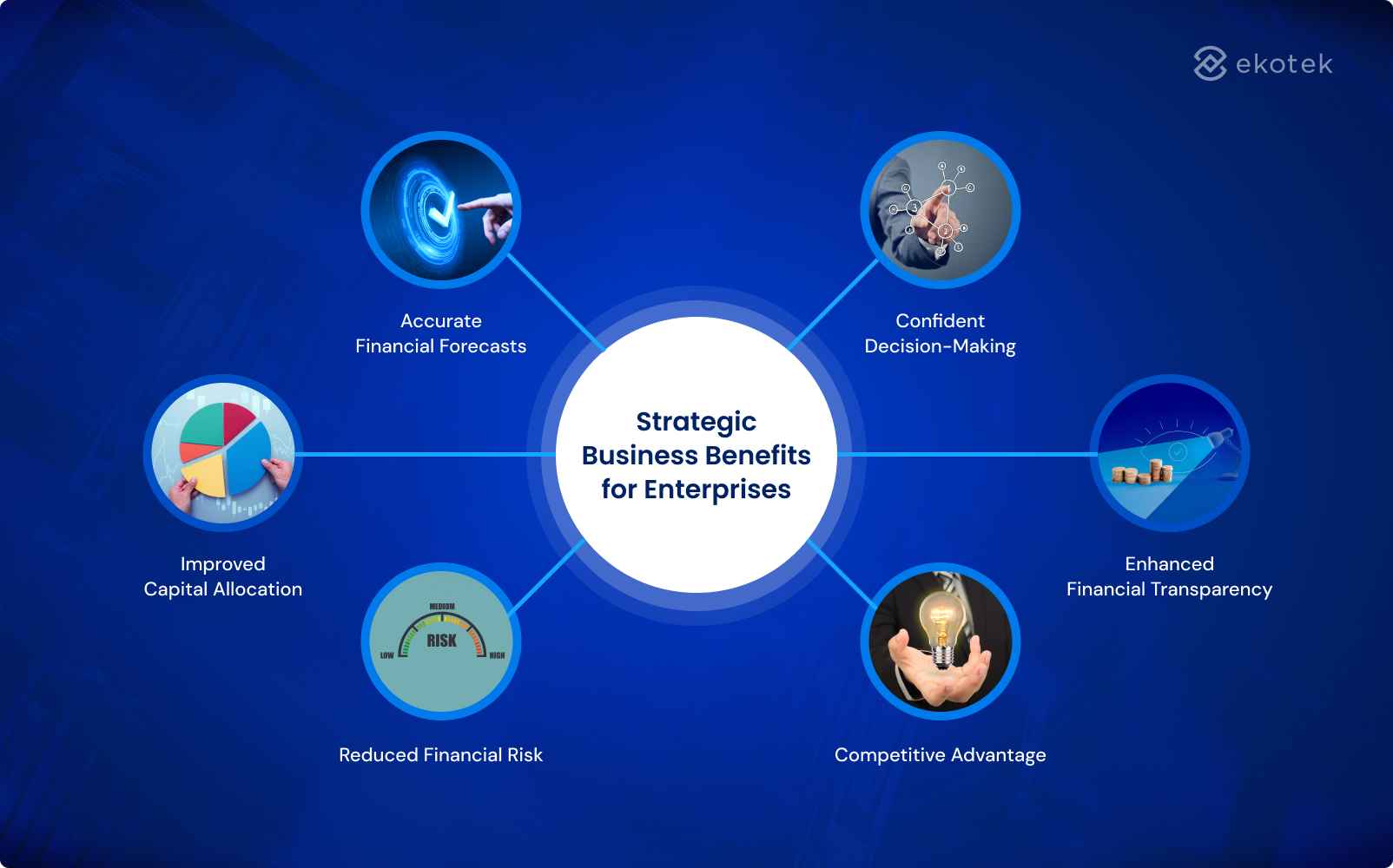
Strategic Business Benefits for Enterprises

Predictive analytics delivers tangible, business-focused value by enabling finance teams to operate with greater accuracy, speed, and strategic impact. Below are the key benefits enterprises gain when applying predictive analytics in corporate finance.

More Accurate Financial Forecasts

Predictive models continuously analyze historical data, current performance, and external signals to improve forecast reliability.

  • Reduce forecast errors caused by manual assumptions

  • Adapt forecasts dynamically as conditions change

  • Increase leadership confidence in financial projections

Improved Capital Allocation

With clearer visibility into future performance, enterprises can allocate capital more strategically.

  • Prioritize high-return investments

  • Optimize working capital and cash usage

  • Avoid over-investment or resource misalignment

Reduced Financial Risk

Predictive analytics helps identify risks before they materialize.

  • Detect early warning signals for liquidity or revenue shortfalls

  • Model downside scenarios and stress-test assumptions

  • Strengthen risk mitigation and contingency planning

Faster, More Confident Decision-Making

Real-time insights enable leaders to act quickly and decisively.

  • Shorten financial planning and forecast cycles

  • Support data-driven executive decisions

  • Respond rapidly to market and operational changes

Ekotek developed a Financial Report Inspection System for a client to automate financial report analysis and accelerate executive decision-making. The AI-powered solution extracts and validates complex financial data, detects anomalies, and supports natural language queries for faster insight generation. By integrating predictive modeling, the system enables leadership teams to assess potential financial and valuation impacts in near real time, significantly improving both decision speed and confidence.

Contact us to learn more about our case studies

Enhanced Financial Transparency & Governance

Standardized, data-driven forecasting improves financial control and accountability.

  • Improve data consistency across finance teams

  • Enable auditability and regulatory compliance

  • Strengthen trust in financial reporting

Competitive Advantage Through Predictive Insights

Enterprises that anticipate change outperform those that react late.

  • Identify emerging opportunities ahead of competitors

  • Align financial strategy with business growth initiatives

  • Turn corporate finance into a strategic differentiator

⭐️ Go deeper into Enterprise Fintech Adoption and unlock the next phase of enterprise financial innovation

Strategic Business Benefits for EnterprisesKey Applications of Predictive Analytics in Corporate Finance

In corporate finance, predictive analytics is applied directly to core financial processes where accuracy, timing, and scenario visibility are critical. Rather than replacing finance expertise, these applications augment decision-making with forward-looking intelligence.

Revenue Forecasting

Predictive analytics is used to forecast revenue by modeling historical sales, pipeline data, customer behavior, and market trends.

  • Project revenue by product, region, customer segment, or channel

  • Identify early signals of demand shifts or revenue risk

  • Continuously update forecasts as new data becomes available

Global retailers like Amazon apply predictive analytics to forecast revenue across regions and product categories by combining purchase history, seasonality, and demand signals. This allows finance teams to adjust forecasts continuously as customer behavior changes.

Cash Flow Prediction

Finance teams apply predictive models to anticipate future cash positions and liquidity needs.

  • Predict cash inflows and outflows over short- and long-term horizons

  • Monitor payment behavior and receivables risk

  • Support treasury planning and funding decisions

Budgeting and Financial Planning

Predictive analytics enables more dynamic and adaptive financial planning processes.

  • Support rolling forecasts instead of static annual budgets

  • Simulate the financial impact of business initiatives

  • Align financial plans with operational and strategic drivers

Companies like Unilever use predictive analytics to shift from static annual budgets to rolling forecasts, allowing finance teams to reallocate budgets based on real-time performance and changing market conditions.

Cost Optimization & Profitability Analysis

Advanced analytics is applied to understand cost behavior and profitability drivers.

  • Model cost structures under different operating scenarios

  • Analyze profitability by product, customer, or business unit

  • Identify cost anomalies and efficiency improvement opportunities

Telecommunications companies such as AT&T analyze network usage, maintenance costs, and customer profitability to predict cost trends and identify areas for optimization, helping improve margin management.

Risk Management & Scenario Modeling

Predictive analytics plays a central role in financial risk analysis and stress testing.

  • Model downside, upside, and disruption scenarios

  • Quantify financial exposure to market, credit, or operational risks

  • Support contingency planning and executive risk assessments

Mergers & Acquisitions (M&A) Valuation Support

In M&A activities, predictive analytics supports more data-driven valuation and due diligence.

  • Forecast post-merger financial performance

  • Evaluate synergy realization and integration risks

  • Test valuation assumptions under multiple scenarios

⭐️ Stay ahead of the curve, explore the latest Fintech Trends

How Predictive Analytics Works in a Corporate Finance Environment

In a corporate finance environment, predictive analytics operates as an end-to-end process that transforms raw enterprise data into forward-looking financial insights. Rather than a single tool, it is an integrated workflow combining data, analytics models, and decision-support systems.

Data Sources: ERP, CRM, Market Data, Operational Systems

The process begins with data collection from multiple enterprise systems.

  • ERP systems provide financial data such as general ledger, accounts payable/receivable, and budgeting information

  • CRM platforms contribute sales pipeline, customer behavior, and revenue drivers

  • Market and external data add macroeconomic indicators, pricing trends, and industry benchmarks

  • Operational systems supply production, supply chain, and project-level data that directly impact financial outcomes

Data Integration & Cleansing

Once collected, data is integrated into a centralized analytics environment.

  • Consolidate data across systems and business units

  • Cleanse, standardize, and normalize data to ensure consistency

  • Resolve data quality issues such as duplicates, missing values, and timing mismatches

This step is critical, as predictive accuracy depends heavily on data reliability.

Model Development & Validation

With clean data in place, predictive models are developed to forecast financial outcomes.

  • Apply statistical methods and machine learning algorithms to identify patterns and drivers

  • Train models using historical data and test them against known outcomes

  • Validate models for accuracy, bias, and stability before production use

Finance and data teams collaborate closely to ensure models align with business logic.

Scenario Simulation & Stress Testing

Predictive analytics enables finance teams to simulate multiple future scenarios.

  • Model best-case, worst-case, and most-likely financial outcomes

  • Stress-test assumptions such as demand shifts, cost inflation, or interest rate changes

  • Quantify the financial impact of strategic decisions under uncertainty

This allows leadership to evaluate trade-offs before committing resources.

Real-Time Dashboards & Executive Reporting

Finally, predictive insights are delivered through intuitive dashboards and reports.

  • Visualize forecasts, risks, and scenarios in near real time

  • Enable executives to drill down into key drivers and assumptions

  • Support faster, data-driven decisions across the organization

How to Successfully Implement Predictive Analytics in Corporate Finance

Successfully implementing predictive analytics in corporate finance requires more than deploying new technology. It demands a structured approach that aligns analytics capabilities with financial strategy, data readiness, and business priorities.

Define Strategic Finance Objectives

Implementation should begin with clear, business-driven objectives.

  • Identify the financial decisions that need better forward-looking insight

  • Align predictive analytics initiatives with enterprise goals such as growth, risk reduction, or capital efficiency

  • Ensure executive sponsorship from finance and business leadership

Clear objectives prevent analytics efforts from becoming isolated or purely technical projects.

Assess Current Data & Analytics Maturity

Enterprises must evaluate their readiness before scaling predictive analytics.

  • Review data availability, quality, and governance across finance and operational systems

  • Assess existing analytics capabilities, tools, and skills

  • Identify gaps that could limit model accuracy or adoption

Select the Right Technology & Implementation Partner

Choosing the right platform and partner is critical to long-term success.

  • Select analytics technologies that integrate with existing ERP and data environments

  • Ensure scalability, security, and enterprise-grade governance

  • Work with implementation partners who understand both finance processes and advanced analytics

For enterprises seeking a proven partner, Ekotek brings deep experience in both predictive AI and fintech, enabling organizations to design, implement, and scale predictive analytics solutions tailored to complex corporate finance environments. With strong domain expertise and hands-on delivery capabilities, Ekotek helps bridge the gap between advanced analytics and real-world financial decision-making

Start with High-Impact Use Cases

Rather than attempting a broad rollout, enterprises should focus on targeted applications.

  • Prioritize use cases with clear business value, such as cash flow forecasting or revenue prediction

  • Deliver quick wins to build confidence and stakeholder buy-in

  • Use early successes to expand analytics across additional finance functions

Measure ROI and Continuously Optimize Models

Predictive analytics is an ongoing capability, not a one-time deployment.

  • Track performance metrics such as forecast accuracy, decision cycle time, and financial impact

  • Monitor model performance as business conditions evolve

  • Continuously retrain and refine models using new data

How to Successfully Implement Predictive Analytics in Corporate FinanceConclusion

Predictive Analytics in Corporate Finance enables enterprises to move beyond traditional forecasting by delivering more accurate insights, proactive risk management, and data-driven financial decision-making. By embedding predictive analytics into core finance processes, organizations can improve planning agility, optimize capital allocation, and respond faster to market volatility. As financial complexity continues to grow, predictive capabilities are becoming essential for modern corporate finance functions.

To successfully unlock this value, enterprises need a trusted technology partner with both deep technical expertise and real-world industry experience. Ekotek is a leading software development firm in Vietnam, specializing in AI, blockchain, and digital transformation. We have a proven track record of delivering predictive analytics and fintech solutions for global clients across industries such as banking and finance, retail, manufacturing, and education. Backed by a highly skilled engineering team proficient in modern tech stacks, Ekotek is able to deliver high-quality solutions quickly while meeting enterprise-grade standards.

Looking to implement Predictive Analytics in Corporate Finance?

Partner with Ekotek to turn advanced analytics into practical and high-impact financial solutions

Talk to us

FAQ on Predictive Analytics in Corporate Finance

1. How is predictive analytics different from descriptive and diagnostic analytics in corporate finance?

Predictive analytics focuses on forecasting future financial outcomes, while descriptive analytics explains what happened and diagnostic analytics identifies why it happened

2. Do enterprises need a large data science team to adopt predictive analytics in corporate finance?

Not necessarily. Many enterprises start with small, cross-functional teams and leverage external expertise or platforms to accelerate adoption without building large in-house teams

3. Can predictive analytics in corporate finance support both short-term and long-term planning?

Yes. Predictive models can be designed to support short-term operational forecasts as well as long-term strategic financial planning using different time horizons and assumptions

4. How does predictive analytics handle uncertainty in corporate finance decision-making?

Predictive analytics incorporates probability, scenario modeling, and sensitivity analysis to help finance leaders understand uncertainty and evaluate potential financial outcomes

공유하기
Facebook
Twitter
LinkedIn
최고의 인사이트를 이메일로 받아보세요

    관련 게시물

    저희가 어떻게 도와드릴 수 있는지 확인해 보세요!

    베트남 아웃소싱을 고려하고 계신가요?

    베트남의 주요 21개 아웃소싱 회사를 모든 분야와 산업별로 다룬 가이드와 함께 귀사에 가장 적합한 회사를 찾아보세요.
    Table of Contents

    저희가 어떻게 도와드릴 수 있는지 확인해 보세요!

    전략 상담 예약을 위해 이메일을 남겨주세요 – 전액 무료로 제공됩니다!

      Dylan Dong Do
      최고경영자
      딜런 동 도
      Dylan Dong Do는 제품 및 ITO 기업 전반에 걸쳐 15년 이상의 경영 경험을 보유한 숙련된 리더입니다. 그의 리더십 하에 Ekotek은 5년 만에 소규모 팀에서 200명 이상의 숙련된 전문가들로 구성된 번창하는 조직으로 성장하였습니다.

      Dylan의 경력 전반에 걸쳐 그는 놀라운 성과를 달성해 왔습니다. 2009년에는 batdongsan.com.vn 개발에 핵심적인 역할을 하여 베트남 최고의 부동산 매물 플랫폼으로 자리매김하였습니다. 2018년에는 VTI의 Chief Operating Officer로 승진하여 30명 규모의 팀을 300명이 넘는 강력한 조직으로 성장시키는 데 기여하였습니다.

      기술 혁신을 일상생활에 통합하고자 하는 열망으로 Dylan Dong Do는 Ekotek을 설립하였습니다. 그는 회사의 방향성을 설정하기 위해 첨단 기술에 대한 지식과 기술을 꾸준히 업데이트하여 글로벌 트렌드에 부응하고 고객의 요구에 더욱 효과적으로 대응할 수 있도록 하고 있습니다.