LLM Chatbot: The Future Of Intelligent Customer Engagement For Enterprises

Picture of Ngoc Lam
저자
게시됨
8 mins read
Table of Contents

Modern enterprises face mounting pressure to deliver faster, more personalized customer interactions across multiple channels, while keeping operational costs under control. According to Gartner, by 2027, chatbots will handle 70% of all customer conversations in enterprise settings.

A new generation of conversational AI is emerging: the LLM chatbot. Powered by Large Language Models, these tools can understand context, generate human-like responses, and integrate seamlessly with business systems.

In this article, we’ll explore how an LLM chatbot works, the business benefits, real-world use cases, and best practices for successful deployment.

What is an LLM chatbot?

Definition

An LLM chatbot is a conversational system powered by a Large Language Model (LLM), a neural network trained on massive text corpora to predict the next token and thereby generate coherent, context-aware language. In practice, it can understand user intent, maintain context across turns, and produce task-specific responses

  • Typical engines: ChatGPT (OpenAI), Gemini (Google), Claude (Anthropic), and open-source families (Llama, Mistral) via API or on-prem.
  • Enterprise architecture (high level): User channel (web, app, WhatsApp) → Orchestrator → LLM (+ system prompts) → Tools/Connectors (CRM, ERP, knowledge base via retrieval) → Guardrails (policy filters, PII redaction, grounding) → Analytics/Monitoring.

LLM Chatbot vs. Rule-Based Chatbot 

Dimension LLM Chatbot Rule-Based Chatbot
Language understanding Interprets natural, unstructured text; long messages Relies on exact intents; brittle with phrasing changes
Context handling Maintains multi-turn context; can summarize and reference prior steps Limited memory
Adaptability Generalizes to new queries with minimal config New intents/flows require design, training, and testing per path
Answer quality Generates synthesized, fluent responses; can cite sources when grounded Delivers predefined answers; consistent but narrow
Control Probabilistic; needs guardrails, validation, and fallback policies Highly deterministic; easy to audit each branch
Data integration Calls tools/APIs (CRM, ERP, search) at runtime; supports retrieval over docs Usually form-fill and simple API calls inside fixed flows
Maintenance Update knowledge via content pipelines; monitor with evals and feedback Ongoing intent upkeep; frequent script changes across channels
Scalability Handles wide topic coverage without exponential flow growth Complexity scales poorly as intents multiply
Costs Variable (per-token inference + retrieval); optimize via caching, routing, and small models Predictable (platform/license); higher content design labor
Use-case fit Complex FAQs, troubleshooting, document drafting, knowledge search, internal support Narrow flows: password reset, order status with fixed steps

How LLM chatbots work

Data training and language mastery

An LLM is trained on vast and diverse datasets, ranging from public text to domain-specific content, to learn grammar, vocabulary, factual knowledge, and reasoning patterns. For business applications, this base model can be fine-tuned with proprietary company data, ensuring the chatbot understands industry terminology, product details, and customer nuances.

Natural Language Processing (NLP) and context awareness

Unlike rule-based chatbots, LLM chatbots use advanced NLP to interpret user intent, not just keywords. They recognize context from previous messages, adapt responses accordingly, and maintain a natural conversation flow, critical for customer engagement, technical support, or sales interactions.

Integration with business systems

A high-value LLM chatbot connects seamlessly to your CRM, ERP, knowledge base, or external APIs. This integration enables it to:

  • Retrieve up-to-date customer or product data
  • Trigger workflows (e.g: creating a support ticket or generating a quote)
  • Provide personalized, real-time responses instead of static, pre-written answers

Continuous learning and optimization

Effective deployments include a feedback loop: user interactions are monitored, performance is analyzed, and the model is updated to reduce errors and improve accuracy over time. This ensures the chatbot evolves alongside your business goals and customer expectations.

🚀 Make the right choice – learn the differences between chatbots and conversational AI

Key business benefits of LLM chatbots

Key business benefits of LLM chatbotsAlways-on customer service automation

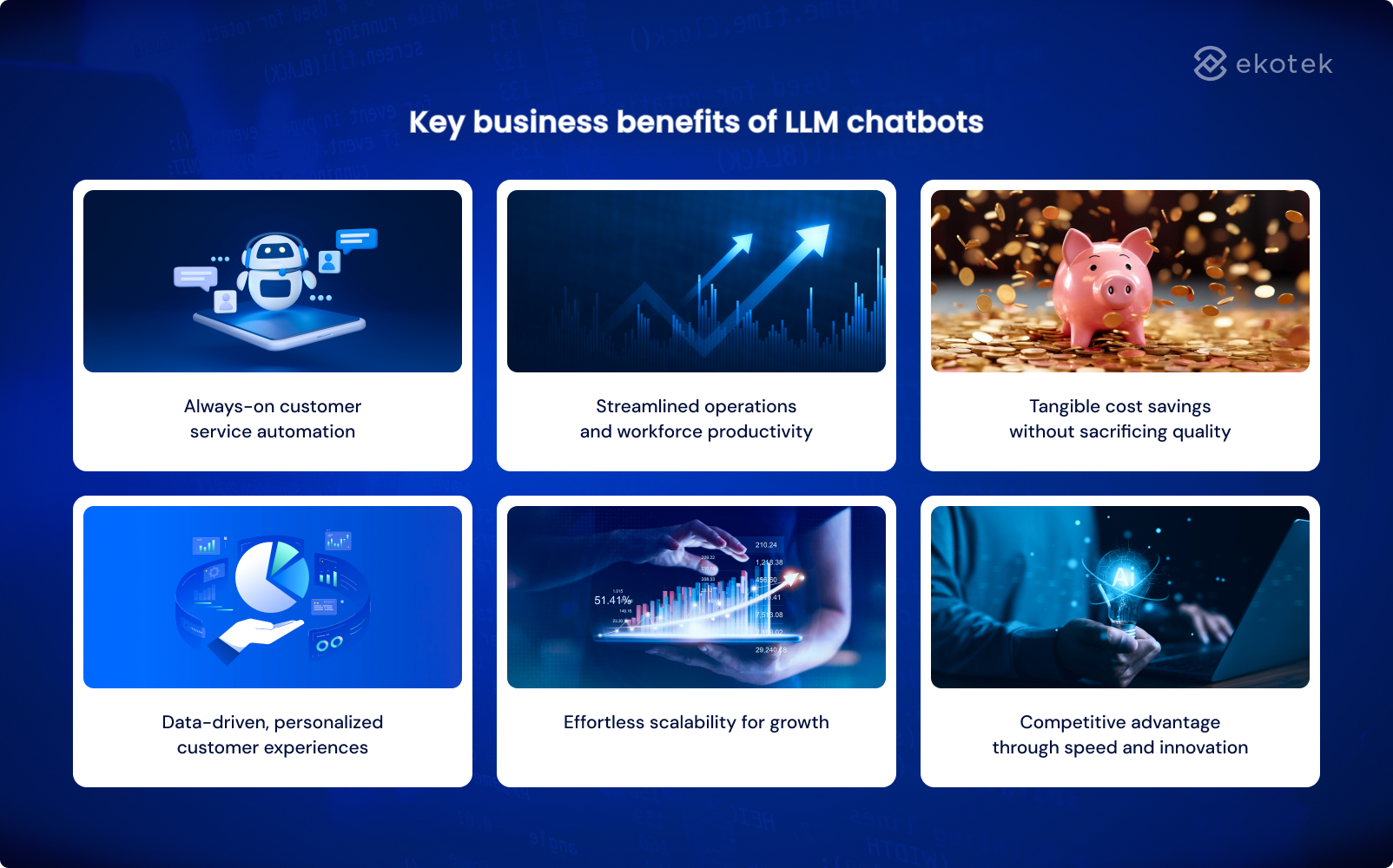
An LLM chatbot provides uninterrupted, 24/7 support without the limitations of human schedules or time zones. It can handle high inquiry volumes instantly, reducing average response times from hours to seconds. This ensures customers always receive timely, accurate assistance, which directly impacts satisfaction and retention rates.

🚀 Reimagine customer engagement by integrating ChatGPT into your service workflows

Streamlined operations and workforce productivity

LLM chatbots can manage a wide range of routine processes, FAQ handling, appointment scheduling, order tracking, internal knowledge lookups, and even compliance checks. By offloading these repetitive tasks, human staff can focus on strategic, revenue-generating activities, accelerating overall business throughput.

Tangible cost savings without sacrificing quality

Replacing or supplementing traditional support teams with an LLM chatbot can reduce operational costs by 30-60% in customer service functions. The technology also minimizes expenses tied to training, onboarding, and turnover, while still delivering consistently high-quality responses.

Data-driven, personalized customer experiences

LLM chatbots leverage customer history, behavioral patterns, and company data to deliver hyper-relevant responses, whether it’s personalized product recommendations, targeted upsell opportunities, or tailored troubleshooting steps. This personalization not only enhances customer trust but also drives higher conversion rates.

Effortless scalability for growth

During seasonal spikes, product launches, or crisis situations, an LLM chatbot can instantly scale to manage thousands of simultaneous conversations without additional hires or infrastructure. This scalability protects service quality during peak demand, keeping both customers and internal teams satisfied.

Competitive advantage through speed and innovation

Early adopters of LLM chatbot technology position themselves ahead of competitors by responding faster, serving more customers, and extracting actionable insights from chat data. These insights can feed back into product development, marketing, and sales strategies, creating a continuous cycle of improvement.

🚀 Learn the key benefits of using ChatGPT-based AI chatbots

Real-world business use cases of LLM chatbots

Real-world business use cases of LLM chatbotsE-commerce and retail

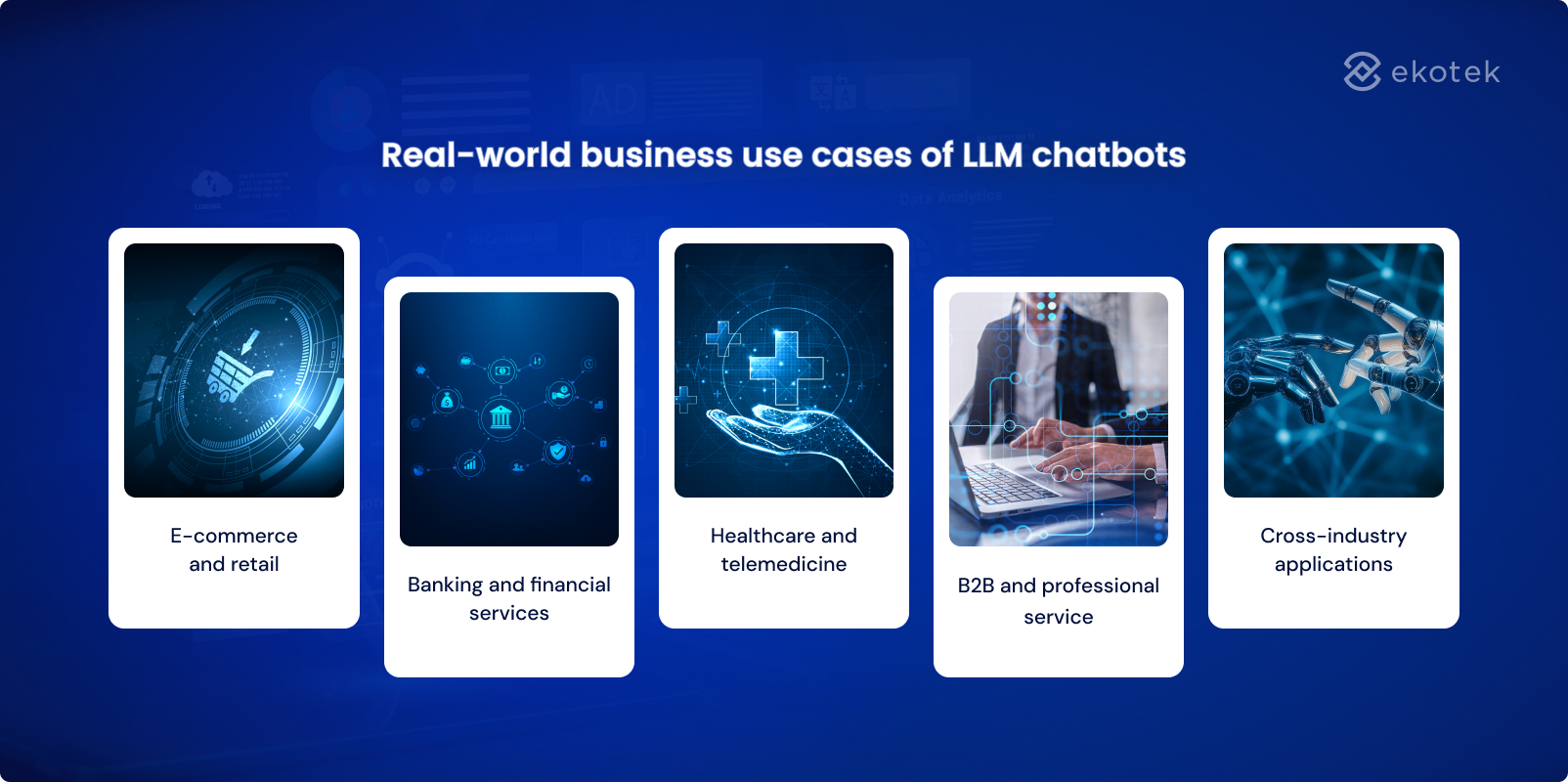
An LLM chatbot can act as a 24/7 virtual shopping assistant, guiding customers to the right products through personalized recommendations, helping with size or compatibility queries, tracking orders in real time, and managing returns or exchanges without human intervention. This not only boosts sales but also reduces post-purchase friction.

🚀 Unlock the secret to delivering continuous, high-quality support with Ekotek smart chatbots

Banking and financial services

Banks and fintech companies deploy LLM chatbots to handle secure account inquiries, explain transaction details, issue real-time fraud alerts, and assist with loan or credit card applications. Integration with backend systems allows instant balance updates, statement generation, and customer verification, enhancing trust while lowering call center load.

Healthcare and telemedicine

Healthcare providers use LLM chatbots for appointment booking, pre-visit symptom checks, and quick access to patient records (with proper compliance measures like HIPAA or GDPR). They can also send medication reminders, post-treatment care instructions, and triage non-urgent cases, freeing medical staff for critical care.

B2B and professional services

In the B2B space, an LLM chatbot can qualify inbound leads by asking targeted questions, assist in drafting proposals or contracts based on templates, and serve as an internal knowledge manager for employees, retrieving policies, procedures, or technical documentation instantly.

Cross-industry applications

Beyond sector-specific roles, LLM chatbots can power HR onboarding, employee IT helpdesks, multilingual customer support, and even compliance audits, making them a versatile investment across industries.

Best practices for implementing an LLM chatbot in your business

Best practices for implementing an LLM chatbot in your businessSet clear objectives and measurable KPIs

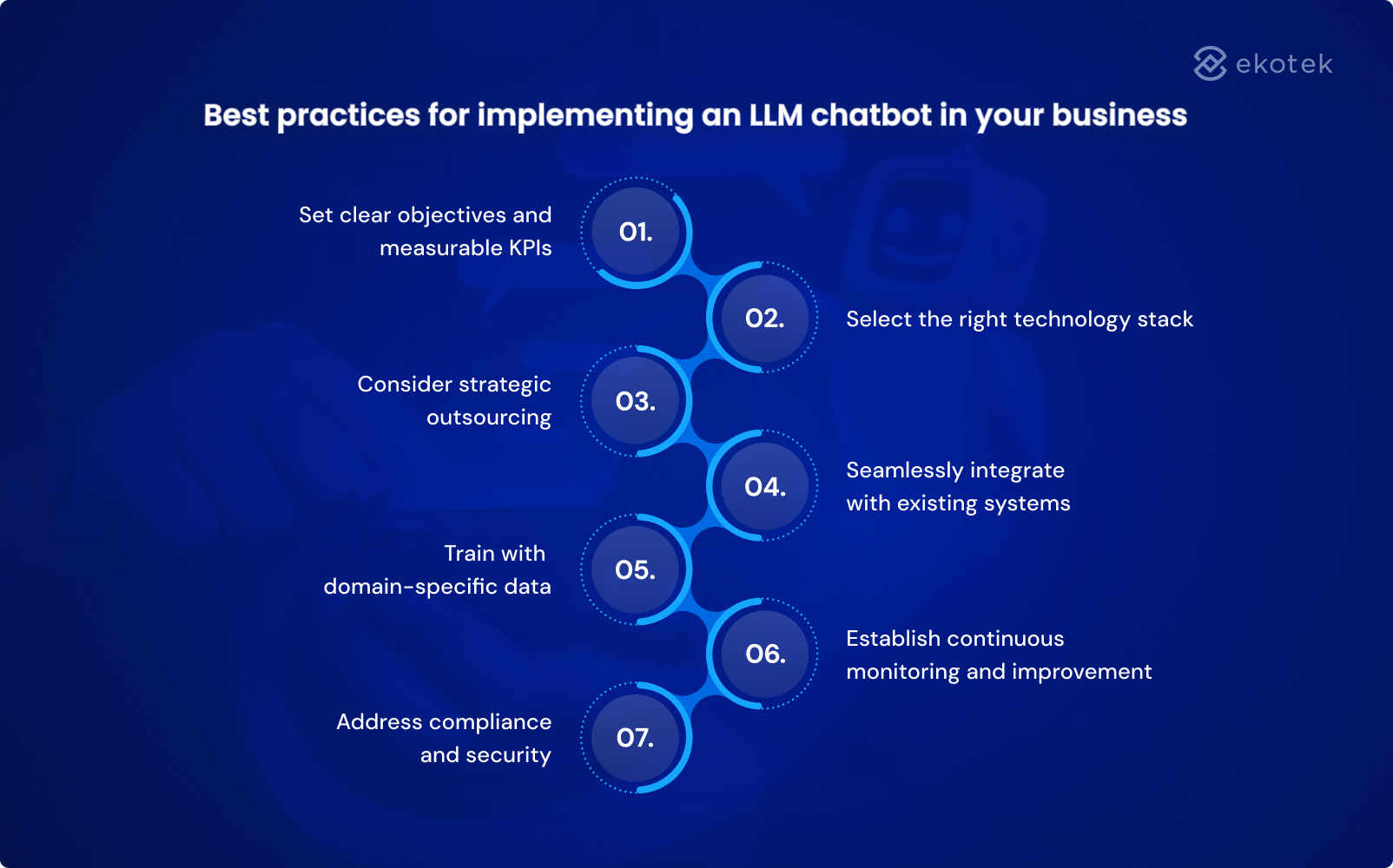
Before deployment, define the exact problems your LLM chatbot should solve, whether it’s reducing support response times, increasing lead conversion, or automating internal processes. Establish measurable KPIs so you can track ROI and prove business impact.

Select the right technology stack

Evaluate whether an open-source LLM offers the flexibility and customization your business needs, or if a SaaS-based chatbot platform provides faster implementation and easier maintenance. The right choice balances cost, control, and scalability.

Consider strategic outsourcing

If your organization lacks in-house AI expertise, partnering with a specialized vendor can accelerate deployment, reduce risk, and ensure best-practice implementation. Look for providers with proven experience in LLM fine-tuning, enterprise system integration, and regulatory compliance in your industry. Outsourcing can also serve as a bridge, allowing you to launch quickly while building internal capabilities over time.

🚀 Curious about the real cost of AI in 2025? Get the complete breakdown here.

Seamlessly integrate with existing systems

An LLM chatbot delivers the most value when connected to your CRM, ERP, knowledge base, and other operational tools. This integration enables real-time data access, personalized responses, and automated workflows.

Train with domain-specific data

Fine-tuning the LLM with your company’s data, such as product catalogs, service documentation, and historical customer interactions, ensures the chatbot understands your terminology and can handle complex, business-specific queries.

Establish continuous monitoring and improvement

Post-deployment, track performance metrics like accuracy, resolution rate, and user satisfaction. Use feedback loops to retrain the model, fix errors, and keep the chatbot aligned with evolving business needs.

Address compliance and security from day one

Ensure your implementation meets data privacy regulations (GDPR, HIPAA) and includes safeguards to prevent data leakage or unauthorized access. Security should be built into both the chatbot’s architecture and operational processes.

🚀 Explore the complete guide to AI integration for businesses

Challenges and considerations for businesses

Challenges and considerations for businessesData privacy and security

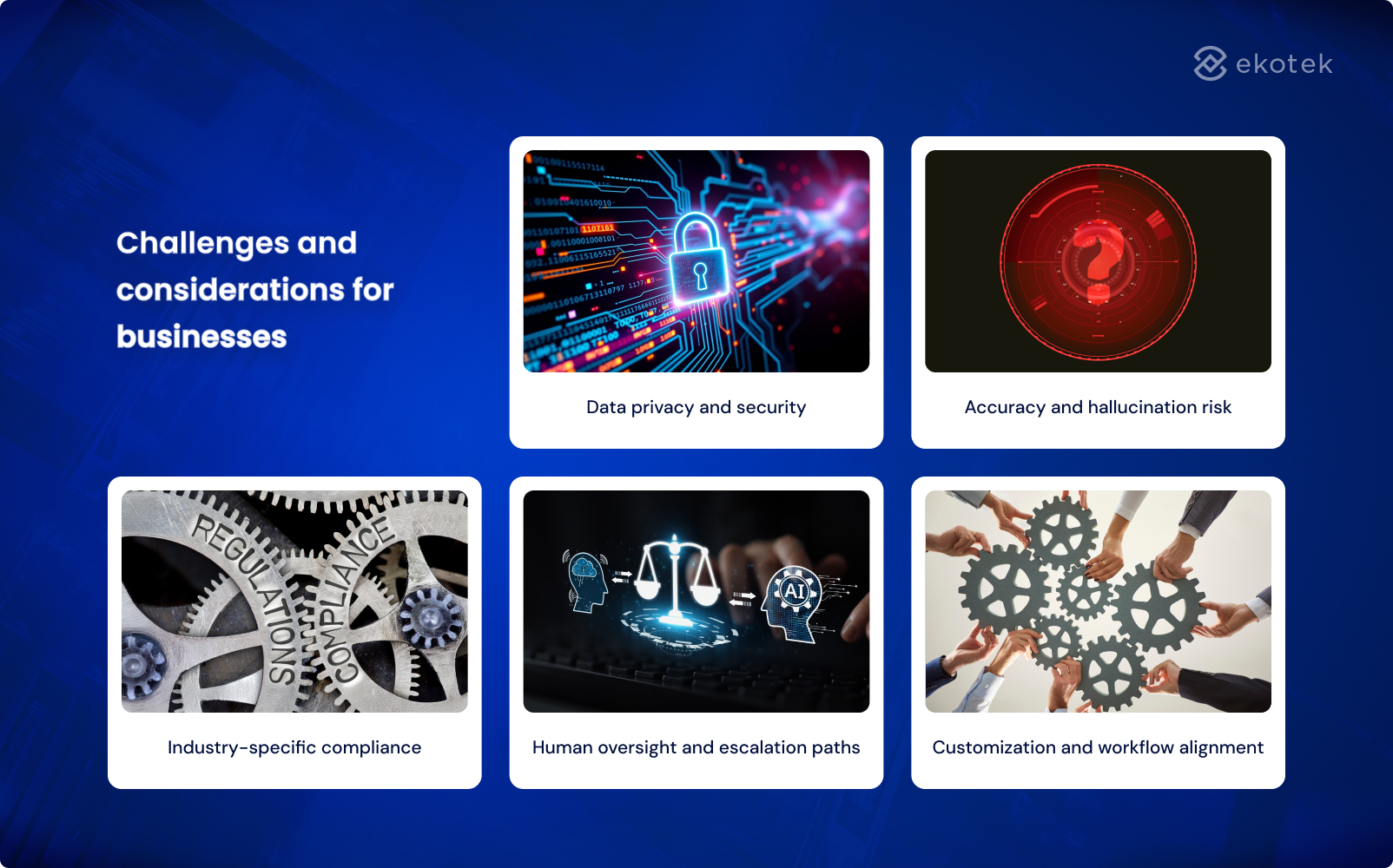
An LLM chatbot must comply with data protection laws such as GDPR, HIPAA, or CCPA. This includes securing sensitive customer information, preventing data leakage, and ensuring any third-party integrations meet your security standards.

Accuracy and hallucination risk

LLMs can occasionally produce incorrect or fabricated information. Implement safeguards such as human review for critical outputs, fine-tuning with verified data, and clear disclaimers where appropriate.

Industry-specific compliance

Highly regulated sectors, like finance, healthcare, or legal, require strict adherence to industry regulations. Your chatbot should be trained on compliant workflows and regularly audited for adherence.

Human oversight and escalation paths

Even the most advanced chatbot cannot handle every scenario. Maintain a trained human support team to address complex, sensitive, or high-value interactions, with clear escalation triggers built into the system.

Customization and workflow alignment

A generic chatbot rarely delivers maximum ROI. Customize your LLM chatbot to reflect your business processes, terminology, and customer service standards to ensure relevant, high-quality interactions.

Future of LLM chatbots in business

Multimodal interaction capabilities

Next-generation LLM chatbots will engage through text, voice, images, and even video, enabling richer, more natural conversations and expanding accessibility for diverse customer preferences.

Autonomous AI Agents

LLM-powered agents will go beyond answering questions, executing multi-step workflows from start to finish, such as processing an order, arranging delivery, and updating records, without human intervention.

🚀 Find the best AI agent development companies in Vietnam to scale your business

Hyper-personalization through advanced analytics

By combining customer data with predictive analytics, future chatbots will proactively anticipate needs, offer timely recommendations, and adapt conversation styles to individual users.

Strategic AI partnership in decision-making

LLM chatbots will evolve from being a tactical support tool into a strategic asset, providing executives with insights, scenario simulations, and data-driven recommendations to shape business decisions.

Conclusion

LLM chatbots are transforming how businesses operate, from delivering instant, 24/7 customer support to streamlining operations, cutting costs, and creating hyper-personalized experiences. Success comes down to choosing the right technology, integrating it with your systems, and continuously optimizing for performance. Companies that move early can scale faster, serve better, and stay ahead of the competition.

Ekotek is a trusted AI and software development partner, delivering end-to-end solutions that go far beyond LLM chatbots. Our capabilities cover generative AI and smart AI chatbot, AI agent-based automation for complex workflows, predictive analytics for data-driven decisions, and computer vision for industry-specific applications. 

We work with clients from early-stage consulting and proof-of-concept to seamless system integration and large-scale enterprise deployment. With proven experience across finance, manufacturing, retail, and education, we bring both technical depth and industry insight. By combining speed, scalability, and measurable results, Ekotek helps businesses unlock the full potential of AI to stay competitive in a fast-changing market.

Ready to build an LLM chatbot or a broader AI solution? Schedule a consultation with Ekotek and explore what we can build together.

공유하기
Facebook
Twitter
LinkedIn
최고의 인사이트를 이메일로 받아보세요

    관련 게시물

    저희가 어떻게 도와드릴 수 있는지 확인해 보세요!

    베트남 아웃소싱을 고려하고 계신가요?

    베트남의 주요 21개 아웃소싱 회사를 모든 분야와 산업별로 다룬 가이드와 함께 귀사에 가장 적합한 회사를 찾아보세요.
    Table of Contents

    저희가 어떻게 도와드릴 수 있는지 확인해 보세요!

    전략 상담 예약을 위해 이메일을 남겨주세요 – 전액 무료로 제공됩니다!

      Dylan Dong Do
      최고경영자
      딜런 동 도
      Dylan Dong Do는 제품 및 ITO 기업 전반에 걸쳐 15년 이상의 경영 경험을 보유한 숙련된 리더입니다. 그의 리더십 하에 Ekotek은 5년 만에 소규모 팀에서 200명 이상의 숙련된 전문가들로 구성된 번창하는 조직으로 성장하였습니다.

      Dylan의 경력 전반에 걸쳐 그는 놀라운 성과를 달성해 왔습니다. 2009년에는 batdongsan.com.vn 개발에 핵심적인 역할을 하여 베트남 최고의 부동산 매물 플랫폼으로 자리매김하였습니다. 2018년에는 VTI의 Chief Operating Officer로 승진하여 30명 규모의 팀을 300명이 넘는 강력한 조직으로 성장시키는 데 기여하였습니다.

      기술 혁신을 일상생활에 통합하고자 하는 열망으로 Dylan Dong Do는 Ekotek을 설립하였습니다. 그는 회사의 방향성을 설정하기 위해 첨단 기술에 대한 지식과 기술을 꾸준히 업데이트하여 글로벌 트렌드에 부응하고 고객의 요구에 더욱 효과적으로 대응할 수 있도록 하고 있습니다.