Why Embedded Finance Matters For Modern Enterprises

Picture of Ngoc Lam
저자
게시됨
8 mins read
Table of Contents

Introduction

In today’s market, business leaders face unprecedented pressure to keep pace with rising customer expectations and competitors rapidly embracing fintech-enabled platforms. Recent figures indicate the embedded finance for business market is projected to exceed $7 trillion in annual transaction value by 2026, underlining how crucial it has become for executive teams to rethink everything from customer journeys to monetization. As digital transformation accelerates, traditional approaches are struggling to deliver the speed and flexibility enterprises need, compelling leadership to explore smarter, platform-native solutions.

This guide is tailored for executives, managers, and tech leads who want to act—not just react. Inside, you’ll find practical frameworks, proven enterprise case studies, and tangible benefits, along with a step-by-step action plan for adopting embedded finance. This is not just about understanding the “what”; it’s about uncovering the “how” and “why now” with tools, checklists, and ready-to-implement strategies drawn from leading enterprises. By the end, you’ll have a blueprint to capture new revenue, embed finance seamlessly, and future-proof your business.

What Is Embedded Finance for Businesses?

Embedded finance is the ability for a business to offer financial services right inside its own product or platform, without sending users to a bank or another website.

In simple terms, it means:

  • A logistics platform can let drivers receive instant payouts.

  • An e-commerce site can offer buy-now-pay-later at checkout.

  • A SaaS platform can give customers a built-in digital wallet.

  • A marketplace can provide insurance during the purchase flow.

The business isn’t becoming a bank. Instead, it connects to licensed financial providers through APIs, and the financial service appears seamlessly inside the user experience.

For enterprises, this turns finance into a quiet engine that improves convenience for customers, reduces friction, and opens new revenue opportunities, all while staying behind the scenes.

⭐️ You may be interested in Digital transformation in banking

Why Embedded Finance Matters for Today’s Businesses

Embedded finance is becoming essential not because it’s trendy, but because powerful shifts in customer behavior, technology, and market dynamics are pushing businesses toward deeper financial integration.

Customer expectations for seamless digital experiences are rising

Modern users expect everything, payments, credit, payouts, verification, to happen instantly within a single platform. Any extra step, redirect, or delay feels outdated and causes drop-off. Businesses that cannot deliver smooth, in-platform financial experiences risk losing customers to competitors who can.

⭐️ Learn the key strategies and technologies that are redefining customer experience in the digital era

The shift toward platform-based business models

Enterprises are evolving into digital platforms rather than single-product companies. As ecosystems expand, embedded finance becomes the glue that connects services, partners, and users in one unified experience. Without it, platforms struggle to scale or monetize effectively.

Traditional financial systems are too slow and fragmented

Legacy banking infrastructure wasn’t built for today’s always-on digital operations. Processes like verification, payouts, lending, or reconciliation often involve manual steps, long waiting times, and disconnected tools. This creates friction that modern businesses can no longer afford.

Competitive pressure across industries

From retail to logistics to SaaS, companies are adding financial features to differentiate and capture more value. When competitors offer instant payments, flexible financing, or embedded insurance, customers start to expect the same everywhere, forcing others to follow suit.

⭐️ Explore how digital transformation is reshaping the retail sector

Advances in fintech infrastructure & API availability

Fintech enablers have made it dramatically easier for businesses to integrate financial services without becoming banks. Modern API-first platforms handle compliance, security, and licensing, allowing enterprises to innovate faster than ever.

Benefits of Embedded Finance for Enterprise

As embedded finance becomes more widely adopted, enterprises are discovering that it delivers far more than convenience, it strengthens the entire business model from revenue to operations.

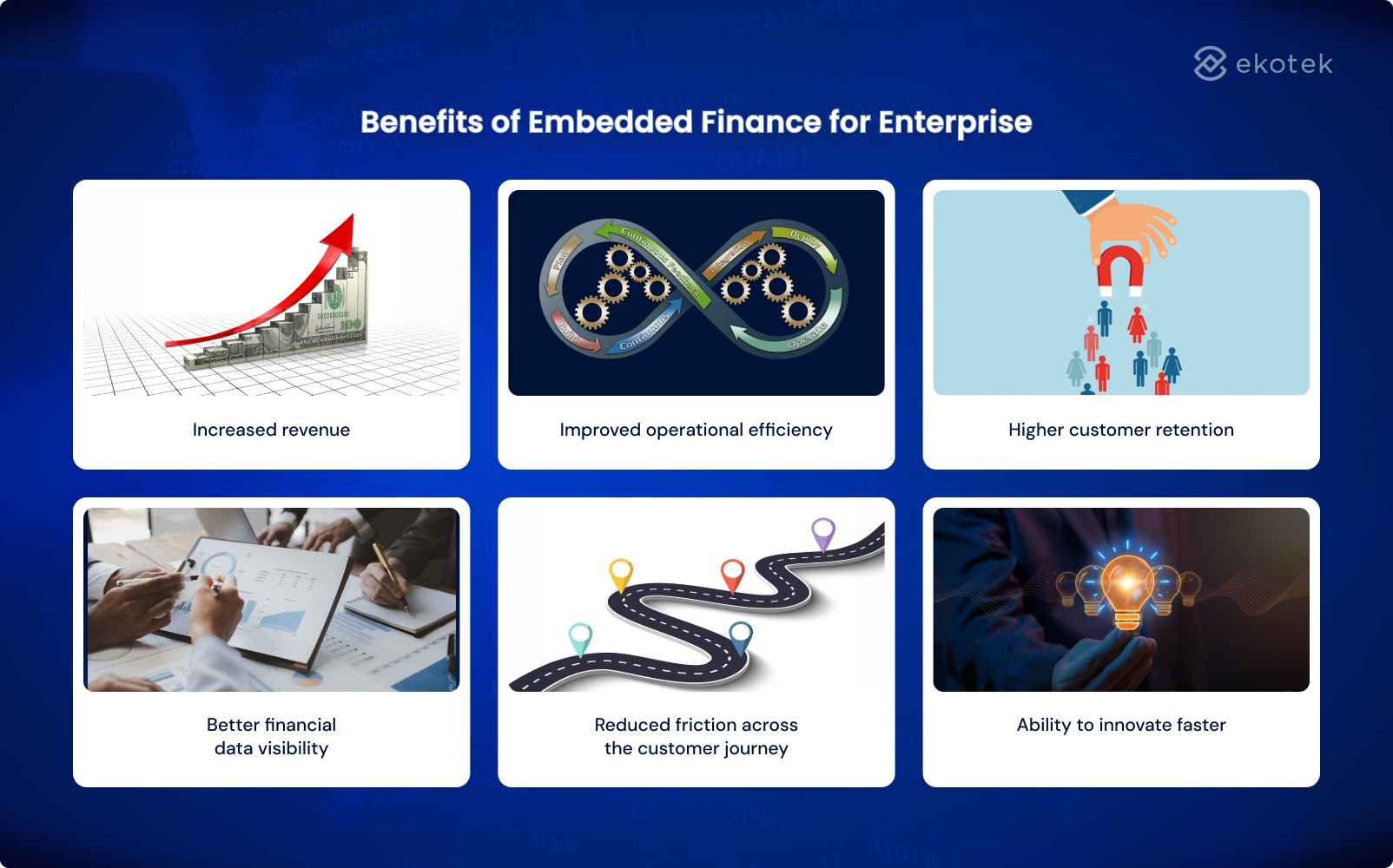
Increased revenue and diversified income streams

By offering services like payments, financing, insurance, or wallets directly inside their platforms, enterprises can generate new revenue through fees, interest spreads, or value-added services. Instead of passing financial value to external banks, businesses capture it themselves.

Ekotek helped a payments provider build a modern payment infrastructure that integrates international networks like Visa and local e-wallets such as ShopeePay. By enabling merchants to accept a wider range of electronic payments across multiple countries, the client unlocked new transaction-based revenue streams and expanded into markets that were previously difficult to serve. This transformation turned payment processing from a cost center into a scalable source of recurring income.

⭐️ Contact Ekotek to explore how embedded payments can grow your revenue

Improved operational efficiency

Automated payouts, streamlined onboarding, integrated KYC, and real-time settlements reduce the manual work that traditionally slows teams down. Embedded finance eliminates multiple third-party systems and replaces them with smoother end-to-end workflows.

Higher customer retention & stronger loyalty

When customers can pay, borrow, insure, or transact without leaving the platform, they have fewer reasons to switch to competitors. Embedded finance creates a “stickier” experience where users stay longer and engage more frequently.

Ekotek partnered with a client to build a Web3 rewards platform that allows traditional businesses to offer crypto-based loyalty programs without needing blockchain expertise. The solution included a ready-to-use on-chain engine, wallet, rewards logic, token/NFT handling, and a quest-based engagement system, fully integratable with existing apps and CRM systems. This enabled businesses to launch modern, tokenized loyalty experiences quickly and securely, opening new ways to boost customer engagement and retention.

Better financial data visibility

With transactions happening inside one platform, enterprises gain clearer insights into customer behavior, cash flow, risk patterns, and operational performance. This data becomes a strategic asset for forecasting, personalization, and smarter decision-making.

Reduced friction across the customer journey

Every time a user is redirected to another website or app, the business risks losing them. Embedded finance removes those barriers, making checkout faster, onboarding easier, and financial interactions nearly invisible.

Ability to innovate faster

With API-driven financial capabilities, enterprises can quickly test, launch, and iterate new financial services without building infrastructure from scratch. This accelerates time-to-market and allows businesses to stay ahead of competitors and emerging customer needs.

Benefits of Embedded Finance for EnterpriseHow Embedded Finance Works

Embedded finance may feel seamless to the end user, but behind the scenes it relies on a coordinated ecosystem of roles, technologies, and compliance processes working together.

The relationship between key participants

  • The business (platform provider): The company integrating financial services into its product, responsible for the user experience and where financial actions appear.
  • The financial infrastructure provider / fintech enabler: Supplies the APIs, workflows, and compliance-ready technology that power the financial features behind the scenes.
  • The licensed financial institution: A regulated entity (often a bank) that holds funds, provides underwriting, and ensures all financial activities meet legal requirements.

⭐️ Read more about Fintech adoption in enterprises

API-first integrations

APIs act as the bridge that allows businesses to embed payments, lending, wallets, or identity verification directly into their platforms. This API-first approach makes financial actions happen instantly and keeps the user inside one seamless experience.

Compliance, KYC/AML, security layers

Embedded finance requires strict safeguards:

  • KYC verifies user identities

  • AML monitors and flags suspicious activities

  • Security controls (encryption, tokenization, authentication) protect data and transactions
    Most of these layers are handled by the fintech enabler and the licensed institution, reducing the burden on the business.

Data flows and orchestration

When a user performs a financial action, data moves smoothly between the business, the fintech provider, and the licensed institution. The orchestration layer manages:

  • sending requests,

  • performing checks,

  • executing the financial transaction,

  • returning results in real time.

This behind-the-scenes coordination is what makes embedded finance feel instant and effortless to the end user.

How Businesses Can Get Started with Embedded Finance

Adopting embedded finance doesn’t require becoming a bank, it requires a clear strategy and the right partners. Below are practical steps enterprises can follow to move from exploration to execution.

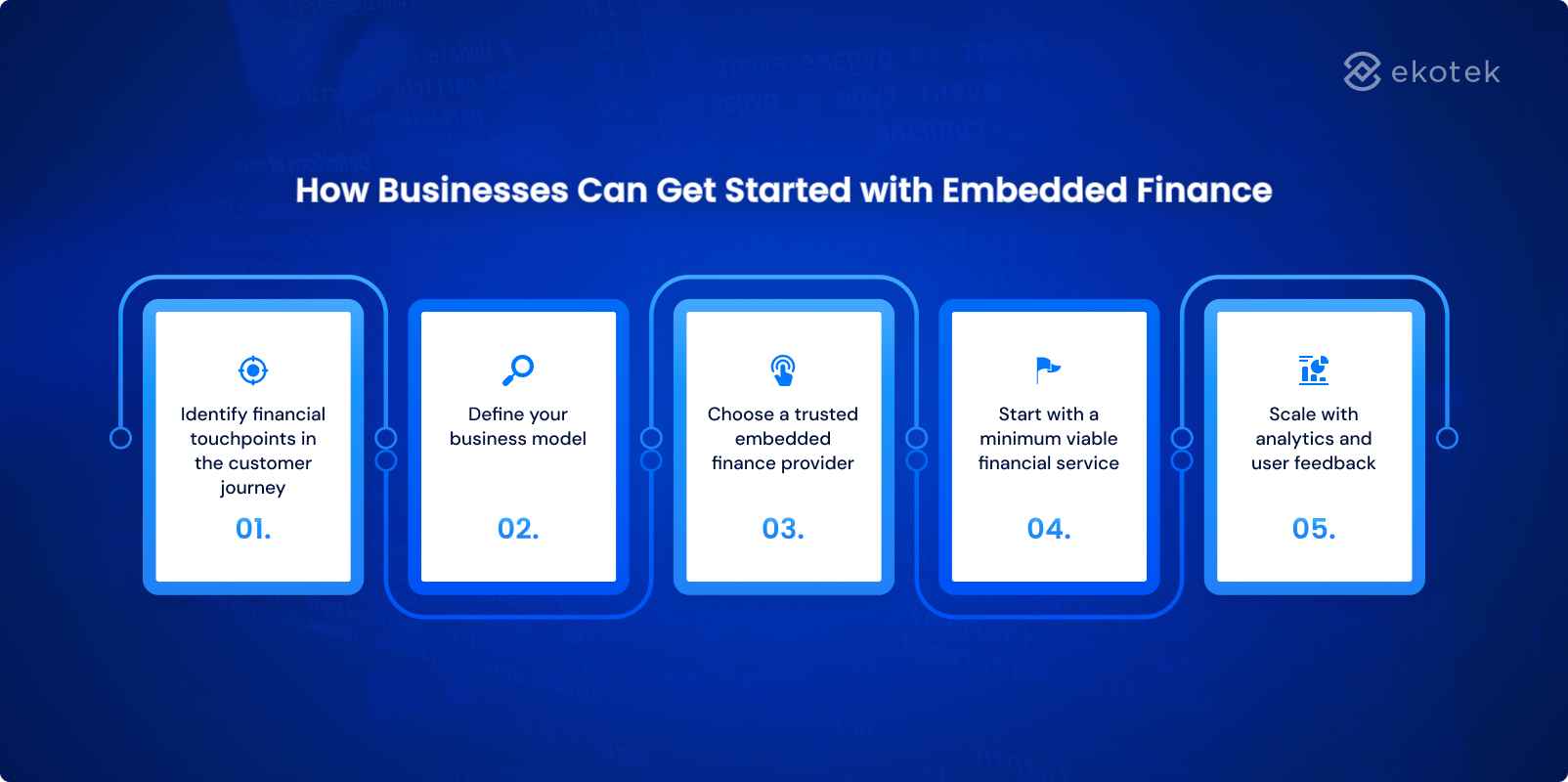
Identify financial touchpoints in the customer journey

Start by mapping where users naturally interact with money: payments, payouts, deposits, credit checks, insurance needs, subscriptions, or wallet balances. These moments reveal where embedded finance can remove friction or add value.

Define your business model and revenue opportunities

Consider how financial services could strengthen your offering:

  • Will you generate revenue from fees, interest spreads, or premium features?

  • Will embedded finance improve retention or customer lifetime value?
    A clear business model helps prioritize which financial features to launch first.

Choose a trusted embedded finance provider

Select a fintech enabler that offers secure APIs, handles compliance, and has experience working with enterprises. Look for partners that can integrate smoothly with your existing systems and support future scaling.

⭐️ Explore how Ekotek can help your organization with our fintech services

Start with a minimum viable financial service

Instead of launching multiple features at once, begin with one high-impact service, such as instant payouts, BNPL, or a digital wallet. This reduces risk, speeds up deployment, and allows teams to learn from real user behavior.

Scale with analytics and user feedback

Track adoption, user satisfaction, transaction volume, and operational performance. Use these insights to optimize existing features and expand into new ones. Embedded finance works best when it evolves alongside customer needs and business goals.

How Businesses Can Get Started with Embedded FinanceEkotek Fintech Services Offering

Ekotek supports enterprises on their embedded finance journey with a deep foundation in banking, fintech, and blockchain technologies, backed by a service model designed for complex, enterprise-level transformation.

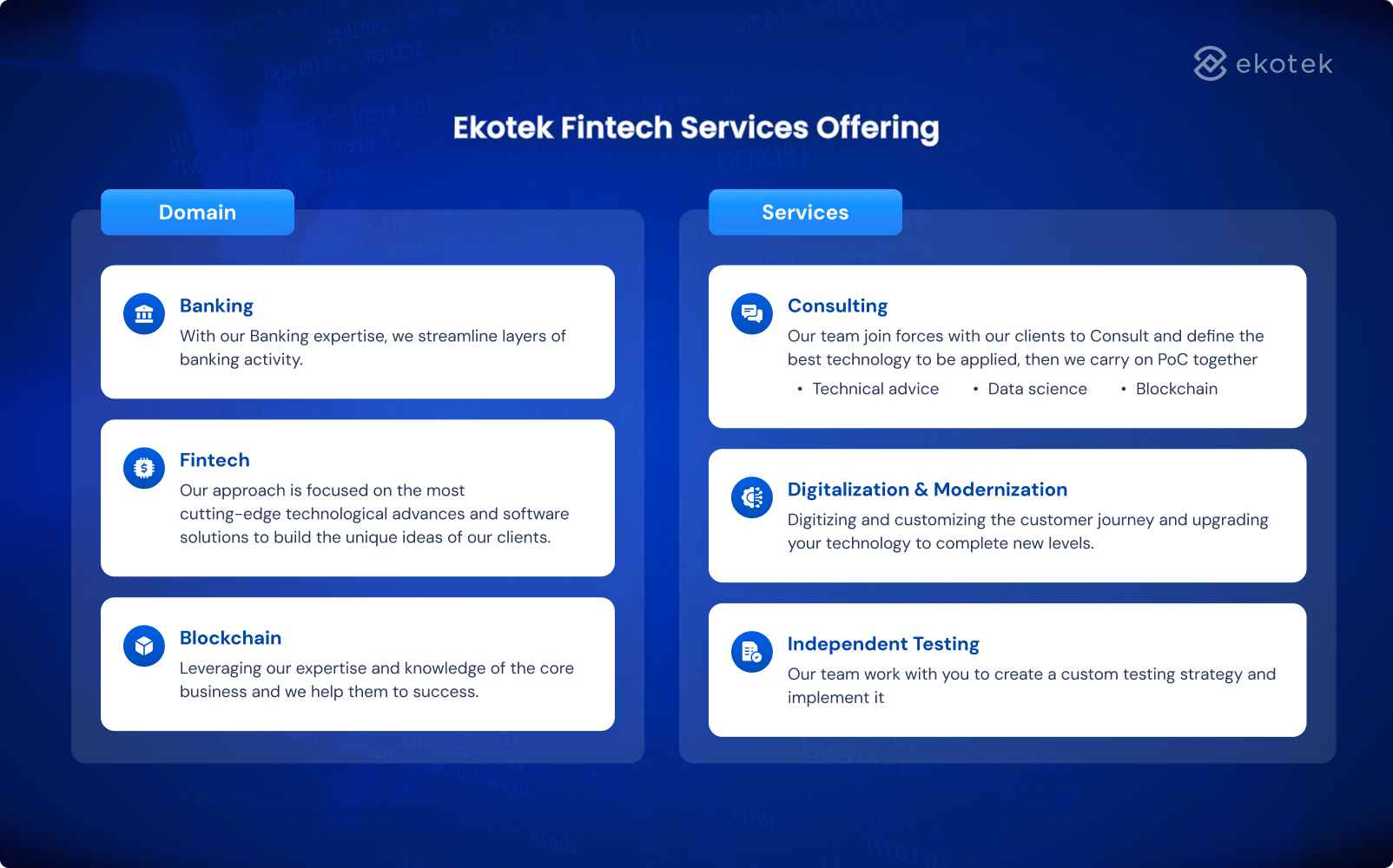
Domain expertise across banking, fintech, and blockchain

Ekotek brings hands-on experience building lending systems, credit and risk engines, neo-banking platforms, payment and transaction solutions, and Web3/tokenization applications. This breadth allows us to design financial features that fit seamlessly into modern digital ecosystems.

Consulting to define the right transformation strategy

Our team works closely with business and technology leaders to identify opportunities, select the right financial technologies, and validate concepts through proof-of-concept development. We provide technical advisory, data science support, and blockchain expertise where needed.

Digitalization & modernization of enterprise platforms

Ekotek helps organizations upgrade legacy systems and customize the customer journey to support embedded finance capabilities. From architecture redesign to API enablement, we ensure platforms can scale securely and efficiently.

Independent testing for financial-grade reliability

Because trust is essential in financial services, we provide rigorous, independent testing to validate performance, security, and compliance. Our tailored testing strategies ensure new financial features launch with confidence and stability.

Ekotek Fintech Services OfferingConclusion

Embedded finance is reshaping how modern enterprises operate, turning financial interactions into seamless, in-platform experiences that drive revenue, strengthen loyalty, and streamline operations. As customer expectations rise and digital ecosystems become more interconnected, businesses that adopt embedded finance early will be far better positioned to innovate, differentiate, and scale.

For organizations exploring this transformation, choosing the right technology partner is essential. Ekotek brings deep domain expertise across banking, fintech, and blockchain, along with a refined workflow, rigorous quality control, and the ability to scale quickly for complex enterprise needs. Whether you’re modernizing core systems, integrating new financial features, or building end-to-end digital experiences, Ekotek can support you across the entire fintech service stack, from front-end interfaces to API integrations and core system orchestration.

Ready to turn embedded finance into a real competitive advantage

Ekotek is here to help you build it, securely, efficiently, and at scale

Talk to us

FAQ on Embedded finance for business

1. Is embedded finance only relevant for digital-native companies?

No. Traditional enterprises, from manufacturing to logistics to retail, are increasingly adopting embedded finance to modernize customer experiences, automate payments, and unlock new revenue streams without rebuilding their entire technology stack.

2. How difficult is it for an enterprise to integrate embedded finance into existing systems?

With modern API-based platforms, integration is far more manageable than in the past. Enterprises can add financial features incrementally, layering them onto current systems without major disruption or full system replacement.

3. What risks should enterprises consider before launching embedded finance?

The main risks involve regulatory compliance, data security, and operational oversight. These are mitigated by partnering with licensed financial institutions and fintech enablers that provide built-in compliance, risk monitoring, and secure infrastructure.

4. How can enterprises measure whether their embedded finance initiative is successful?

Key indicators include increased transaction completion rates, higher customer retention, reduced manual processing time, improved cash-flow visibility, and new revenue generated from financial features. Clear KPI tracking helps quantify ROI and guide future scaling.

공유하기
Facebook
Twitter
LinkedIn
최고의 인사이트를 이메일로 받아보세요

    관련 게시물

    저희가 어떻게 도와드릴 수 있는지 확인해 보세요!

    베트남 아웃소싱을 고려하고 계신가요?

    베트남의 주요 21개 아웃소싱 회사를 모든 분야와 산업별로 다룬 가이드와 함께 귀사에 가장 적합한 회사를 찾아보세요.
    Table of Contents

    저희가 어떻게 도와드릴 수 있는지 확인해 보세요!

    전략 상담 예약을 위해 이메일을 남겨주세요 – 전액 무료로 제공됩니다!

      Dylan Dong Do
      최고경영자
      딜런 동 도
      Dylan Dong Do는 제품 및 ITO 기업 전반에 걸쳐 15년 이상의 경영 경험을 보유한 숙련된 리더입니다. 그의 리더십 하에 Ekotek은 5년 만에 소규모 팀에서 200명 이상의 숙련된 전문가들로 구성된 번창하는 조직으로 성장하였습니다.

      Dylan의 경력 전반에 걸쳐 그는 놀라운 성과를 달성해 왔습니다. 2009년에는 batdongsan.com.vn 개발에 핵심적인 역할을 하여 베트남 최고의 부동산 매물 플랫폼으로 자리매김하였습니다. 2018년에는 VTI의 Chief Operating Officer로 승진하여 30명 규모의 팀을 300명이 넘는 강력한 조직으로 성장시키는 데 기여하였습니다.

      기술 혁신을 일상생활에 통합하고자 하는 열망으로 Dylan Dong Do는 Ekotek을 설립하였습니다. 그는 회사의 방향성을 설정하기 위해 첨단 기술에 대한 지식과 기술을 꾸준히 업데이트하여 글로벌 트렌드에 부응하고 고객의 요구에 더욱 효과적으로 대응할 수 있도록 하고 있습니다.