Native Mobile App Development — Top 9 Key Benefits

Picture of Dam LyLy
저자
게시됨
5 mins read
Table of Contents

Smartphones have evolved into multifunctional devices, allowing people to perform many day-to-day functions using apps on their phones. The number of mobile software available for iOS and Android, the two major operating systems, is constantly increasing, with 3.5 million iOS and 2.2 million Android applications as of 2022 (source: Statista).

There are three main approaches to mobile app development: native, hybrid, and cross-platform. Today’s article will discuss the benefits of native mobile app development in detail to help you decide whether it is the most suitable choice for your project.

What is native mobile app development?

Native mobile application development entails creating a product that is dedicated to one platform only. The app will be developed for a specific mobile operating system and released on the respective app store, such as the iOS App Store and Android’s Google Play.

Native apps typically provide better functionality and performance than hybrid and cross-platform apps because they are built for the operating system and have access to different hardware on the phone. It is important to note that different programming languages and tools are designed for the various platforms on which a native app can be developed, which we will cover in the next section.

Technology stack

⭐️ While there are many operating systems, 99% of the market is conquered by iOS and Android.

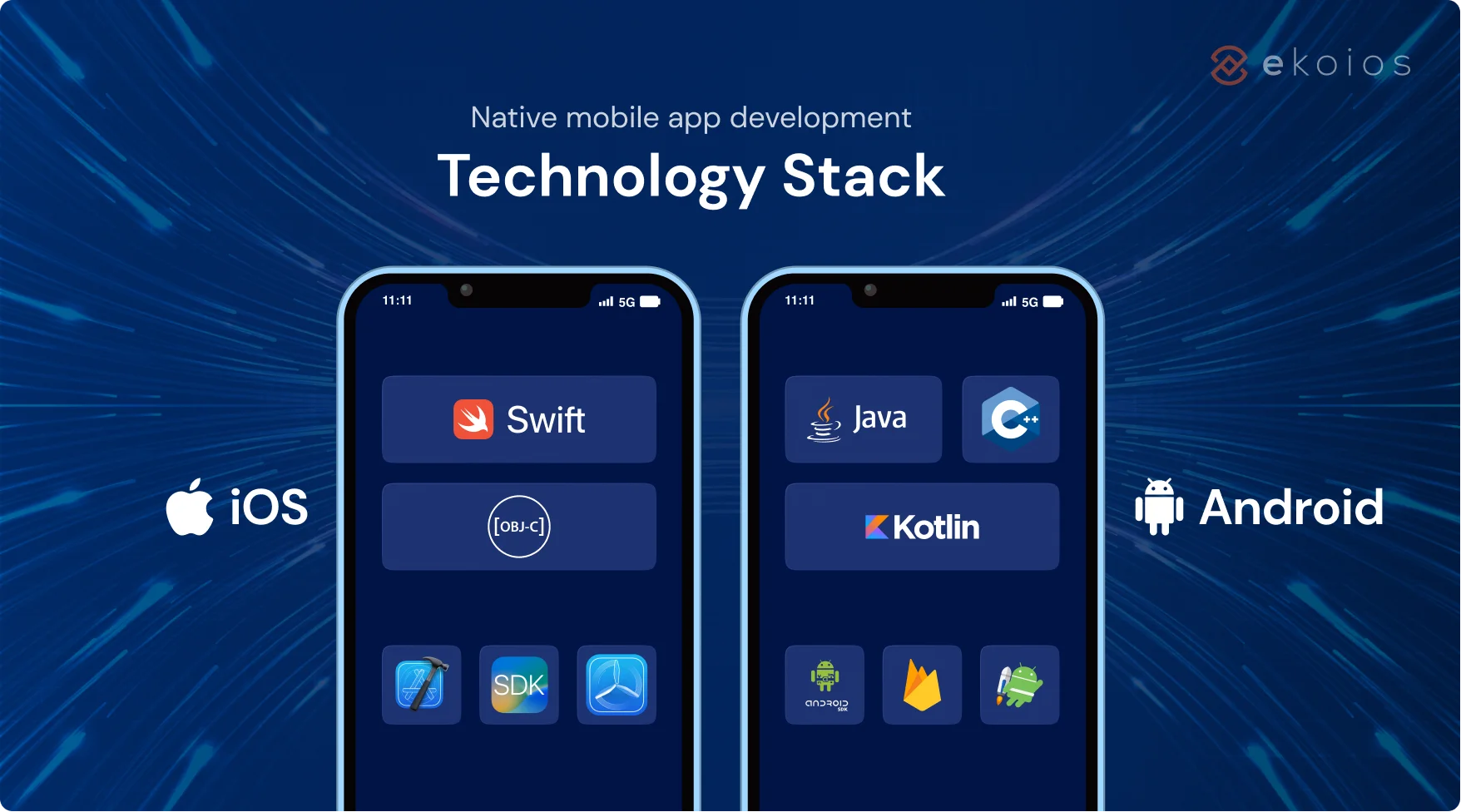
For Android native apps, professional developers will typically use Java, C++, and Kotlin. Additional tools are also provided such as the Android SDK, Firebase, command-line tools, and the Android Jetpack from Google, along with numerous third-party tools.

The iOS system, on the other hand, is closed-source for Apple devices only. This means that iOS developers will need a Mac computer and programming languages such as Swift or Objective-C. Apple also provides a variety of resources, including XCode, the iOS SDK, TestFlight, and Swift Playgrounds.

native mobile app technology stack

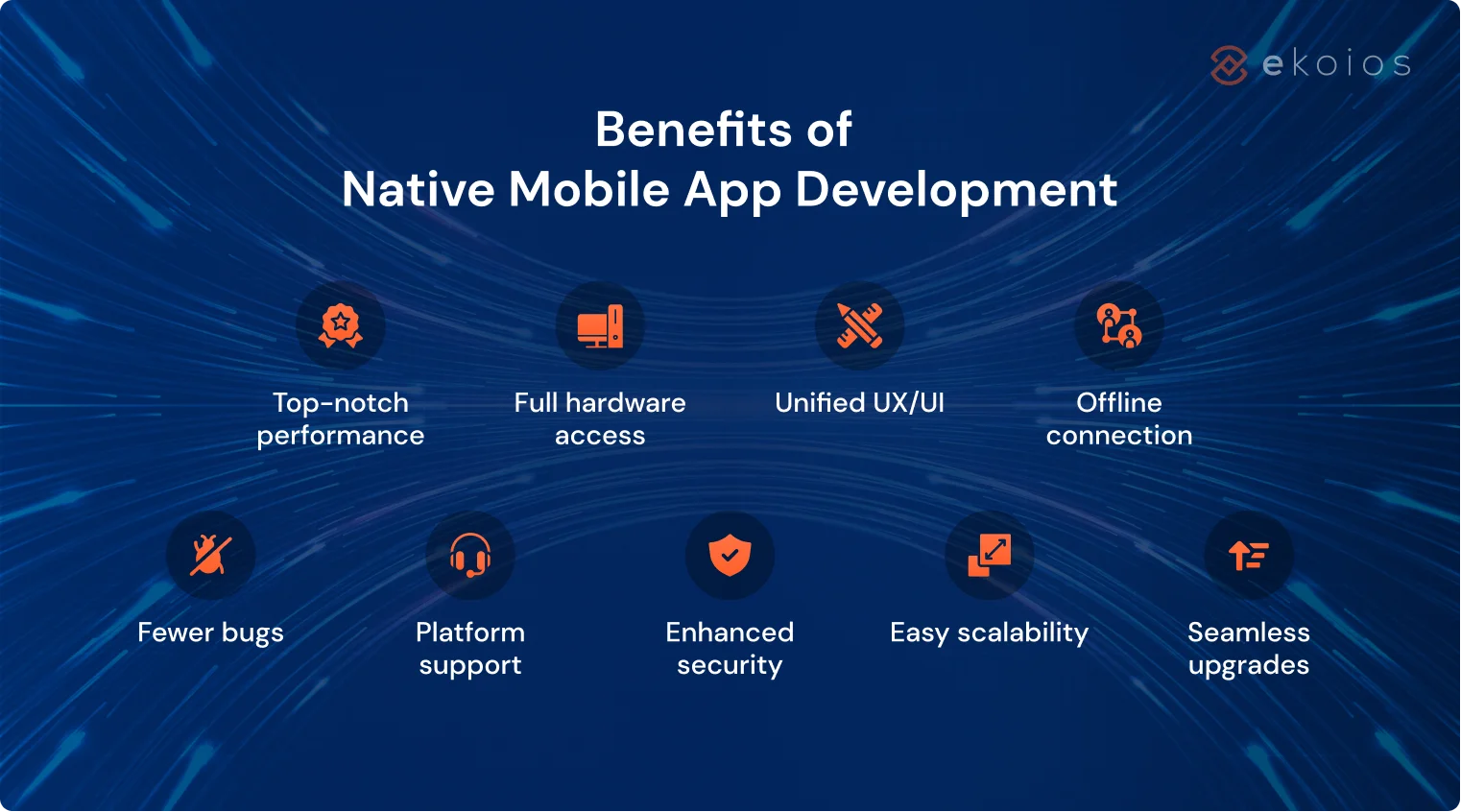
Benefits of native mobile app development

1. Top-notch performance

The primary reason for this is that the application interacts directly with native APIs and doesn’t depend on middleware. Plus, the devices they’re loaded on actually store all the key data and help content load faster. This makes native apps perform much better than cross-platform or hybrid solutions.

2. Full hardware access

Native mobile apps have complete access to a device’s features such as GPS, microphone, camera & so on. There is access to APIs and tools, so the user can fully enjoy the app’s capabilities as long as they allow it. Another advantage is the ability to attract users by sending push notifications.

3. Unified UX/UI

For developers, each native platform has its own design guidelines for UX/UI, so they don’t have to worry about adjusting the size and resolution for each device. Consequently, native applications bring more interactivity to users than hybrid or cross-platform ones, as they are much easier to navigate.

See what UI/UX design entails and our agile approach →

4. Offline connection

Going native ensures that users can still use the app when offline because their content has already been downloaded: planners, organizers, navigators, and even games can operate offline. Although HTML5 supports in-browser caching, it does not provide the same level of freedom as a native app.

5. Fewer bugs

Developed using the operating system’s SDK and tools, native mobile apps have fewer dependencies for bugs to develop. Furthermore, native development keeps one codebase for each platform, making it less prone to errors than other methods with one codebase for all platforms.

📌 Related topic: Manual Testing vs. Automation Testing

6. Platform support

When publishing your app, both the App Store and Google Play have rules and standards that you must follow. Cross-platform or hybrid apps may have more bottlenecks to deal with. Native mobile app developers, on the other hand, use the operating system’s tech stack from the very first line of code, which makes the approval process much more efficient.

7. Enhanced security

Native applications can leverage the built-in security features and measures from the SDK of the respective operating system. Furthermore, they do not rely on any third-party system, but on official APIs that have been thoroughly tested across multiple system versions.

8. Easy scalability

As mentioned above, the architecture of native applications allows for better performance in speed and bandwidth, which translates into better opportunities for your product’s future growth. Native apps are easier to scale as needed because they use existing hardware more effectively, provide a better performance, and reduce the risk of the app crashing during increased traffic.

9. Seamless upgrades

When Android and iOS release software updates, native app developers can quickly implement the latest features with access to new SDKs that allow them to modify the application. Given the frequency with which iOS and Android release updates, this can save significant time and resources compared to other types of mobile app development.


benefits of native mobile app development

Popular native mobile applications

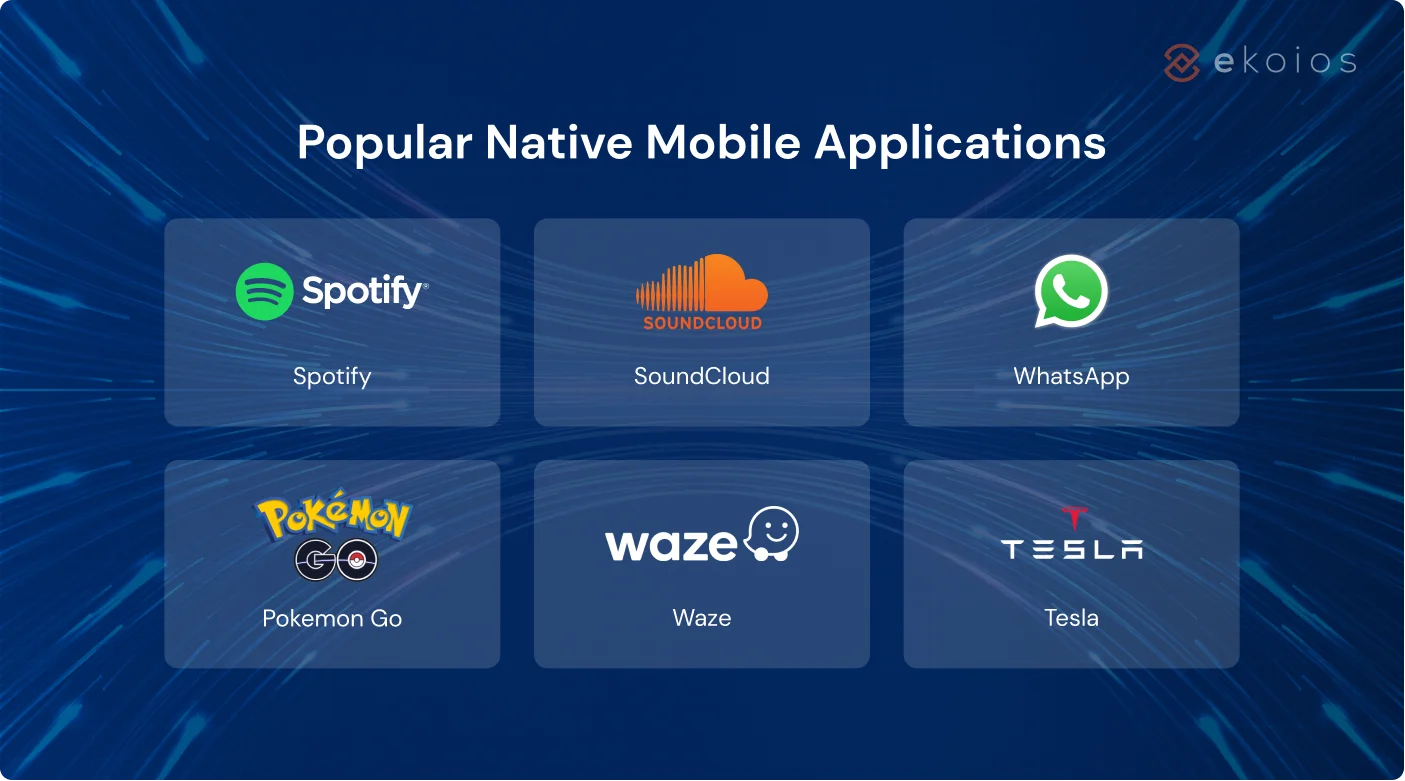
It should come as no surprise that native apps account for a sizable portion of the mobile app market, spanning a wide range of industries. Some apps you may find yourself familiar with are:

  • Music: Spotify, SoundCloud
  • Communication: WhatsApp
  • Entertainment: Pokemon Go
  • Navigation: Waze
  • Tech control: Tesla

📌 Browse Fammi Live the Next-gen Live Streaming Mobile App case study

popular native mobile apps

Choosing between native, hybrid, and cross-platform apps

So you are looking for the best way to build your enterprise mobile app. Besides native mobile app development, there are also hybrid and cross-platform methods, each has pros and cons of its own. For your convenience, we have put together a comparison table as follows:

Criteria Native Hybrid Cross-platform
Codebase One per platform One for all platforms One for all platforms
Reusable code No Yes Yes
Performance Fast Slower Slower
UX/UI Native Non-native Close to native
Hardware access Full Limited Limited
Built-in security Yes No No
Offline functionality Yes Yes No
Source dependency Lower High High
Debugging Native tools Native + web tools Framework-dependent
Development cost High Lower Lower
Time to market Slower Fast Fast

📌 Read more: Native apps vs. Hybrid apps: Unlock the benefits and make the right choice

If you want a high-quality and resilient output, native mobile app development is the way to go. It will give you a competitive advantage with stunning UX/UI design, fast operating speed, and extensive features. Although the cost for your time and resources can be pricier than hybrid or cross-platform apps, high chance it will be a return on investment in the long run.

Closing thoughts

Mobile application is the unrivaled force behind mobile usage. By going native mobile application, your business will be building apps that are high-performing, user-friendly, scalable, and more secure than other development methods. Also, you should consider whether hiring an external development team is a more cost-effective option than an in-house team.

If you would like to explore the topic further or get a strategic consultation on your project, get in touch today with Ekotek experts. Awarded GoodFirms’ top mobile app development company in Vietnam, we possess years of experience delivering mobile app services that set businesses up for success – and hopefully, yours will be next.

Looking to level up your mobile app?
Discover our mobile app development services and see what suits you

Explore now

공유하기
Facebook
Twitter
LinkedIn
최고의 인사이트를 이메일로 받아보세요

    관련 게시물

    저희가 어떻게 도와드릴 수 있는지 확인해 보세요!

    베트남 아웃소싱을 고려하고 계신가요?

    베트남의 주요 21개 아웃소싱 회사를 모든 분야와 산업별로 다룬 가이드와 함께 귀사에 가장 적합한 회사를 찾아보세요.
    Table of Contents

    저희가 어떻게 도와드릴 수 있는지 확인해 보세요!

    전략 상담 예약을 위해 이메일을 남겨주세요 – 전액 무료로 제공됩니다!

      Dylan Dong Do
      최고경영자
      딜런 동 도
      Dylan Dong Do는 제품 및 ITO 기업 전반에 걸쳐 15년 이상의 경영 경험을 보유한 숙련된 리더입니다. 그의 리더십 하에 Ekotek은 5년 만에 소규모 팀에서 200명 이상의 숙련된 전문가들로 구성된 번창하는 조직으로 성장하였습니다.

      Dylan의 경력 전반에 걸쳐 그는 놀라운 성과를 달성해 왔습니다. 2009년에는 batdongsan.com.vn 개발에 핵심적인 역할을 하여 베트남 최고의 부동산 매물 플랫폼으로 자리매김하였습니다. 2018년에는 VTI의 Chief Operating Officer로 승진하여 30명 규모의 팀을 300명이 넘는 강력한 조직으로 성장시키는 데 기여하였습니다.

      기술 혁신을 일상생활에 통합하고자 하는 열망으로 Dylan Dong Do는 Ekotek을 설립하였습니다. 그는 회사의 방향성을 설정하기 위해 첨단 기술에 대한 지식과 기술을 꾸준히 업데이트하여 글로벌 트렌드에 부응하고 고객의 요구에 더욱 효과적으로 대응할 수 있도록 하고 있습니다.