Public vs. Private Blockchains Compared and Their Use Cases

Picture of Harris
저자
게시됨
6 mins read
Table of Contents

Blockchain, the underlying technology behind cryptocurrencies like Bitcoin, is quickly gaining popularity in the digital space. More and more companies are recognizing its revolutionary potential and are choosing to adopt this new technology for their daily operations, making blockchain less of a buzzword and more of a forward-thinking mantra.

In short, a blockchain is a continuously growing list of public records broken up into “blocks” based on specific windows of time. A community of users controls how this information is edited and updated, and all blocks are chained together chronologically.

While more organizations are becoming aware of the applications of blockchain in the enterprise, there is less familiarity with the differences between public and private blockchains.

The Similarities of Public and Private Blockchains

Before we touch on the differences, it is important to understand the similarities between public and private blockchains. Both of them:

  • Are decentralized peer-to-peer networks built on a community of users, meaning that no one entity (like a bank or broker) is in charge of authorizing transactions
  • Rely on numerous users to authenticate edits to the distributed ledger, thereby creating a new master copy that is accessible to everyone at all times
  • Are completely immutable, meaning the verified block can never be erased or modified once it is authenticated by users

So, how are they different?public and private blockchain compared

Public Blockchain

A public blockchain is the model of Bitcoin, Ethereum, and Litecoin and is essentially considered to be the original distributed ledger structure.

This type of blockchain platform is completely open and anyone can join and participate in the network. It can receive and send transactions from anybody in the world, and can also be audited by anyone who is in the system.

Each node (a computer connected to the network) has as much transmission and power as any other, making public blockchains not only decentralized but fully distributed, as well.

In order for a transaction to be considered valid, it must be authorized by each of its constituent nodes through the consensus process. Once this authorization takes place, the record is added to the chain. Public blockchains typically have incentives to encourage people to join the network as well as to authenticate transactions.

One of the biggest disadvantages of a public blockchain is its complete openness. This type of transparency implies little to no privacy for transactions and supports a weak concept of security. Another drawback is the substantial amount of computing power that is necessary for the maintenance of the ledger. With so many nodes and transactions as part of the network, this type of scale requires extensive effort to achieve consensus.

Private Blockchain

Private blockchains, on the other hand, are essentially forks of the originator but are deployed in what is called a permission manner.

In order to gain access to a private blockchain network, one must be invited and then validated by either the network starter or by specific rules that were put into place by the network starter. Once the invitation is accepted, the new entity can contribute to the maintenance of the blockchain in the customary manner. Due to the fact that the blockchain is on a closed network, it offers the benefits of the technology but not necessarily the distributed characteristics of the public blockchain. The extent to which the entity can view or validate transactions is up to the network starter to determine.

A typical way for enterprises to use private blockchains is intra-business, ensuring that only company members have access. This is a useful business solution if there is no reason anyone outside of the company should be part of the chain as data can be restricted to certain individuals on a need-to-know basis. With fewer people as part of the chain, they are typically quicker and more efficient with an easier consensus process.

While this sort of structure may not be entirely different from older digital structures as the public blockchain is, the technology is still highly powerful and the strong cryptography and auditability offer more security than traditional protocols.

Public and Private Blockchain Use Cases

1. Public Blockchain

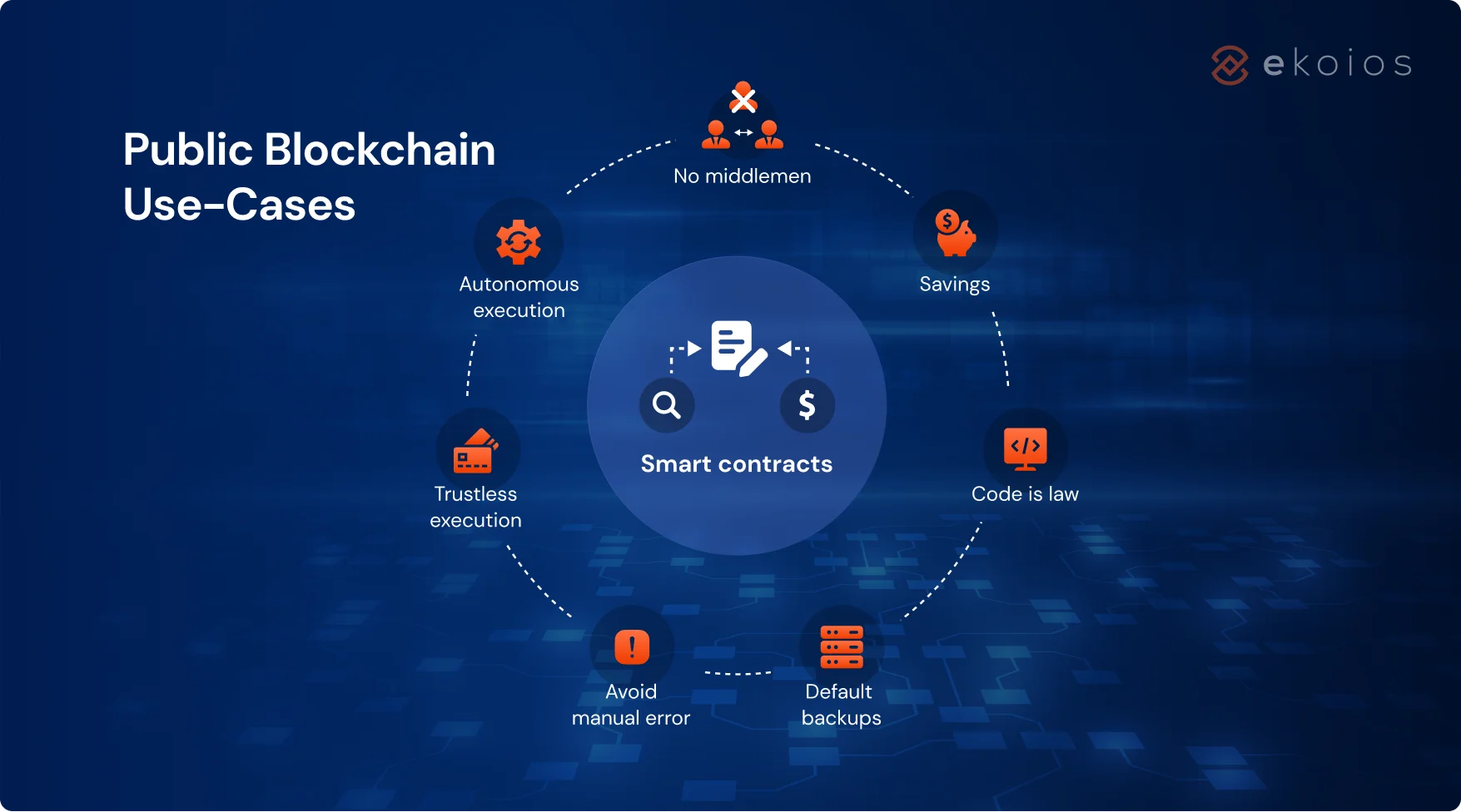
Blockchain as technology was introduced more than a decade earlier. However, it came into the limelight only recently. Initially, distributed ledger technology was also known as ‘permissionless or public blockchain’ as the right to information was available to all, and there was no central authority controlling them. Bitcoin and Ethereum are well-known examples of permissionless blockchains.

Permissionless blockchain networks power up most of the market’s digital currencies. They allow every user to create a personal address and begin interacting with the network, by submitting transactions and hence adding entries to the ledger.

Additionally, all parties have the choice of running a node on the system or employing the mining protocols to help verify transactions.

In the case of Bitcoin, mining is done by solving complex mathematical equations which in return validate the transactions saved on the network – anyone is free to download the bitcoin blockchain and begin mining operations, in exchange for mining fees and block rewards.

Additionally, for digital currencies such as Ethereum, the blockchain network also supports smart contracts, which are automated transactions that self-execute when certain criteria are met.

public blockchain use case

As Ethereum also employs a permissionless blockchain, anyone (including experts like Ekotek Technology) can develop and add smart contracts onto the network, with no limitation imposed by the developers.

2. Private Blockchain

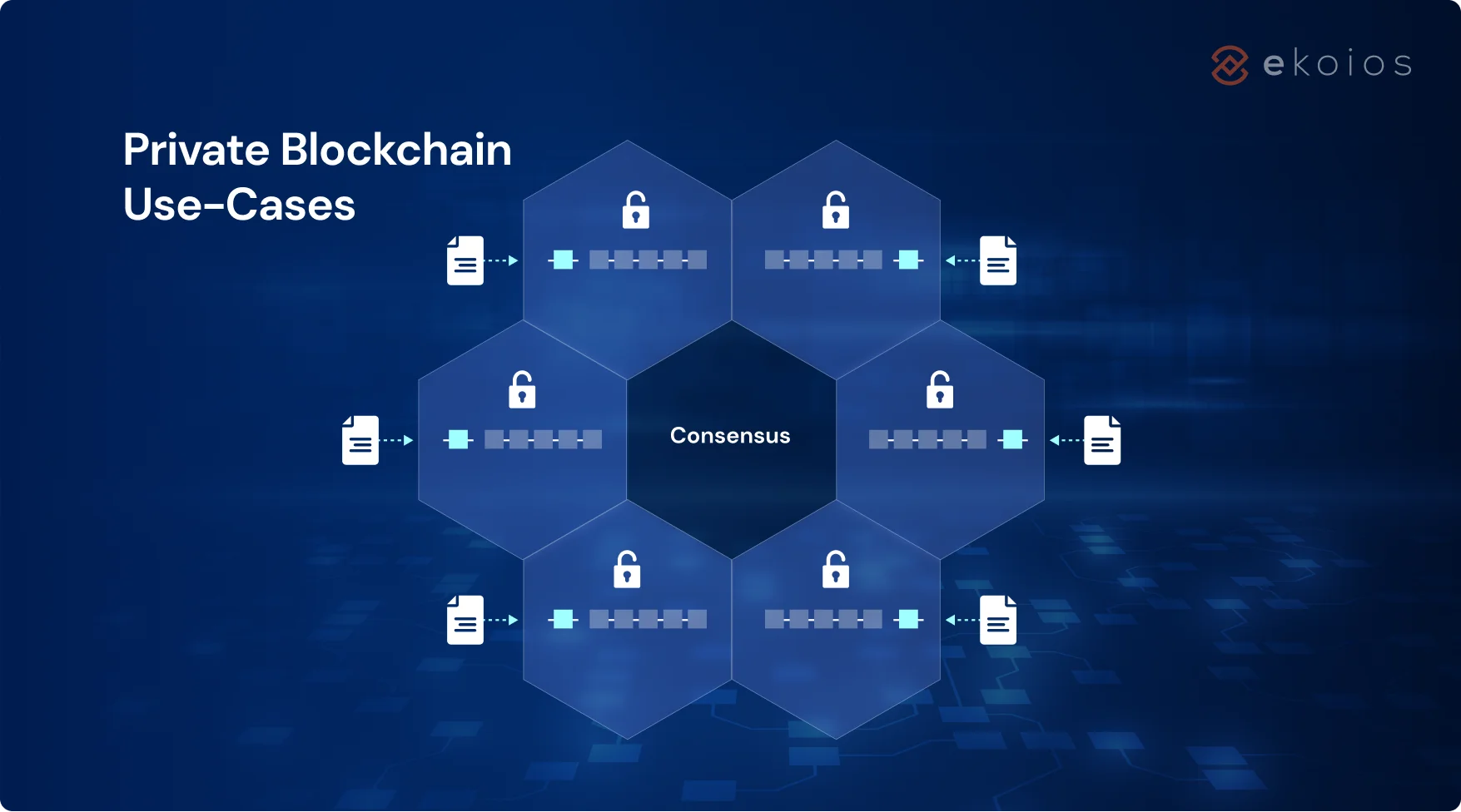
The American investment bank JPMorgan Chase & Co. has developed a private blockchain called Quorum, and it’s suitable for the financial service industry. The project team has forked the Ethereum blockchain to create this, and Quorum supports several Ethereum features such as smart contracts. It also has a distributed ledger. Quorum moves some parts of transaction data off-chain. They store the cryptographic hash of the transaction data on-chain. This enables transaction validation because the hash is immutable, and one data set will always produce the same hash. Hence, if the hash matches, the transaction is valid. Quorum uses a constellation protocol in this permission blockchain to allow one node to send an encrypted message to another.

🔎 One example of use cases for blockchain is handling investment transactions in a secured manner, which is a prominent private blockchain use case.

private blockchain use case

Another use case is Hyperledger Fabric – a permissioned blockchain. The platform assigns different access levels to nodes based on their role in the identity management system of the organization. It’s industry-agnostic and uses many features of Ethereum, such as smart contracts. They use container technology for hosting smart contracts.

In the finance industry, R3 Corda – a private blockchain platform specifically designed for the financial service industry, has been built by R3. It’s a permissioned blockchain, with different access levels for different categories of nodes according to the organizational roles and responsibilities.

Corda uses smart contracts, and a notable feature is that smart contracts in this platform have specific legal expressions. The industry operates under a stringent regulatory framework, and the legal expressions in the smart contracts are to give them legitimacy.

The consensus mechanism involves transaction validity and uniqueness. The smart contracts address the validity part. To ensure uniqueness, the protocol program in Corda checks whether any other transaction has used any of the input states of this transaction. If no other transaction has used any of the input states, this transaction is unique.

Public vs Private Blockchain – What to Choose?

Whether organizations choose to turn to the more established public blockchains or rest assured with higher security measures for private ones, the potential of blockchain technology for enterprises is still wildly untapped.

As security measures for public blockchains become stronger, their value will further increase, making the use of private blockchains less essential. However, when it comes to having more control and the ability to restrict access to specific individuals, private blockchains can’t be beaten. In the end, the choice of whether to use a public or private blockchain for business lies with each organization that utilizes it.

Still unsure about what to choose for your organization? Contact us now for a free consulting session!

Got a web3 business idea that you’re confident with?
Browse our web3 development services and see what suits you

Explore now

공유하기
Facebook
Twitter
LinkedIn
최고의 인사이트를 이메일로 받아보세요

    관련 게시물

    저희가 어떻게 도와드릴 수 있는지 확인해 보세요!

    베트남 아웃소싱을 고려하고 계신가요?

    베트남의 주요 21개 아웃소싱 회사를 모든 분야와 산업별로 다룬 가이드와 함께 귀사에 가장 적합한 회사를 찾아보세요.
    Table of Contents

    저희가 어떻게 도와드릴 수 있는지 확인해 보세요!

    전략 상담 예약을 위해 이메일을 남겨주세요 – 전액 무료로 제공됩니다!

      Dylan Dong Do
      최고경영자
      딜런 동 도
      Dylan Dong Do는 제품 및 ITO 기업 전반에 걸쳐 15년 이상의 경영 경험을 보유한 숙련된 리더입니다. 그의 리더십 하에 Ekotek은 5년 만에 소규모 팀에서 200명 이상의 숙련된 전문가들로 구성된 번창하는 조직으로 성장하였습니다.

      Dylan의 경력 전반에 걸쳐 그는 놀라운 성과를 달성해 왔습니다. 2009년에는 batdongsan.com.vn 개발에 핵심적인 역할을 하여 베트남 최고의 부동산 매물 플랫폼으로 자리매김하였습니다. 2018년에는 VTI의 Chief Operating Officer로 승진하여 30명 규모의 팀을 300명이 넘는 강력한 조직으로 성장시키는 데 기여하였습니다.

      기술 혁신을 일상생활에 통합하고자 하는 열망으로 Dylan Dong Do는 Ekotek을 설립하였습니다. 그는 회사의 방향성을 설정하기 위해 첨단 기술에 대한 지식과 기술을 꾸준히 업데이트하여 글로벌 트렌드에 부응하고 고객의 요구에 더욱 효과적으로 대응할 수 있도록 하고 있습니다.