Japan is back to Web3, again: A 2023 Report

Picture of Dam LyLy
저자
게시됨
3 mins read
Table of Contents

Back in October 2022, Japan’s Prime Minister Fumio Kishia said in a speech delivered before Japan’s National Diet that the country would be promoting a slew of Web3 services as part of its broader efforts to ramp up investments in digital transformation.

And the leader of the Liberal Democratic Party really doubled down on the promise. A specialized Web3 office was established earlier in July 2022, directly under the Ministry of Economy, Trade and Industry (METI), focused on creating policies, proposals, and initiatives that attract investment and fuel the expansion of Web3. Here are their results after 9 months of action.

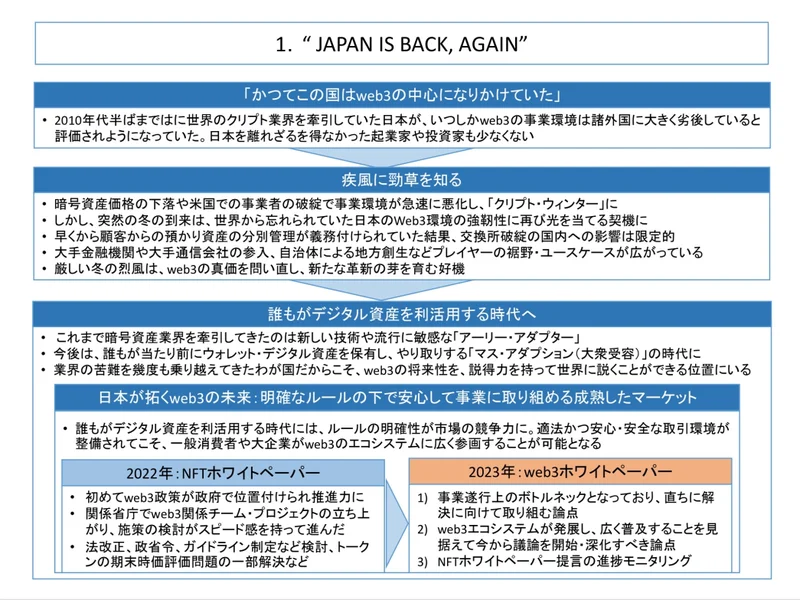
Approved: The Web3 White Paper “Cool Japan”

Approved: The Web3 White Paper “Cool Japan"

On April 6, Japan approved the “Cool Japan” white paper outlining recommendations for boosting the country’s crypto industry, proposing tax reforms, clearer accounting standards, a DAO law, and more. The recommendations are as follows:

  • Additional tax changes, including tax exemptions for companies holding tokens issued by other companies
  • DAO law based on Japan’s godo kaisha (similar to limited liability companies)
  • A more transparent screening process for circulating and new tokens
  • Accounting standards for existing Web3 companies and guidelines for banks and insurance companies entering the Web3 industry.
  • Regulations for stablecoins (both local & foreign) and self-regulatory organizations.
  • Public-private partnerships to sort out data and NFT rights, and explore ways to legally license NFTs.
  • Issuance of crypto visas to skilled workers to expand the startup visa system.

🔸 Learn more about web3 trends in 2023

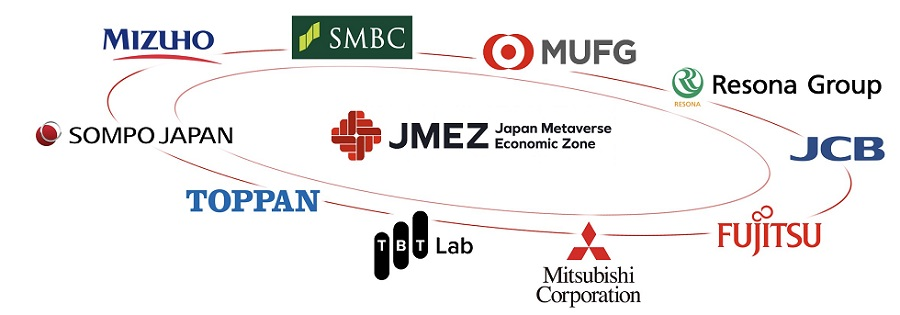
Assembled: Japan Metaverse Economic Zone

This February, 10 Japanese powerhouses in tech and finance announced the plan for Japan Metaverse Economic Zone, by building an open metaverse infrastructure called “Ryogukoku”.

Assembled: Japan Metaverse Economic Zone

This will enable interoperability between different metaverse platforms and serve as a new social infrastructure for enterprise DX, marketing, work style reform, and consumer DX/EX. Financial institutions can also collaborate on identity authentication, various payments, data infrastructure, insurance, and more.

Piloted: The digital yen, and the comeback of stablecoins

Japan will launch a pilot program in April to test the use of digital yen, a central bank digital currency (CBDC). The program aims to test the technical feasibility and ways to utilize the skills and insights of private businesses in designing a CBDC ecosystem. The Bank of Japan has been experimenting with the concept for over two years, as China’s digital yuan continues to lead the CBDC race globally.

Moreover, the Financial Services Agency (FSA) announced to lift the ban on stablecoins by June 2023, but with certain restrictions. Only stablecoins that satisfy the agency requirements are to be listed on Japanese exchanges, for example, USD Coin (USDC), Tether (USDT), and those with reserves backed by liquid assets.

Movements that fuel the transformation

  • NTT Docomo, Japan’s largest mobile network, has committed to investing up to 600 billion yen (US$4 billion) in Web3 infrastructure, in collaboration with Astar Foundation. (source: CoinDesk)
  • Animoca Brands Japan, a non-fungible token (NFT) and metaverse investor has raised $45 million from MUFG Bank and its parent company to secure local licenses and investments. (source: Animoca Brands)
  • Japan’s Digital Ministry plans to create a DAO to explore Web3 technology, its potential, and limitations, as well as the legal position of governance tokens used for voting. (source: CoinTelegraph)
  • Binance acquired the JFSA-registered Sakura crypto exchange, committing to re-entering Japan under regulatory compliance. (source: Binance)

Regulations are now in startups’ favor

Japan has the world’s most progressive climate for cryptocurrencies, however, growing AML concerns are drawing the FSA’s attention toward further regulatory steps. FSA’s framework has undergone 3 reforms, with the latest in 2022 taking all Web3 aspects into account: stablecoins, DeFi, and NFTs. For more detail, you can refer to the FSA’s latest international release via this link.

From April 1 forward, crypto startups are exempted from paying corporate taxes on unrealized gains, instead of the previous 35% rate that has driven project founders away from the country.

Seizing the unprecedented opportunity

So what does this mean? Digitalization of the entire financial system, regulatory changes in all Web3 aspects, lower entry barriers for startups – there is really no better time than now to enter the Web3 door that Japan has made wide open.

Are you testing the water, drafting a product design, or ramping up infrastructure for this promising future? Whichever your need is, Ekotek Technology, a leading Web3 development firm, is well-equipped with in-depth market knowledge, technical expertise, and human resources to meet it. Contact us today for a strategic consultation – we’re always eager to help!

🔸 Read more: Top Web3 Development Companies in Vietnam to Look Out For

공유하기
Facebook
Twitter
LinkedIn
최고의 인사이트를 이메일로 받아보세요

    관련 게시물

    저희가 어떻게 도와드릴 수 있는지 확인해 보세요!

    베트남 아웃소싱을 고려하고 계신가요?

    베트남의 주요 21개 아웃소싱 회사를 모든 분야와 산업별로 다룬 가이드와 함께 귀사에 가장 적합한 회사를 찾아보세요.
    Table of Contents

    저희가 어떻게 도와드릴 수 있는지 확인해 보세요!

    전략 상담 예약을 위해 이메일을 남겨주세요 – 전액 무료로 제공됩니다!

      Dylan Dong Do
      최고경영자
      딜런 동 도
      Dylan Dong Do는 제품 및 ITO 기업 전반에 걸쳐 15년 이상의 경영 경험을 보유한 숙련된 리더입니다. 그의 리더십 하에 Ekotek은 5년 만에 소규모 팀에서 200명 이상의 숙련된 전문가들로 구성된 번창하는 조직으로 성장하였습니다.

      Dylan의 경력 전반에 걸쳐 그는 놀라운 성과를 달성해 왔습니다. 2009년에는 batdongsan.com.vn 개발에 핵심적인 역할을 하여 베트남 최고의 부동산 매물 플랫폼으로 자리매김하였습니다. 2018년에는 VTI의 Chief Operating Officer로 승진하여 30명 규모의 팀을 300명이 넘는 강력한 조직으로 성장시키는 데 기여하였습니다.

      기술 혁신을 일상생활에 통합하고자 하는 열망으로 Dylan Dong Do는 Ekotek을 설립하였습니다. 그는 회사의 방향성을 설정하기 위해 첨단 기술에 대한 지식과 기술을 꾸준히 업데이트하여 글로벌 트렌드에 부응하고 고객의 요구에 더욱 효과적으로 대응할 수 있도록 하고 있습니다.