Top Digital Transformation Trends In 2025: What Businesses Need To Know

Picture of Hai Le
저자
게시됨
5 mins read
Table of Contents

Introduction

As we approach 2025, the role of digital transformation in business is accelerating at an unprecedented pace. According to IDC, global spending on digital transformation is expected to reach $4 trillion by 2027, reflecting the critical priority businesses place on adopting emerging technologies. Rapid advancements in AI, blockchain, cloud migration, and the Internet of Things (IoT) are already reshaping industries, driving innovation, streamlining operations, and creating new revenue models.

In the context of digital transformation trends in 2025, these technologies are not optional, they are becoming essential pillars of business competitiveness and agility. Staying ahead of these trends is vital for companies striving to maintain market leadership and resilience in an increasingly digital, data-driven world.

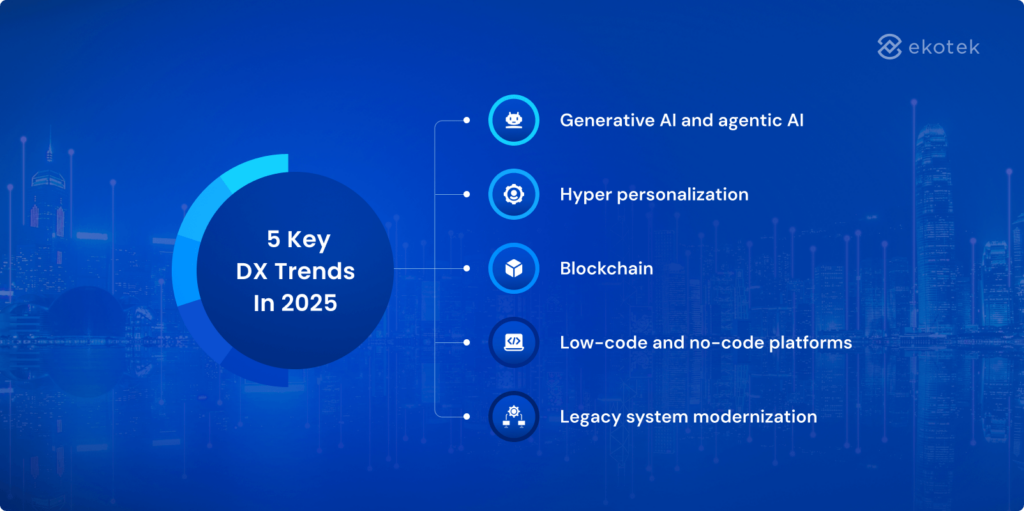
5 DX trends in 2025

The rise of generative AI and agentic AI

Generative AI

Generative AI uses machine learning models to produce original content including text, images, audio, video, and even code. Tools like ChatGPT by OpenAI, DALL·E, and MidJourney are revolutionizing how companies generate marketing copy, customer emails, social media posts, and product visuals at scale.

For example, Ekotek helped an e-commerce client integrate a ChatGPT-powered AI chatbot into customer service. The chatbot handles complex inquiries case-by-case, without rigid scripts, leading to higher customer satisfaction and reduced support workload.

Agentic AI

Agentic AI, in contrast, goes beyond content creation. It refers to systems that can act autonomously to complete tasks based on high-level goals. These AI agents can make decisions, adjust to feedback, and perform continuous actions without human supervision.

Ekotek also delivered an AI agent for a global footwear manufacturer, combining computer vision and NLP to classify component images, extract text from PDFs, and automatically generate Bills of Materials (BOM). This automation minimized errors, freed up staff, and accelerated production.

📌 See the impact of our AI agent solution for the global footwear manufacturer

Hyper-personalization through data analytics

Hyper-personalization through data analytics

Building on the power of AI, digital transformation trends in 2025 also focus on customer-centricity. Hyper-personalization uses real-time data and advanced analytics to deliver individualized experiences tailored to each customer’s behavior, preferences, and context.

At the heart of hyper-personalization are technologies like Customer Data Platforms (CDPs) and AI-driven analytics. CDPs collect and unify data from multiple channels—website visits, app interactions, purchase history, and even customer service interactions—into a single customer profile. AI models then analyze this data to uncover patterns and predict customer behavior. Tools such as Salesforce Customer 360 and Adobe Real-Time CDP are leading the market in this space.

Real-world success stories highlight the power of this approach.

  • Netflix uses advanced data algorithms to recommend highly personalized content to over 260 million users worldwide, significantly reducing churn.
  • Amazon’s recommendation engine drives nearly 35 % of its total sales by suggesting products based on browsing history and purchase patterns.

Blockchain for trust, security, and transparency

Blockchain for trust, security, and transparency

Trust and security remain paramount as part of digital transformation trends in 2025. Blockchain is redefining how businesses manage data, transactions, and customer relationships. Its decentralized, tamper-proof ledger enhances trust, security, and transparency, making it a powerful tool across industries.

In supply chains, blockchain allows real-time tracking of products, reducing fraud and improving efficiency. In finance, it facilitates secure, instantaneous cross-border payments. For identity management, blockchain protects sensitive personal data from breaches, while in data security, it ensures the integrity of records.

Ekotek applied blockchain to solve a real-world challenge for a premium F&B company with high-end products vulnerable to counterfeiting. We developed a digital authenticity solution powered by blockchain technology, enabling customers to verify product authenticity by simply scanning the product’s NFC tag. Beyond anti-counterfeit protection, the system provides valuable customer purchase history data, allowing the brand to offer personalized product recommendations. Our solution significantly increased customer trust and engagement, while giving the company full traceability and actionable insights into buyer behavior.

Expansion of low-code and no-code platforms

The surge in demand for rapid digital solutions has propelled the rise of low-code and no-code platforms, another key highlight of digital transformation trends in 2025. These platforms offer drag-and-drop interfaces, pre-built templates, and reusable components that allow even non-technical users to build and deploy applications without writing extensive code.

By reducing reliance on scarce IT resources, low-code and no-code solutions empower companies to accelerate digital initiatives and respond to market changes in real time. Gartner predicts that by 2025, 70 % of new applications developed by enterprises will use low-code or no-code technologies.

A strong example is Unqork, which helped New York City launch an emergency COVID-19 portal in just 72 hours. The city rapidly deployed essential services like application intake and case tracking, without writing traditional code. This unprecedented speed helped the city efficiently manage critical resources during a public health emergency, demonstrating the practical value of no-code development under extreme time constraints.

Legacy system modernization

Completing the picture of digital transformation trends in 2025, modernizing legacy systems is essential to enhance agility, scalability, and operational efficiency. Outdated infrastructure often hampers innovation and responsiveness, making system modernization not just beneficial but critical.

However, transitioning from legacy systems presents challenges, including data migration, system integration, and minimizing downtime. Best practices for successful modernization include thorough system audits, phased implementation strategies, and robust testing protocols to ensure seamless integration and functionality.

Ekotek has demonstrated expertise in this domain through projects like the one undertaken for a leading logistics company. The client faced limitations due to an aging on-premises system that restricted scalability and efficiency. Ekotek developed a comprehensive modernization roadmap, executed the transition with minimal disruption, and optimized the new system for enhanced performance. Post-migration, the company experienced improved system reliability, faster service delivery, and greater flexibility to adapt to evolving business needs.

📌 Take a look at our legacy migration case study

Final thoughts

As we look ahead to 2025, the landscape of digital transformation continues to evolve rapidly, reshaping how businesses operate and compete. From the rise of generative and agentic AI driving automation and creativity, to hyper-personalization that enhances customer engagement through data-driven insights, organizations are embracing technologies that deliver agility and innovation. Blockchain is redefining trust and transparency, low-code and no-code platforms are accelerating development cycles, and legacy system modernization remains a critical pillar for unlocking operational efficiency and scalability.

Ekotek prides ourselves on being at the forefront of this transformation journey. Our proven expertise across AI-driven solutions, blockchain-powered authenticity systems, data analytics, and large-scale modernization projects positions us as a trusted partner for companies seeking to future-proof their business. Whether you’re navigating complex technology shifts or looking to unlock new value streams, Ekotek stands ready to guide and implement tailored digital transformation strategies that drive measurable outcomes.


공유하기
Facebook
Twitter
LinkedIn
최고의 인사이트를 이메일로 받아보세요

    관련 게시물

    저희가 어떻게 도와드릴 수 있는지 확인해 보세요!

    베트남 아웃소싱을 고려하고 계신가요?

    베트남의 주요 21개 아웃소싱 회사를 모든 분야와 산업별로 다룬 가이드와 함께 귀사에 가장 적합한 회사를 찾아보세요.
    Table of Contents

    저희가 어떻게 도와드릴 수 있는지 확인해 보세요!

    전략 상담 예약을 위해 이메일을 남겨주세요 – 전액 무료로 제공됩니다!

      Dylan Dong Do
      최고경영자
      딜런 동 도
      Dylan Dong Do는 제품 및 ITO 기업 전반에 걸쳐 15년 이상의 경영 경험을 보유한 숙련된 리더입니다. 그의 리더십 하에 Ekotek은 5년 만에 소규모 팀에서 200명 이상의 숙련된 전문가들로 구성된 번창하는 조직으로 성장하였습니다.

      Dylan의 경력 전반에 걸쳐 그는 놀라운 성과를 달성해 왔습니다. 2009년에는 batdongsan.com.vn 개발에 핵심적인 역할을 하여 베트남 최고의 부동산 매물 플랫폼으로 자리매김하였습니다. 2018년에는 VTI의 Chief Operating Officer로 승진하여 30명 규모의 팀을 300명이 넘는 강력한 조직으로 성장시키는 데 기여하였습니다.

      기술 혁신을 일상생활에 통합하고자 하는 열망으로 Dylan Dong Do는 Ekotek을 설립하였습니다. 그는 회사의 방향성을 설정하기 위해 첨단 기술에 대한 지식과 기술을 꾸준히 업데이트하여 글로벌 트렌드에 부응하고 고객의 요구에 더욱 효과적으로 대응할 수 있도록 하고 있습니다.